Showing posts with label learning. Show all posts

Sunday, April 24, 2022

Reconstructing development notes: Onyx Ashanti's Sacred Geometry in Sound performance

For some backstory that no one asked for but I'll write out before my memory gets too fuzzy:

It's March of 2018. Onyx may or may not have just gotten back to the US from a chapter of life in Europe going from Sainte-Etienne to Berlin. I may or may not have just migrated back from the East Coast with the geese.
I had joined the audience just in time for the performance without really getting an ideal seat in the auditorium for close-up filming in a way that wouldn't be obnoxious. I freehand recorded it on my phone with my elbow propped up against my one of instrument cases at one of the side wing seats of the audience as an unofficial cameraman for the performance and shared the video with Onyx after so you're technically seeing a bootleg recording that turned into the "official music* video" :-)
If I were to think about lighting with a better command over the phone camera (or any camera available) I would have probably tried zooming a bit more so that we could see the LED colors that correspond with his positional accelerometer sensors and filters*(? I don't think he had filters activated for this performance or even the entire iteration of the sonocybin exohands) plus adjust the white balance, ISO etc. and maybe avoid or block out the exit sign with his body position. But I kept the frame set at this distance as Onyx sometimes gets very physical with his range of hand and body movement in performance so I wanted to be able to ensure relatively smooth tracking within the frame just in case he did move more.
Choosing Your Own Patterns: Polyrhythms and Parrellels
On a sonic/aesthetic and musical level--while Onyx was still constantly seeking new standing wave experiences that could be created with the streams of sound in each hand throughout these 2017-2019-ish years, what I really enjoyed about this iteration was how he centered the possibility for listeners to discern or conceive of pattern/polyrhythms in a way that hearkens to the roots of Traditional Afrikan drum polyrhythms.

There's a less wordy and complicated way to say that, let's try:
I like that his way of building the instrument and playing it lets people "choose their own groove" based on how they're able to hear patterns as the "drums" of each hand played rhythms against the other regardless of their actual cadence.

This is important to note because it says a lot about the skills or care that may be beneficial for other concepts that involve self-organization and working together while respecting independence.

As a metaphor for healthy social relationships: Think of a co-dependent relationship but with rhythms--It's like two people doing things in their own time without forcing one to fully conform and rely on the other. Whereas the "Interdependent" notion of a healthy relationship lets people do their own thing at their own pace. But it's the attention given to how the two patterns of rhythms find their groove together is what makes the relationship. Or how groups of people in organizations and cultures might be able to operate. In sentiment, I think of the quasi-autonomous sort of anarchistic (for lack of words in English) governance dynamics of the Anishinaabe Confederacy as nations and the cohesiveness still afforded by their inter-clan governance systems.
There are better descriptions to be heard or read from Anishinaabek folks, or elsewhere on the interent but for a shallow hint of what comes to mind in real historic context, read how the Anishinaabe factioned to be neutral, allied with the British, and the U.S. -- sometimes all at the same time:
In contrast to systems that meet catastrophic results if something goes another direction.
e.g. "US Congress failed to pass a budget? Panik! Kaos! Shut down everything run by the Federal Governement." [insert meme here] Again these aren't the most precise examples, but if you look enough you'll probably get what I'm touching on.

So we have a contrast: autonomy between two different agents and structure normally don't work harmoniously without a lot of active work and preparation. But if you know how to sit back, watch or *listen* to the rhythms for long enough, the beats turn into a pattern. Here, the left hand kind of "knows" what the right is doing because Onyx is listening. But we as the audience are listening too and we get to let the wonderfully fundamental part of evolutionary wiring in our brains to pick out when we hear a groove, or texture, or other interesting moment come together.

As Onyx had said in a conversation to me on a cold Autumn or Winter night in 2018 "Chaos exists at the threshold of one's capacity to discern pattern." At that point, patterns establish coherency from what would otherwise be a mess of dots .

*A technical development note for technology documentation purposes:
As someone who got to watch his projects develop and basically lived as his housemate (but like kind of on his front yard and porch, a story for another time), plus as a fellow bandmate I got to see and hear a lot being made along the way at a level of depth that most people don't get to see. I think it's important to document that where we can as the thought process and little mundane developments sometimes become a lot more significant than we think when no one is around to pay attention until later. So here's what I can recall short of reaching out to Onyx again and fact checking (which eventually I probably will try--Onyx if you're reading this let me know!):

I don't remember if he had knuckle sensor filters working at this point in the development of his exohands in that particular Infinity Drum software development iteration or if he was just activating golden ratio "notes" with each finger but I think that would come up later before he would put the entire infinity drum phase to rest and redirect his attention on being able to type and manipulate digital cursors on his network of Raspberry Pi computers without a keyboard. I think at this time Onyx was using one or at most maybe two Raspberry Pi B+ish generation computers that either ran ethernet cables to the hands or maybe even used tiny shortwave radio. The main Raspberry Pi B+(or something older and bigger) was still mounted on his bicep with a touchscreen monitor interface on the other and maybe started positioning the battery packs on the back of his 3d printed body harness around this time or embedded them along with the bicep computers. Soon after this performance Raspberry Pi zeros would come onto the market at the local microcenter just a few months later and he'd rip it all apart and rebuild a new version in his ongoing quest for eliminating latency down by milliseconds haha (I forget exactly which numbers but it was a shift by orders of magnitude like from 200 to 24 or 24 to 4 milliseconds of latency when compared to what he performed with in 2017 while we toured in Sainte-Etienne to Paris).

Monday, January 28, 2019

Dreams*(?) and Development

​A three part dream that happened this morning before I woke up to take out the trash and recycling with post-slumber commentary:
1. I'm in a new [or maybe rather more appropriately capitalized, New] Detroit neighborhood restaurant/cafe watching a s​kit​/presentation akin to Goldilocks and the three bears between the owners and employees during its preliminary grand opening.

Goldilocks, a young ​caucasian girl, pours and presents a big bowl of hot chocolate as she narrates the origins of the cafe and what it values ​in balancing its business aspirations ​as part of the community. She sweetly closes her story punctuating it with a casual "that'll be $40 bucks, hun." For the bowl of hot chocolate as the punchline to the community and up-and coming city entrepreneurship story.

The customer (not identifiable to the audience/nor heard) implicitly complies and requests for something additional to which the matron of the cafe quickly gathers the other local employees, gets on the phone and discusses in Zulu or some other language heard in South Africa with all the staff huddled around, before she confidently hangs up the phone to declare to the imaginary customer: "I have good news, you're eligible for an additional $0.30 per hour sitting fee too!"

We (the audience) laugh and ​as I turn away ​I ​​start figuring out how to make a sliding scale menu cost structure for non-locals and locals that can accommodate more people with less outrageous prices while still accounting for the higher I come demographic who wouldn't hesitate to buy a $40 bowl of hot cocoa (or in real life, pay more than $40 for a hair cut).

2. My dream transitions to sitting at the counter of another cafe/diner that bears a less monied air to it: imagine a classic 1950s hamburger joint  converted into a general diner/cafe that hadn't been updated since the 50's that's in a Downriver (low-income labor town) community like River Rouge or Wyandotte. It's now under the ownership and operation of an immigrant Indian woman and she's working to serve us friends as her guests before it officially opens.

I ask if there's any local favorite juice available as she opens and closes a basic household refrigerator that's nestled on the wall facing the counter and register. "All I have for drinks is in that fridge." And I note that A box of wine was the only fruit beverage available. A classmate from second grade, Vijay [Vijay!? What are you doung here in my subconscious bro? Still got that cool San Jose Sharks winter coat too], smiles and sarcastically proclaims "Ecorse' s finest!" And gestures with a culinary kiss to the air. I laugh [his sense of himor is still on point].

I'm now outside the restaurant with my friend Onyx, pouring two glasses from that boxed wine as we "celebrate" "Ecorse's finest" -- and the fact that we both witnessed French hosts serve us boxed wine [yes, in real waking life during our time as guests in southern France while performing on tour]. Onyx smiles agreeing with that tone of voice you get at the end of sharing a memory in the way a fire burns down to smoldering coals, and mentions that "having some music from the 90s playing would be great right now." I mention if WiFi is available we might be able to pull something up and quietly ponder what kind of music could constitute the best of the 90s.

3. My dream transitions again and I'm inside a neighborhood salon+barbershop where one of my former employers, Mrs. Michele Loveberry --who in real life owned a salon while briefly leading a non-profit-- is working with a customer already after promptly arriving at 6:00am on one side while a barber works with someone else toward the front on the other side of the room. My friend Jemeer and another guy tells me how important barbershops are for the community (true, and we've had a conversation like this in waking life before) as well.

Post-Slumber Commentary
So here's what I think we can learn (or at least be reminded of) from the dream above among other things: 
1) there's a point when a well-grounded and intentional price policy becomes outrageous to the average person and yet entirely acceptable for a new target audience--I.e. the $40 haircut yuppie or in the case of my dream, the gentrified who pays $40 for a ridiculously large bowl of hot chocolate.

Speaking with my friend Ulysses, this is exactly how countries like Finland operate--

2) The $0.30 per hour sitting fee sounds like something (a terrible something) that a crowded New York or San Francisco kind of city actually would do, except they'd charge you even more for just being there. For [dystopic neoliberal urbanization/gentrification​/colonialism​] comedic purposes, $0.30 is ​"​reasonable​"​--just small enough to be petty, but the real offense comes from its mere existence​ ​​and audacity to charge people for their mere existence​.

3) I still work even in my dreams to figure out things like equitable cost strategies and price points.

4) Zulu (though I don't know the language well) and South Africa are a very interesting parallel--in waking life I met a journalist who focused on apartheid and how similar patterns manifest in Detroit last year. For those unfamiliar with the city, Detroit is approximately 83% black, ~89% "minority", and highly segregated as a city still. The economic development patterns also tend to reflect this too with most investment underway in majority white downtown core financial and cultural districts. Meanwhile, most of the neighborhoods remain overlooked unless they're ripe for ["market"] exploitation [or straight-up exploitation in itself] according to the downtown administration and deep pocket developers.

5) There's an interesting contradiction to connecting boxed wine with the expression "Ecorse's finest" --the river that makes "downriver" communities was called the Rouge River by the French settlers (and still called that today by residents) because of all the grapes that would grow in the region. It's hard to say what the soil and air quality would be for growing grapes for wine there today as it's somewhat an industrial labor town now, but if we of the region were to begin making wine there again, I wouldn't be surprised if boxed wine would the way to start as the expertise, "market audience", and taste palate for most people in southeast Michigan would probably take time to develop before we skip ahead to fine wines. Alcoholism in Michigan is a major problem, and it happens to be, at least during some point within the past 5 years, among one of the most common Google searches in our state.

6) The Salon/Barber Shop dream builds directly from a conversation I had last night realizing how continuity for employing and owning a business in Detroit remains by the person, and often ends at the entrepreneur rather than continuing with the team/a community to support the training and workers beyond the founder. I also think the gender roles (one side salon, another side barber) is something to note though I haven't got much insight for it beyond observation. Mrs. Loveberry's mother opened and owned a historic salon business, one of the first in Detroit, and the legacy of her entrepreneurship remains under celebrated except for those who may have known her directly or through the family stories like my friend Jemeer and Mrs. Loveberry. Mrs. Loveberry recently retired and left the state. 

I now realize she was part of the 93% businesses in Detroit that are black, and of them, 90% are/were run with 1-4 employees. The continuity between owner to new generations differs from places in Japan or even Vietnam where businesses survived for centuries--even surviving colonialism and world wars--with artisans and other people who continue the line and legacy.

In my waking life, I know/know of an interesting cross section of the cosmetic industry. I also connected [albeit briefly] with someone from outside Detroit focused on using barber shops as places to address mental health in the black community. They all have important elements, and the opportunity to convene and discuss how workforce development + business ownership advances in the city's neighborhoods is important and feasible to implement with someone like Chase Cantrell of Building Community Value and the folks who put on Hair Wars.


References

Toward the end of this sketch, Trevor Noah speaks in Zulu--deep in the comment section of the original clip on youtube someone gave a translation:
https://www.youtube.com/watch?v=pwT-2KdK894

Wednesday, January 23, 2019

Inspiring comment sections, language and music

https://www.youtube.com/watch?v=8-dQdASWkDU

This is so inspiring to see how many people wish to learn traditional indigenous languages in the comments.

The video is also very, very, very interesting--I'm quite happy to run across it online and excited to share it with some friends.

There's another video I saw earlier this week that had wonderful comments (that time, for music) which I'll post somewhere too.

Tuesday, November 27, 2018

Expertise vs Curiosities in Experience

​Expertise, experience, and the depth it can bring to a situation are necessary for putting evrnts into proportion. Yet not at the expense of curiosity and not to the degree that it should altogether silence the validity of other people's experience.

21:21
Nov 27th?

Saturday, November 24, 2018

Designing to Demystify Development Doings

Last year, I advised the 2018 Detroit City of Design Strategic Action Plan's creation as part of a group of other UNESCO/Detroit Design-connected peers (if you want the fancy technical term, we're referenced as the Peer Advisory Board on p. 147) -- though I'd be remiss to say a lot of the comments and advisory I contributed went unheeded by the consulting firm tasked to do the report.

In particular:
1) the need to address the legacy of economic suppression, divestment, or even outright oppression that made and let institutionalized racism continue in the city
i.e. from removing skilled trades and the arts from k-12 in recent years and dismantling the public school system's efficacy, or a highly segregated population that results from a mix of insurance and housing policy that resulted from remnants of the early 1900s when supremacist/terrorist groups groups like the KKK openly influenced and controlled business districts and cities.
2) the need to shift toward skill-based "gig economy" resilience rather than building more job pipelines
3) the role of cultural competency and "industry translation" for delivering genuine inclusion and better informed public decision making that lets people take advantage of the projected surge in industry and Detroit's shiny new "UNESCO City of Design" status.
One of the best ways to do that is to connect the every day practical things that normally seem out of reach to the average Detroiter with better communication, and not all of it should rely solely on written word (and yes, I realize criticizing the bias in communicating with text with an equally lengthy article-sized written narrative isn't optimal but we're starting here with a different audience in mind).

Which brings us to the Development industry. The more we learn about the development industry, the more I find it's traditionally about making debts profitable (at least for the big players, but really, when was the last time you ever heard about a small-player in the development industry, if you ever hear about the development industry at all?).

So with an article from early 2018 about Dan Gilbert's desire to use tax breaks and funds that normally would go to things like schools and corrections (go read it and then come back to finish this), it's an opportunity to demystify a bit of this further--here the question becomes whose debt and to what end does it become a profitable investment--for the public and/or Dan Gilbert's works.

In this case, by capturing the tax revenue via brownfield redevelopment incentives (for those without an environmental science or economic/city planning background: brownfields are land that's been contaminated with something like industrial waste, fuel spills, etc. that would make it unsuitable for normal living/farming etc.; but still useful for developing buildings on top of or "fixing" aka remediating the soil so that it's healthy again).

That normally would go toward basics like education. For others (like Ben Mallah of Koncrete's "Life for Sale" show), it's often by flipping large properties--sometimes accelerated by using bank-loaned money to achieve aggressive profit margins (i.e. 2:1 ratio of profit to investment) -- so they're constantly burning to find another bigger property to pay back the investing bank(s) before they get into hot water with their lender(s).

Yet even when we teach people to read in the U.S., we begin with picture books -- yet here we are attempting to learn and teach with the limits an ambitious and dedicated journalist is limited to working with by deciphering troves of text.

So here's a design challenge: I'm certain there's a way to turn the following chunk of text excerpted below into a diagram, infographic, or something that more people would be able to quickly understand:

So how does all this work when you get down in the weeds? One incentive Gilbert is using is called a "brownfield." It allows developers like him to collect property tax revenue to pay for remediation costs after they redevelop contaminated or seriously blighted properties.

In a hypothetical scenario that illustrates how brownfields work, Gilbert's Hudson site property is valued at $100 in 2018. Let' say later this year, the city and state approve a brownfield incentive for it. Next, Gilbert builds on the land, so it's worth $150 in 2019. The city and state continue to collect tax revenue off the original $100, but Gilbert collects tax revenue off the $50 increase.

Gilbert then captures tax revenue off the property tax increases for the next 20 years. So if the property is worth $1,000 in 18 years, Gilbert collects tax revenue off of $900, and the city and state still only collect it off of $100.

The property tax money that the government collects goes to several "jurisdictions," including schools, libraries, parks, jails, cities' general funds, and more. According to the MEDC, Gilbert will be collecting tax money intended for jurisdictions that fund education at the county and state level. So when the property tax revenue collected from that $900 goes to Gilbert, it doesn't go to schools.

In that way, Gilbert's use of the brownfield impacts schools.

But there's another layer. The projects are in Detroit's Downtown Development Authority district. The DDA currently receives the tax money that Gilbert will use — not the schools. Thus, Gilbert can claim that schools aren't impacted because the money is diverted from the DDA to his company. However, the DDA takes the money from the schools, so education taxes are ultimately what funds Gilbert's projects.

-Excerpted from:
https://metrotimes.com/news-hits/archives/2018/01/11/yes-dan-gilbert-wants-to-use-school-money-to-fund-his-new-downtown-projects

You could especially visualize this as an elegant sankey diagram of sorts -- see this for a black and white example in petroleum energy and this with colors in energy; better yet check out Canada's energy systems and imagine how it might be done to demonstrate tax and business investment.

For a crude attempt, here's my take on what I just read:

In a hypothetical scenario that illustrates how brownfields work, Gilbert's Hudson site property is valued at $100 in 2018. Let' say later this year, the city and state approve a brownfield incentive for it. Next, Gilbert builds on the land, so it's worth $150 in 2019. The city and state continue to collect tax revenue off the original $100, but Gilbert collects tax revenue off the $50 increase.

2018 Value (note: let each + = $10 )

$100 ++++++++++

2019 Value: Gilbert Builds on the Land ( note: let each ~ = $10 in 2016 )
$150 ++++++++++~~~~~

Gilbert then captures tax revenue off the property tax increases for the next 20 years. So if the property is worth $1,000 in 18 years, Gilbert collects tax revenue off of $900, and the city and state still only collect it off of $100.

$900 (note: each ++++++++++ = $100, and if I understand the lines above correctly, that money still comes from you, the tax payer)

Gilbert's $900 (which he and his companies will make some kind of argument that says the jobs created and the business they attract, especially for remediating contaminated soil to build upon, will make it worth while for Detroiters and maybe the state--if you're extremely lucky, maybe you can figure out a way to become a shareholder or take equity in the project to influence what happens, the odds however are extremely slim for the average person)

++++++++++
++++++++++
++++++++++
++++++++++
++++++++++
++++++++++
++++++++++
++++++++++
++++++++++

Meanwhile, Detroit's $100 (which, from the ashes of taxpayer dollars, we'll hope good things will rise for the tax paying residents again--in other words, this is the hypothetical portion that the public has the highest likelihood of maintaining accountability and influence over for ensuring the revenue goes toward actual priorities in the interest of the city's residents) remains the same, possibly unadjusted for inflation too:

++++++++++


Total Hypothetical Property Value coming from the Detroit Tax Base: $1000

++++++++++
++++++++++
++++++++++
++++++++++
++++++++++
++++++++++
++++++++++
++++++++++
++++++++++
++++++++++

There's still a much better way to depict this which I've not taken time to illustrate with my ascii art rendition above. How could we show the money flowing from the tax base? I'd reference the petroleum diagram in terms of what the fund actually supports and how it gets prioritized for this particular development scenario. And then add the colors etc. to make it more visually appealing.

Yet where do we go to make this kind of development and data literacy happen? Design advocates would say "Designers! Ask the designers!" and inevitably you'll find there's a high-end design firm lurking somewhere in a trendy downtown office hungry for a commission or contract from someone with a decent pocket book.

As the public waits, where can we go? Perhaps someone might wish a non-profit for supporting design might exist to provide these services. In Detroit, the Go-To clearinghouse might be Design Core Detroit (formerly DC3), which is the Org I referenced at the start of this post. But they're a clearinghouse who tends to pursue big-picture funding and reputation with a limited team, it's easy to suspect a measly infographic isn't really in the scope of their perceived responsibility. In function, they're a Chamber of Commerce who laid claim on Detroit's "creative + design industry" and replicated all the traditional organizational functions a typical Chamber of Commerce does to keep its membership and influence in a city.

Say what you will about the New York Times, but spend enough time looking at their work and you'll find outstanding work when it comes to conveying some of the data they use to examine stories -- take for example this piece that points to school segregation and success by comparing money, race, and student success.

For the City of Detroit (and the world at large), one thing that would distinguish its industry might be the way it communicates important data -- the kind that's visceral to our day to day lives like traffic accident statistics, crime, disinvestment/investment/development, accessibility, education, home and utility affordability, glocal civic engagement (as in, how local decisions and elections intertwine with global issues) etc. in a way that accelerates public literacy and competence around the issues.

While data for literacy rates in Detroit might be a contested topic, the reality that most people tend to do better with pictures

On the other end of the spectrum, we might appeal to the Designer's Guild for Justice or maybe some kind of diasporic remnant of the Occupy Movement's Design and Research collectives.

For now however, I'll leave this question "who's going to do the design work?" to all of you...


Detroit native Aurora guides a group through the stories in this Detroit youth-made mural during an anniversary observance of Vincent Chin's murder and in solidarity with the Detroit Asian American community on the final remains of Detroit's Chinatown. Shortly after telling her story, she expressed her frustration and surprise that she discovered the city of Detroit was bidding on a rail transit development proposal through a late night broadcast on BBC World News before hearing anything from the City.


REFERENCES

Life for Sale: Focuses more on large multi-unit buildings (Apartments, Senior Citizen Homes, Shopping Plazas), but gives you a taste of how developers would focus on large tracts of land. I don't necessarily agree with or enjoy his sense of humor, you'll still learn a lot about the scale of investment in the industry from watching the early episodes in the series.

This episode turned on the "Aha." for demystifying how real estate development works and looks like:
https://www.youtube.com/watch?v=8gC8dUcoKFE

The trick is to continue buying and selling else he'd have to pay tax--I don't understand all the details yet but I get the impression there are a lot more millionaires out there who are just as caught up in a similar game:
https://youtu.be/TGEPle4uFPU

Awaiting the close of a deal between a bank loan, etc.:
https://youtu.be/3YoAbBRCa34

Buying/Flipping a Senior Citizen Complex:
https://youtu.be/GjCBJtibA7k
https://www.youtube.com/watch?v=3Zfq5-Sj4GU


Detroit's #1 Billionaire, Dan Gilbert technically does want to use money that funds schools for his development projects; also thinks people miss the nuances to why big developments deserve tax breaks.
https://metrotimes.com/news-hits/archives/2018/01/11/yes-dan-gilbert-wants-to-use-school-money-to-fund-his-new-downtown-projects

NOTE to people about tax breaks:
For environmental science students who took Dr. Riebesell's land use planning and management course, development incentives -- especially brownfield redevelopment, etc. -- these are typically emphasized as a good thing. A brownfield is normally a contaminated (i.e. risky, somewhat toxic or at least polluted enough that you can't just set up and do typical building on) site that people stay away from--real estate developers are more likely to sprawl out their developments and encroach upon pristine land (i.e. cut down a forest, drain a wetland, or push out a historic neighborhood as the likely alternatives).
However, I question whether certain habits become relevant once an individual or entity reaches a different scale. A billionaire like Dan Gilbert might be able to defend his actions by pointing to the basics for how a profitable business needs to run. Yet he no longer operates a basic business or like a normal business person starting at ground zero from scratch--he literally influences governments and entire media cycles with his mere presence. He has the capacity to look at prioritizing his funding and investments in ways that consider the constraints and needs of the environment he chooses to operate in beyond a traditional charitable-foundation model. So unless he's operating on archaic development business practices, cleaning up a brownfield development project likely can be done without taking all of the incentives that the media suggests he's requesting.


Sankey Diagrams:
Petroleum Energy -- Black and White, corresponds to a common source
https://goo.gl/images/vDLyJY

Energy -- Note for Colors
https://goo.gl/images/wknBV2

Canada's Energy System -- Probably the best of the three diagram examples I provide yet
https://goo.gl/images/u11J6t


NY Times Interactive Data: Money, Race, and Success -- see how your school district compares to others:
https://www.nytimes.com/interactive/2016/04/29/upshot/money-race-and-success-how-your-school-district-compares.html

Wednesday, November 14, 2018

Qhipu! (Or Khipu - does a K or Q really matter?...)

This article reads like a thriller, the title begs us to question who "we" really are though:
https://www.newscientist.com/article/mg23931972-600-we-thought-the-incas-couldnt-write-these-knots-change-everything/

​​Imagine a friend hands you a bundle of knotted thread and you smile without breaking eye contact as you "read" what it says without looking. This is what the Incan knot system, qhipu, likely let people do--you could "read the threads" by looking, and probably "read" simpler threads by feel too.

It's also why it's silly to judge others and assume "written language" and "thinking in words" is the only form of tangible or abstract path for communication or the only way to think. A good chunk of the time, people often make hasty calls choosing convenience over learning the nuances -- only to live in the irony of their own arrogance when time makes its final call.

"English is the first form of programming most of us learn."-Onyx Ashanti

Language is the first form of programming that people learn, and it often reveals a lot about how people tend to think, how they organize, and what governance tends to look like too. We can only infer, but from the article it sounds like the government and economy functioned very similarly to the way the qhipu is made and organized: federalized with a control economy, much like how one core thread serves to anchor lots of other pieces in place.

When you look at how English (and likely other Western, especially Romance, languages) is written and constructed, much of it points toward consolidation and objectification--about 70% of the language exists as nouns --"people, places, or things" -- relationships are frequently couched in transactional terms, and how we refer to non-people also lends it to "thingness".
i.e. "Who owns that dog?" remains reflexive vs. "Who leads that dog?"
We're still in an age that, for most U.S. Americans, comfortably refers to other living things from a frame of ownership -- just a few percentage points away in DNA from chattel slavery.

In an excerpt from the book, Braiding Sweetgrass, the author notes that Potawatomi (an Aanishinaabemowen language -- so related to Ojibwe and shares some common roots with Algonquinaak* [the name for the Algonquin language?] ) is comprised of about 75% verbs. Lots of the things we consider as things in their noun-form are described in states of being. The rock is being, a river is being, etc.
So imagine referring to a trail or road as a noun and verb at the same time--"I MichiganAvenued [to] work today." would mean you drove on Michigan Avenue, which might imply all of its potholes, construction, and traffic patterns that are typical of the avenue for where you live. The place and thing has its own dynamicism while maintaining a degree of specificity to it that doesn't need to become an abstract geographic fact to memorize disconnected from the rest of its social and physical context. One beauty of a language with this orientation offers is that it suddenly puts almost everything we engage into context as a relationship--things suddenly have a degree of action, dynamicism, and maybe even agency to them.

Verbs are the grammatical abstraction of a relationship -- it's an action which implies cause, consequence, and something or one as a party to initiate or orient around the action. Relationships invite the opportunity for more nuanced ethical consideration -- we're literally called to reckon how an action to a relationship might affect an entity that's likely connected to its own set of behaviors and relationships.

There are more examples which you can read from the Braiding Sweetgrass book or hear at a discussion from Dylan Atminer who introduced it to many Detroiters this year, but for now let's return to news about the quipu and the research connected to it.

What's also exciting about this research that helps us relearn the literacy and thinking behind the quipu is that the techniques for decrypting it likely translate well into physical gestures too--know how to communicate using common syllables, words, or general concepts and you can assign them to physical movements. That's something my friend Onyx is playing with as he develops his own sono-cybernetic system.


From http://ciencias.pe/sites/default/files/styles/slide_principal/public/field/image/quipu-wari.jpg?itok=vPsFV8mw

NOTE: this post was edited part way on Nov. 30th when I realized I forgot to finish a sentence that actually connected to an entire section about other languages hehe .
References:

Braiding Sweetgrass by Robin Wall Kimmerer
https://milkweed.org/book/braiding-sweetgrass

Dr. Dylan AT Miner, a Metis native artist and scholar
http://www.wiisaakodewinini.com/


Debt: The First 5000 years by David Graeber
https://en.wikipedia.org/wiki/Debt:_The_First_5000_Years

[I've yet to read it though suspect it's very relevant given how transactional everything is--"owe a life", "forgive us", "I'm indebted to your kindness", etc.:]

Conversations and observations (plus probably some essays on his blog which I haven't yet read) with Onyx Ashanti


Thursday, July 30, 2015

Anger and actions

This February I walked with someone who noticed an unconscious youth and identified it as alcohol poisoning--when he kept walking by and justified leaving the young man behind with a cynical remark ("survival of the fittest"), and onlookers also left the kid, I became extremely angry--relentlessly angry. It was around then that I realized a lot of the people I was around also kept a similarly apathetic attitude.

I since adapted a framework used for intervening with bias (e.g. racism/unconscious bias) in professional environments (initially developed by Cook Ross) and applied it to doing something a bit better with that anger than trying to destroy things or getting myself into accidents with my rage:

1. Identify
Whatever makes you angry/how it impacted you--(this is a first step where you can take out the anger and feel it through unbridled) -- express it in a way that safely calls attention to the issue, while remaining consistent with your ethical and moral values.


2. Inquire
Ask/humanize/try to empathize with the cause of anger--talk to someone, or investigate (this is where grounding again with reason becomes critical, and disarming the situation with genuine curiosity)


3. Innovate
Create ways to handle & prevent future situations from happening, if appropriate & feasible, invite the person who angered you to come up with a solution together(this is when peacemaking/peacebuilding happens by co-creating solutions)


Since then, I've learned it's exactly what many people do to end abusive behavior or relationships (minus the inquiry step, depending on the situation), especially the subtler kinds of abusive behavior:


For recognizing behaviors that tend to go under-the-radar but eventually don't sit well:
http://coda.org/index.cfm/meeting-documents/patterns-of-recovery/ or (printable version)

For a guide on how to intervene with those tendencies minus a lot of junk psychology (on using anger to inform how to end a codependent relationship, not necessarily ending all relations with the individual):

http://mindfulconstruct.com/2010/07/09/end-a-codependent-relationship-the-healthy-way/

I've yet to synthesize the following article into the above frameworks, though I believe it's worth posting because it was thoughtfully created and includes in-process guides that appear to be written from experience (e.g. don't exhaust your mind + body at the same time when channeling anger):

http://www.fastcompany.com/3048912/how-to-be-a-success-at-everything/how-anger-can-help-unlock-your-creativity

Wednesday, May 6, 2015

"Getting beat up does not make you a better fighter"

Getting beat up does not make you a better fighter
In most of my experiences, if there's clear focus and deeper reason for doing something, any harm experienced should become a minor if not negligible concern. When I focus on what I genuinely wish or strive to do, the fears that hint to potential injuries from failure tend to get outweighed by the experience.

At the same time, courage doesn't always remind you which direction actually brings you closer to living your own life on a better path--whatever "better" means to you. Which is where it can be easy to commit yourself to terrible situations for the sake of trying to withstand whatever you can because you think you're doing the "right" thing.

I benefited from growing up in circumstances where "Tighten up your defense, stay relaxed, and avoid as many shots as you can until the fight is over." was the only realistic way for operating intact around people who were two to seven times your age or size. I sometimes used the "go out like a warrior and die on your shield" approach from time to time. Regardless of the approach however, it was really challenging to realize the situation was always a losing one.

Johnny's articles on boxing interest me because he takes an insightful approach with very intentional and intensive experiences. He applies wisdom garnered from ballroom dance to boxing rings. He looks deeply into fight strategy and tactics, and like the below excerpt, there's typically something worth learning about life outside of boxing.

Getting beat up does not make you a better fighter


Sure, it MIGHT make you tougher. But it also MIGHT make you a more psychologically damaged fighter. Your ego can only take so much abuse before your self-esteem is damaged. I can bet you right now that the most confident fighters you see in the gyms are probably not going to be the most beat-up ones.
Often, the reason why fighters are scared of getting hit is because they’ve subjected themselves to getting hit hard. They’ve somehow made up in their mind that they need to get hit hard in order to learn how to fight.
-Johnny Nguyen

I'm not sure where I stand on how Johnny looks at self-esteem in this case--I suspect that recovering that might be possible even if it takes a lot more work and time.

One thing I'm sure about is that I wish I learned this earlier in my life--it applies beyond fighting in a ring. It certainly would have spared me a lot of pain and confusion.

Odd ironies for reducing unnecessary injury:

Today (I'm finishing this post on May 11th/12th), Chayn Labs published a "How to build your own domestic violence case without a lawyer" guide I helped develop. The intent is to help people (the organization was focused especially on women, but it applies to anyone) put themselves into healthier situations.

Here I am contemplating Johnny Nguyen's boxing advice about skillfully losing fights and overcoming punches that upholds the importance of smart self-preservation.

To an extent, some physical injuries are a bit easier to deal with: with good fortune, you can assess and understand what needs to be done to heal or adjust accordingly.

It's not about feeling hurt that matters, anyone willing to face life will know that happens. What matters is when someone doesn't know what to do about the pain, doesn't know whom to look to for help, or not knowing why something's wrong that keeps people in a world of hurt.

Emotional injuries, the deep kinds that darken your outlook on life and the world for years when left unchecked, needs honest perspective from wherever you can find it.

Getting beat up does not make you a better fighter.

Don't get beat up anymore than what's necessary for doing what you need to do.

Get up, get out and [figuratively or if necessary, literally] kick ass in the world.


FYI, no photographers were harmed in the making of this picture.
The photo was taken in good fun--a roommate intended the wood for
windchimes, I couldn't resist using them for a Bruce Lee-esque moment.


Resources cited

How to build your own domestic violence case without a lawyer via Chayn Labs and friends (myself included--you're welcome to reach me if you have questions and I'll try to direct you to support as feasible):
http://chayn.co/how-to-build-your-own-case/

How to lose a fight skillfully:
http://www.expertboxing.com/boxing-strategy/boxing-defense/how-to-lose-a-fight-skillfully

Johnny's perspective on overcoming the fear of getting punched:
http://www.expertboxing.com/boxing-training/mental-training/how-to-overcome-your-fear-of-getting-punched

Johnny Nguyen: http://www.expertboxing.com/about-johnny-nguyen

In a way, I sort of regard him as a big brother even though we've never met. Perhaps it's because he grew up in a similar part of California where I was briefly raised (before memory), I can easily imagine how boxing might have become my primary art rather than music had I grown up in the area longer.

Sunday, October 12, 2014

Reality aesthetic and the art of living

Science is the conscientious process for discerning Truth. Ethics are a qualitative science for discerning what is good. We seek to discern what is truly good, yet the process of discovery goes beyond understanding, it is also lived. When we do good, life can be beautiful. I strive to find beauty through experiencing, recognizing, re-presenting and creating reality in its truest forms.

Engaging experiences in the arts and amid the built and natural environment can elicit a tremendous curiosity. "The sense of wonder", a phrase coined by Rachel Carson, captures this phenomenal experience well. It awakens a timeless reverence for beauty that is inspirational, simple, and mysterious at the same time. To contextualize the significance of this phenomenon, I'll refer to the wisdom of a quote from Baba Dioum:

"In the end we will conserve only what we love. We will love only what we understand. We will understand only what we are taught."
We can surmise that we'll best learn when our interests are ignited for discovery through exploratory inquiry. Discovering these facets of creativity and inquiry through the sense of wonder, I believe, is key to authentic learning and appreciation for the people and world we live with alike.
Engaging experiences--the arts, outdoors, courageous conversation, etc.--compel us to relate with the world through our sense of wonder, present a nexus between living and deeper learning. For that reason, I champion pedagogical methods that foster deep learning through exploration, mutual inquiry, reciprocity, and re-integrating our connectivity for a better understanding of the world and one's abilities to purposefully live with it.


When the insight of an individual or community can discern and constructively elicit beauty from parts of life that were once mundane, they've discovered what I call the reality aesthetic. It's how people find profound inspiration, dignity, and meaning in their work. It's the art of living and shines brightest when our basic needs are met with love.

Monday, October 6, 2014

Alexithymia

I'm still figuring out how to look at it in a way that doesn't weigh me down. I definitely felt like a victim of statistics a few weeks ago when reading about it. I do have a few things that help and have shared that here too.

Saw this Saturday, which led me to find the term "Alexithymia." Though I don't drink coffee, I'm glad to know that's what some people would call it. Hopefully it's a useful resource to you/people you know.


Looking at it with strategic clarity in a way that's not condemning remains an open endeavor. I've given a few days to look at it with different eyes. What's helped:
1) Every behavior has a benefit from the an evolutionary biology perspective. In my life, I know from a lot of reflection times where I benefited from it and probably why it came about.
2) There's a spectrum of behaviors that most human beings encounter, this is a blip on it and doesn't represent the entirety of someone's personality, and "Your tendency need not be your destiny." - quote on the walls of Macomb County correctional facility
3) "Tranquility's something everyone seeks, but only you yourself can find." - homeless gentleman in Lansing

Some descriptions:
"you don't live, you just exist. You don't feel, you just function." I'd describe it as being emotionally hollow, inert, or emotionally blocked/stagnant. It often blends with depression and ASD/PTSD. This tune was the closest I got to articulate what it's like to deal with that state a few years ago--stuck, mentally trying to work it off, but not really getting anywhere.

In 2012 I started to realize absence of feeling/emotion was a problem while at a friend's apartment. Later during a class reflection activity at Ryan Correctional facility, we were asked to share how we felt. I didn't know what to do and didn't have anything to say. I realized when everyone started laughing that I was the only one who was genuinely confused among university classmates and people who spent most of their lives in prison alike. In some parts of my life it's been helpful, but it's also been destructive, detrimental, and frustrating in other aspects.

A few resources exist, one in its early stages with a test, most of the posts (often lengthy) are from people discovering, trying to cope, grieving (many heavy stories), or describing their experience as someone with Alexithymia/being with someone with it. The online community remains fragmented.

As far as I can tell, few carry focus on solution/resolution techniques at the moment. Those who shared insight for pulling through mention art, exercise, and laughter in comments online elsewhere. Also, at least one person believes learning directly from others helps resolve it, and I suspect the list of feelings described in Non-Violent Communication might be another approach for wrangling emotion into articulation too.

I've been practicing some solutions for myself. At the least, ways to prevent it, minimize it, or open up when it does happen--I've mentioned running in advance of my day, play, and dancing to open up my capacity to feel. I'm starting to manage how I engage and give space to process situations to find emotion differently. 

I hope it helps someone, thanks for letting me share with all of you.
Ian D. Tran

Sunday, September 14, 2014

Rice and the fist

A revelation: The "take rice from the hand of a kung fu master" thing we see in movies is a really practical exercise for proper* fist formation in a punch. You must keep swift and relaxed, tighten your hand to a fist as you propel forward and immediately withdraw for a proper snap-punch.

Taking the rice isn't the outcome where mastery lies, it's the practice of swiftly delivering and restoring oneself with elegant force, repose, and clarity of intention. Honing how to get what you need even in messy situations.

*note: it's not the same a striking--there's a nuanced difference in distance and the exact moment for clenching the hand--but the essential motions and general timing approximate well to one another.


A tangent on rice and the fist:
Is anyone familiar with and able to explain the conflict between First Nation's rights to wild rice harvest and the DNRE's permitting for mining companies in Northern Michigan? Is this a regulatory outcome of environmental conservation which overlooks other aspects of our existence? It seems there's a double standard between the regulation for harvesting and how the State's departments permit mining and other activities that may/already harm the area.
I overheard someone explain as I was signing out of the Michigan Environmental Justice Summit but wasn't able to catch the whole conversation.

EDIT (!): In retrospect (and after a lot of googling to find where the idea/media inspiration for this post really came from), I guess I've never seen a kung fu movie where the student takes rice from the hand of their teacher. I'm guessing it's actually a pebble. Now that I found the clip below, I'm glad I didn't. Otherwise, I probably never would have made the connection between striking form and reaching for rice. I like my example better, but the advice in the clip on humility's nice to hear too.


https://www.youtube.com/watch?v=j1wjvP-raOI

Wednesday, November 6, 2013

[He]artful dialogue: Co-creating artful conversation with courage


New life-challenge: turn curiosity into courageous questions quickly.

Not so new but still challenging for me to do: elicit passion and wisdom from other people as soon as appropriate.

“Art ain’t about paint. It ain’t about canvas. It’s about ideas. Too many people died without ever getting their mind out to the world.” — Thornton Dial, SR.

Art, as I’ve come to understand, exists as a special form of communication. It’s communication that inspires a sense of wonder—a deep curiosity that has us ponder the encounter and ideas behind what we engage. It compels us to activate our curiosity as we wonder about the possible implications an encounter can have on our lives or the that of others.

I saw Thornton Dial SR.’s quote in the Smithsonian American Art Museum’s folk artist exhibit. It was liberating as much as it was validating: To make art, one requires no rigorous history of training, art degree, special materials or extraordinary circumstances to start. To me, Thornton Dial’s quote was an invitation to make whatever was on my mind if I so wished to do so. Better yet, it comforted me to know there’s boundless opportunity to share any idea, including those that can’t be experienced in writing. Perhaps what we have to share comes forth as good and beautiful. Whatever we choose to do, the act of honestly communicating our ideas certainly brings us closer to truth for our minds and hearts. Whenever that happens, it’s an invitation to live life artfully.

Looking at Mr. Dial’s quote again, it also applies to how I look at living life when speaking with and listening to people. There’s an art to good conversation and dialogue. If we consider Seth Godin’s distinction between the characteristics of work and art, artful conversation becomes a palpable ideal. Godin believes that work can be recognized as something people want to do less of, while art is something people want to make more. In that sense, we can all strive to make artful conversations. Both are important, good work can be necessary for creating better art.

.      .      .

I believe everyone benefits being in and moving from a place of passionate curiosity. Being as Rachel Carson describes, in a “sense of wonder”. When activated, it entices profound intrigue straight from the spirit. Whether mentally or physically, that place could be our own, among others, or perhaps better yet: shared. What matters most is that we speak with the flames of inspiration, those burning deeply from within our being to create that place.

If there’s dead space or if confusion nags at your attention in a way that prevents peace for everyone in the conversation, call it out and help shake things up. Time and life in the presence of another person are too precious an opportunity to squander. For anyone who grants me the privilege of sharing a conversation, this applies to us too. Call me out if I don’t do so first. Just because I’m familiar with the recesses of awkward pause doesn't mean I necessarily need or want us to stay there.

Perhaps the cost of very good conversation comes from committing yourself wholly to the people you speak with by thoroughly listening and keeping the courage to share what really matters to you. But do so in the greater interest of co-creating an enriching dialogue for everyone involved. Live boldly. Don’t be cautious, but be considerate with presence, intelligence, and equal heart. With this in mind, we can strive to create heartful conversations.

I’m still learning how to do so with excellence. But I like the idea that it’s an endeavor to live and share.

Sunday, October 20, 2013

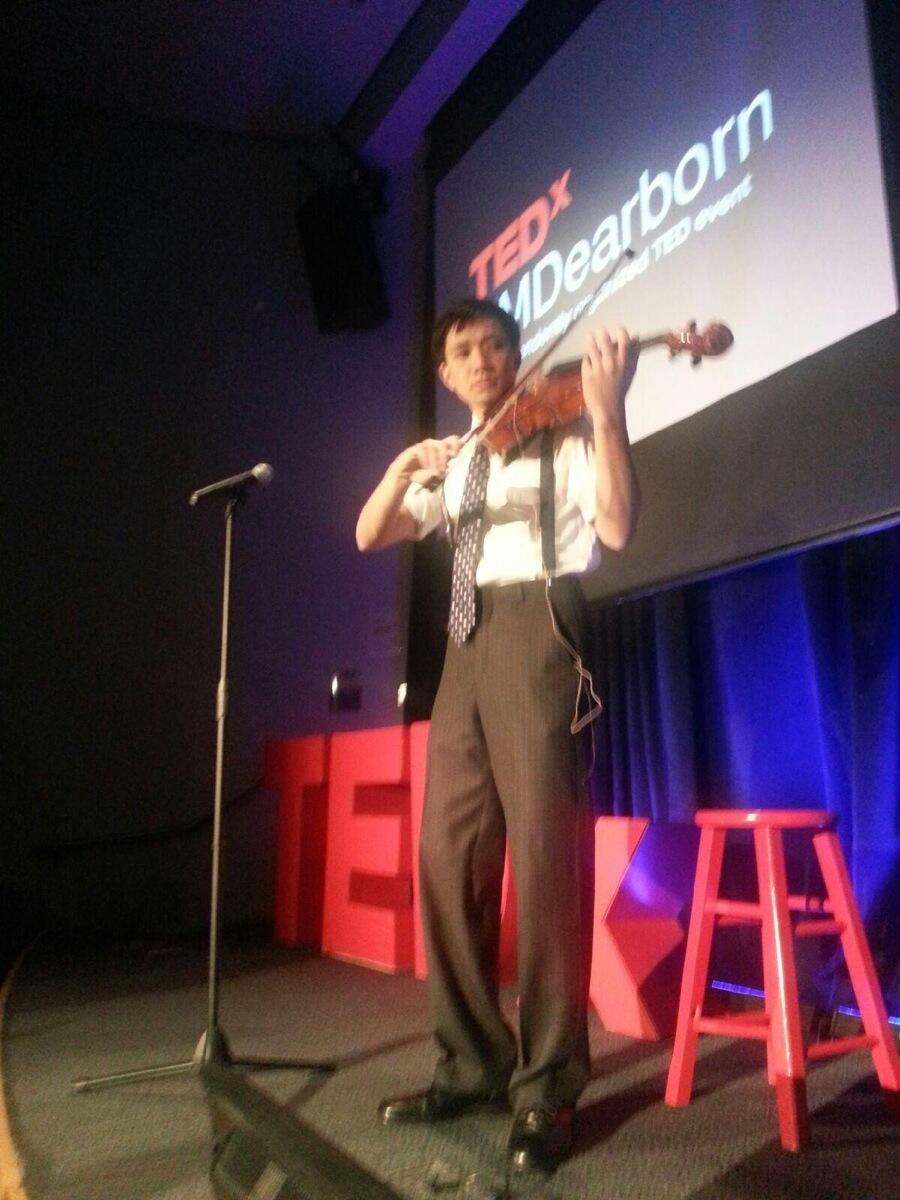
RAW REFLECTION: Post-TEDX Public Speaking

Yesterday I presented and performed two pieces for TEDX UM-Dearborn.  Here are my observations from the event:
Image credit to Greg Ezzo on Twitter

-As with every performance, I learn about who I really am in the moment from what I actually prepared and what I chose to use

-Virtue in performance (for what I mean, here's a statement on virtue in music): 
Everything I really prepared for came through fairly intuitively.  What I hoped but failed to thoroughly prepare for didn't manifest itself clearly when spoken under pressure.  I'll acknowledge that I didn't project my voice sufficiently too.

Granted, there were a fair number of curveballs thrown just before I got on stage:
I was asked to shave 5 minutes off of my time minutes before I walked on from a 12-15 minute timeframe, equipment wasn't readied for me to speak or play (amplifier and receiver was unplugged), and the timer was never started until I requested it about halfway through my set.  But what I've learned from this and previous trials and performances: you find yourself when you push yourself.  I learned on stage what exactly I had internalized and what I had yet to embody.  I'm certain learning to prepare for that better comes with time, additional exposure, and follow-through on not repeating the same mistakes.
My remarks were written in strategy language--they represented the content I sought to intellectually convey, but they didn't represent what I needed to say to human beings.  In my strategy work with the Ismotion/WorldByCycle team we've realized the same thing: every time we got stuck in crafting our business pitch, it was because we no longer wrote words that meant something to most English speaking human beings.  To bring stories to life, one needs verbs, not nouns to move us forward.


-I'm getting better at building emotional solidarity with audiences, but there's a threshold where the enthusiasm and emotion stirred up in my performance-presentations needs to match the integrity of the wisdom I strive to convey.  My intentions for the performance was to show that attendees had both a privilege and responsibility to take whatever they found inspiring or useful and share it with others.  At the same time, I hoped that bringing statistics about environmental health and air quality in Detroit/Southwest Detroit, and the "digital divide" (how the event required online applications in an area where digital literacy and access to the internet remains very low) would also spur lasting attention to bigger systemic environmental and digital justice issues.

-At an event like today's, innovations in emotional technology (how we get people to connect and humanely relate to each other) ought to be coupled with ethical intellectual food for thought of equal or greater quality as well.  I have an opportunity to educate a community.  Using new devices for engagement stays in the heart's memory, but sometimes a clear logical statement can help the mind stir the heart as people wind down from an event.  As a former debater, I know what a logical presentation and argument looks like.  While I wasn't at TEDX UM-Dearborn to debate, I did come with a message to assert.  I don't think it was done as clearly as I'd like, but I'm at peace with it for now.

I'm pleased to learn from various attendees who shared their thoughts (especially from Alex) that the concept of taking inspiration and carrying it forward beyond the event was clear.

-Seek out and listen to the people who didn't get your message(s)
Accolades and enthusiasms are wonderful and deeply appreciated, but in finding ways to refine how I communicate, it's best to engage those who didn't appreciate or grasp the points I hoped to convey.

-Prepare 2x more
For performance presentations that require solid grounding in data and ethics, it certainly takes twice as long to prepare.  In order to use the opportunity well, I need to do two things: Prepare the speech and practice the speaking/audience engagement, prepare the music and practice performing it too.

-That said, I enjoyed sharing it--in the future to prepare for events that charge a fee for attendees, I'll be sure to offer more opportunities to friends/the public for test-running my presentations/performances in progress.

-Unlike featured speakers for the event, I didn't have a dedicated speaking coach assigned to me and have yet to find one I'd trust on my own.  However, thanks to the generosity and attention of friends and the broader community, I was able to practice my remarks (a brief 3 minute or less speech), and sketch out how the presentation aspect blends into the audience participation & performance aspect.  

If you know what to look out for and can ask others to keep you accountable, it's possible to sharpen what you do without a professional coach.  I've been fortunate to have various professors, classes, and extracurriculars which helped hone what I pay attention to for better public speaking.  But without the keen attention, enthusiasm, and support of many friends and amicable acquaintances, I don't believe I'd have refined my message as well as I did.

Many thanks to Sara C., Megan M., Bear, Scotty, Thomas M., Marty S. and all those who shared their attention and insight.


Also: sometimes straightening out another person's collar when they're unaware can be as good as getting a hug from a dear friend.  I really appreciated Ryan K's keen eye in helping make sure I had my tie under the collar before I went onto state.

Pushups helped, I don't mind how odd it looks to others, I did a quick set of pushups a bit before going onto stage and it was worth it.

Thursday, January 17, 2013

Speculating suicide and swingin' the night

A jam-packed day, but I'll start with the evening's events:

Into the evening, I received a text message from a friend who had reached out for help.  He was fighting long-standing suicidal desires and a on Sunday evening/Monday morning I reached him as I suspected and realized it was severe.  We hadn't spoken or seen each other possibly since elementary school-he was the older brother of a classmate of mine, but he reached out to me sometime during college and I accepted his invitation for the opportunity to touch base, and then between late in December and mid January I finally communicated with him.

On Monday morning (as in 03:00-06:00), he mentioned his frustration with life and his ongoing turmoil between severe anger, angst and depression.  He was, sometimes maybe is still, feeling  despondent--so much that he wondered if he should "take a mouthful of sleeping pills" to end his life.  Yet he also expressed to me that he knew it wasn't good, knew there were people who love him, and he actually wanted to live.  With a few exceptions to my circumstances, I had recently gotten over that sense of despondence.  This winter, I was surprised and rather glad to realize that one who endures--and possibly the privileged few who overcome--prolonged suffering earns more than a sense of pride that comes from enduring hardship.  Eventually, some find themselves endowed with a new caliber of empathy and humanity that allows them to work with others who have suffered similarly.

Today I briefly sent him a message after realizing he tended to stay up very late: I recommended ways for him to sleep earlier (research points to less severe/reduced frequency of depression for those who sleep well and earlier at night).  I lost contact with my friend for approximately 6 hours, and realized he had written a confusing statement on his social network profile.

After attempting to reach him and his brother by every means I could find between phones and the internet, I finally called 911.  When I called 911 to request for the police to check on him, I was asked by the dispatcher if my friend had mentioned anything about how he might have planned to commit suicide.  The police do this for several reasons, part of it involves safety--for the officers to prepare appropriately--and part of it is probably to screen the severity of a case.  I knew and gave a likely means: a potential overdose on sleeping pills.  My friend later (around 11:30 pm) sent me a message to inform me that he was well and that he appreciated my concern and initiative.  Ironically, he told me he was sleeping--early during all of the commotion until the police came to his house!

Had anyone asked me in December through March of 2012 where or what I would do a year from then, meaningfully empathizing with people who'd trust me enough to express their concerns and anguish was far from my imagination.


I also wouldn't have thought I'd be fit to participate in swing and blues dancing either.

.   .   .

As another poetic loop, I realized that the elements of the earliest ballroom dances I had ever learned trace their steps to Lindy Hop (dancing with my mum at Eastern University when I was in second grade) and the Tango (dancing with a South American friend at a time that I had never been so close to a female before, not to mention in a situation where I was attempting to learn dance steps from a very competent dancer).

From performing with Amanda Palmer as part of the Grand Theft Orchestra, I learned a valuable nuance about professional rock stars:  they know and live all-out at the times that it matters most.  In other words, they recognize their "greatness", and can tap into it in relatively short order so that they operate at their best by burning through any anxieties almost right away.  The music they (professional celebrity musicians in general) play might not be the most intricate or thoughtfully crafted, but they know how to "maintain the energy" throughout the performance (as articulated by the ladies of the phenomenal Norwegian band Katzenjammer in some interview seen online).

With blues/early swing dance, it's very similar.  Even though I was brand new and was content to hang out at the edge of the dance floor to watch and learn the history of the dances, I was pleasantly--warmly--greeted and asked to dance by many people, several of whom were outstanding dancers in their own right.  In many cases I had long since lost track of the steps and made up my own motions.  Because I've long appreciated the goofy and exaggerated swinging motions and bounce of dances like Lindy Hop and Charleston (there exists a more subtle form of Charleston), I had some exciting moments doing things that seemed like they would make sense.  That said, I suspect it's similar to the principle gleaned from the Amanda Palmer gig I played at St. Andrews hall this past November.  Within reason, I remained rather energetic throughout and probably spent over 4 hours doing dance related things.

At the same time, I realized that I occasionally had no conception of what I could/should/wanted to do next with many of my motions.  This can be scary--I recall realizing that the biggest differences between those on the politically conservative/liberal identity spectrum was their degree of exposure and emphasis of value to possibilities--when we refer to a conservative disposition, it sometimes happens because we really have no way of imagining/conceiving the possibility of an alternative opportunity and/or reality.

With both events said and examined, I think it's really important to know the people in your community--especially those whom might consider you a friend--well enough that you can help

I started this day at 06:28, had a brief but powerful nap, and it's now 02:15.  Easy day, onward to the next!

Friday, September 28, 2012

Didactic Artistry, Socratic Artistry?

Since November of 2011, I sought to certainly create more than I consumed, and accompany any broadcastings/re-broadcastings of my own work/lesser known work with explicit writing about something that I learned from the content or the circumstances surrounding whatever it was I created (see the text accompanying my youtube videos and soundcloud clip).

Better to ask questions in the School of Athens right?
A noble endeavor perhaps, but certainly cumbersome, sometimes burdensome, and for the most part, incompatible with the amount of things I created or found/re-discovered.

In opposition to sporadic postings of things I found (for an extreme example of what I'd call hyperbroadcasting, take a look at almost anyone's tumblr account that re-blogs material sans interpretation), a didactic approach to the arts almost threatens the notion of "art for art's sake".

Yet I also believe that as a form of communication, the arts have remarkable capacity to convey explicit or implicit information, and that many pieces that we enjoy and share sometimes do benefit from pointing to worldly context to enhance our appreciation for the world, or deepen our awareness with troublesome issues.  Based on the following statement:
"Art ain't about paint. It ain't about canvas. It's about ideas. Too many people died without ever getting their mind out to the world." - Thornton Dial, SR. [a folk artist whose quote is on display at a national museum in Washington D.C.]
I believe the integrity of a good idea withstands any questions about value and utility given appropriate context.  In the arts, you need only one of the three for an idea to appeal:

1.  good idea/intention
2.  good conveyance of an idea
3.  relevant circumstances that make parts of an idea more appealing

If you conceive and successfully create something that meets all three of these conditions, it's a wonderful piece and timeless adventure for anyone who has the privilege of experiencing it.

I'm backlogged almost beyond hope with incomplete broadcasts of ideas and pieces, and especially with neat findings of music, film, or imagery chiefly due to the fact that I start to notice that share common threads with other things I've done or seen (time constraints and other obligations being the other contributing factors to this backlog).

For a time, I considered just posting these out of the blue, but doing so degrades the novelty and joy of broader thematic discoveries I had for myself.  This evening, I realized: why not lay out the individual pieces and disclose that I encourage people to find and share any bigger themes they may  come to discover in what I've shared?

A savvy educator usually uses questions to uncover inspiration, appreciation, deeper inquiry, discovery, and understanding about the world.  Yet art also elicits many of the same outcomes in ways that don't necessitate the immediate presence of an individual to ask these questions.  We can communicate and stir the imagination of another person by sharing something that speaks to us.

What happens then, when we recognize something bigger about the things we appreciate?  As in, we've gathered enough information to discover a new level of themes and content among the individual pieces we love?  Can we guide imagination?  I think so, though the process must be done with ethical cognizance.

This is a bit like the success of the Socratic Method (thus the second half of this post's title), which uses a series of questions toward an individual/ group of people to examine the soundness of their foundational beliefs.

More accurately, what I've resolved to explore is a method of sharing glimpses of insight in a way that's akin to a Japanese style of academic essay composition (at least, according to an informational video for writing consultants I saw while working at the UM-Dearborn Writing Center about English as Second Language writers circa 2008/2009).

So here we go, will you kindly share your thoughts with me?

#Started 01:37 27 IX 2012 finished 3 X 2012 0:37 at home

Saturday, July 28, 2012

Youth Verbose

The waiting for wisdom post stirred another thought:

I recently wrote a long e-mail to a friend in an effort to clarify and remediate an oversimplified brief communication I had sent out earlier. I again realized that it’s really important to be explicit about what I intend to do. As I said elsewhere, I’d rather err on the side of being verbose. This goes hand in hand with what I learned about releasing my website in the life as a one shot operation post: industry does not behoove matters of personal care.

Sometime in March or April I resolved to make more contemplative writings in detail.  Why?  Later on in life when things get too hurried, I might not be able to lay out the principles behind how I look at a situation—a learned opinion might be all I have to lean on.  If I’ve already done the reasoning while I’m still young, it gives ample time for others to see where I’m coming from.  If any revisions are needed, I can do so, but assuming the principles are sound, it won’t be as challenging to grapple with compared to getting started for the first time. 
That does not excuse or exempt an older individual from earning their opinions, but it makes it easier for one’s word to bear proper weight when you have a record of reasoning.
I could expound further but I’m certain I’ve conveyed the core of the idea.

Side note: I’m amazed how much faster typing is compared to writing by hand, I think it would have taken me at least 45 minutes to write this.  This took less than ten.  I’d still prefer using a notebook for diagramming ideas though—there are definitely a few visuals I can associate with this note that don’t lend themselves well to text…

This has been another stream-of-consciousness writing.  I'll probably return, revise it, and make note another day.

Waiting for Wisdom

I just realized how important it is to recognize the timeframes between taking a break and forgetting. The intention behind this behavior is essentially to wait for wisdom--time can give additional perspective to a problem. Papers, projects, conflicts, puzzling life problems, etc. benefit from breaks in chunks, but if you wind up needing a lot of time just to figure out what you were trying to do, the break may have taken too long.

At this point, the behavior can be a tremendous detriment--I'd liken a challenge to the development of a fruit:

A plant needs time for fruit to develop, we may recognize its transition from bloom to a fruit, and may wait for it to ripen. Wait too long, and it loses its potentially nourishing and rejuvenating properties. Wait much longer and you may be baffled to discover a new plant in its place.

I frequently wonder if I confuse delay with patience, and how to make the distinction. Discerning necessitates a clear understanding for the definition of patience, as I'm certain that waiting is a vehicle of patience, but does not embody patience. To the dictionaries (note, I omitted a few irrelevant definitions though the phrase "what's in the cards" comes to mind)!

{Randomhouse} pa·tience [pey-shuhns]
1.the quality of being patient, as the bearing of provocation,annoyance, misfortune, or pain, without complaint, loss oftemper, irritation, or the like.
2.an ability or willingness to suppress restlessness orannoyance when confronted with delay: to have patience witha slow learner.
3.quiet, steady perseverance; even-tempered care; diligence:to work with patience.
{World English Dictionary} patience (ˈpeɪʃəns) — n

1. tolerant and even-tempered perseverance
2. the capacity for calmly enduring pain, trying situations, etc
3. chiefly ( Brit ) US equivalent: solitaire any of various cardgames for one player only, in which the cards may be laid outin various combinations as the player tries to use up the wholepack
4. obsolete permission; sufferance

There we have it, my rough summary: the capacity and willingness to to endure misfortune, pain, other presumably unpleasant circumstances with calm. Good to know!

The etymology is interesting too, I suspect when we speak of a person who exhibits piety, especially among christians, it has very strong ties with the concept of pain: early 13c., "quality of being patient in suffering," from O.Fr.pacience, from L. patientia "patience, endurance," frompatientem (nom. patiens), prp. of pati "to suffer, endure," fromPIE base *pei- "to damage, injure, hurt"

Enough tangent, let's return to edible things like fruit again!

There's something I like to call "scorched wisdom". Insight from an experience--particularly a traumatic one--has a ripening period. However, when kept within for too long, or when the conditions which incited insight lose their novelty, an individual starts to take it for granted without getting it across. At which point, anecdote begins to lose its vigor. One of my composition professors, Lee Brooks, likened writing a paper to cooking. We muster many ingredients, assimilate or integrate them into one place, and the heat introduced by our thinking presents a unique outcome.

Dwell too much on the same thing however, and a dark, hardened mass emerges from the process. I liken this to encountering people who have endured tremendous challenges, but were so taxed by the experience that they've burned out or are inclined to give bitter nuggets of truth. I've certainly been there before too.
We can use John Kingdon's concept of policy streams and "windows of opportunity" to weigh out what's happening. When problems, solutions, and politics (I define this as an articulation of desired action) are together, it creates a window of opportunity for us to take coherent action toward. For a person who's experience was burdened for too long by a problem, complacency with their situation becomes a real possibility. If one takes complacency, they eventually lose their desire to engage the problem and articulate some kind of action. At this point, even if they're later introduced to viable solutions, the window of opportunity shuts when it comes to actually doing something useful.


Image sourced from: http://www.scielosp.org/scielo.php?script=sci_arttext&pid=S0042-96862006000800021 fair use disclaimer: I've not copied this image, it's directly linked to its source host and used as an educational aid toward understanding political and philosophical concepts.

The solution to this is simple: communication with others. Share what you've learned, even if it's still an ongoing experience.

Notes and additional references:


Even when I'm not trying, I tend to describe something before I can interpret what I actually tried saying.  I originally gave this post a temporary descriptive title "Patience, breaks, forgetting, and scorched wisdom" that delineated the sequence of concepts I wanted to cover in the post.  I later realized this is a lot about behavior, and I ponder over the structural link between the "waiting for wisdom" and "scorched wisdom" ideas.

The idea for scorched wisdom came up some time around June 24th, and I've forgotten the details behind how they arose. Fortunately, I wrote something on paper about it so I'll try to put it up here later on too.


patience. (n.d.). Dictionary.com Unabridged. Retrieved July 28, 2012, from Dictionary.com website: http://dictionary.reference.com/browse/patience


patience. (n.d.). Collins English Dictionary - Complete & Unabridged 10th Edition. Retrieved July 28, 2012, from Dictionary.com website:http://dictionary.reference.com/browse/patience