To enact sustainability and viability, I hold an ethos of proactivity and humanitas in high esteem: Creative, solutions-oriented initiative with clear outcomes envisioned for the near and long term. The notion of empowerment and the idea that everyone can humanely make a difference in the world create the core of my understanding of "humanitas".
I find my bearings in that process of difference making through a spiraling cycle of humane education, empowerment, and engagement which I attempt to integrate into my presence at every event I attend or create. More specifically, I seek to inform, educate, empower myself and others to take relevant and significant action in the world and repeat with evaluation (which enters the next level of the spiral by informing and educating myself and others about what I've learned from the most recent action).
"In the end we will conserve only what we love. We will love only what we understand. We will understand only what we are taught." -Baba Dioum
Our personal values and worldviews are fostered by what we learn. These values ultimately inform the kinds of information, problems, and solutions we tend to consider and pursue. In this regard, respecting and cultivating the dignity of others to learn and act through compassion make them crucial habits for social sustainability.
Social sustainability ultimately shapes our capacity to understand and act toward comprehensive sustainability. Social sustainability concerns everything from how we communicate with art, non-violence, education, compassion, love, peace, just governance, and democracy with a backbone in living the humane ethics we aspire to understand and share as individuals and collectively. In essence, when focusing on social sustainability, one strives to cultivate lasting and fulfilling relationships.
Trust, security, confidence in other people, in the land we live with, and any other beings we share the planet with are necessary for taking prudent action. To me, prudent action is the essence of economics.
If it quavers and shakes in fear:
let it be for the reasons we share with you.
Speak your truth with courage, and all your heart.
Inspire, then move us--with each word you expel, and each breath you spend. We'll catch our breaths, and then we'll respire.
We'll breathe as we move closer toward something worth every spirited breath of speech, story, and song before our lives expire.
But it ends not at your life, nor ours. Greatness flows over and through endeavors of legacy everlasting.
Free it with your voice and contribution to the world.
Let it ebb and flow from heart to heart: yours to mine, theirs to yours.
Call again!
Through sacred passage of wisdom in your call and listening--let your curiosity open the greatness of others, share your reliable truths, and always ask for the greatest of truth even when the only answer may be silence from your fellows.
The echoes of utterance will be great, and the world may quaver and shake in new movement as it awakens with the warmth of your voice for the reasons we share with you.
Share our Truth with courage and all hearts.
Hollow tree in Interlochen State Park, MI
#09:34 16 X 2013
Sunday, March 24, 2013
Thankful for this peace that I found today
Swear I almost threw my life away -- now I live on
Sweepin' through the streets still around the way
Man a good thing
I found a way -- pain made me strong
- Lyrics by Gmac (unpublished and song still in production)
Last week I was part of a suicide prevention training. By miraculous coincidence I also received the following lyrics via e-mail while I was at the training from a Detroit "conscientious hip hop" artist named Gmac whom I'm in the midst of collaborating with.
Here's what I personally gleaned from the training, and some of the other stuff that arose earlier in the week:
1) Once we've tried everything we can come up with, it's time to wait. Waiting allows new opportunities for us to move forward. To "suffer with patience" is wisdom for the crisp moment at the brink of life and death, and it's perhaps the same test of patience for any life endeavor too.
The biggest challenge posed in the workshop comes from empowering people with reasons to survive and sustain themselves. However, to ensure meaningful impact in the bigger scope of life, you must help them engage something they love--"reasons for living". During an intervention, you facilitate the discovery of their reasons. You might also be their only reason for living at the moment too. Sometimes the opportunity to be heard without retribution is most profound demonstration of compassion one has ever experienced.
In the long-term however, we need a resilient vision that moves one beyond the balance of survival by means of subsistence toward living well. The Applied Suicide Intervention Skills Training (AKA ASIST) workshop, developed by Living Works and hosted by the American Indian Health and Family Services, gave proper priority to the survival aspect of an intervention. However, as I've mentioned before, some of the people I carry concerns for were driven to considering suicide because of the long-term
2) Tenacious creativity literally becomes a vital tool. Creativity no longer becomes a luxury as an outcome of proper resources and imagination, it's necessary for living life and helping others live their lives more fully.
Though I don't have an explicit connection, I know the following's related:
Earlier this week, I clarified part of my interpretation of social sustainability for a social entrepreneur's keynote speech to Jane Goodall's Vision 2020 symposium earlier this week. The notion basically coheres all those lofty ethical ideals (peace, compassion, love, etc.) and processes of governance (democracy, restorative practice, etc.) and brings us to consider at what point do our relationships impact how we engage other things in the world? I used this photo series to visually pose answers to that question: The collateral effects of poor relationships create definite economic and environmental impacts. Though most of the animals here are/were domesticated, the idea that our social relations among other beings bear economic and environmental consequences as well--what does it take to rebuild a war-struck neighborhood?
American Indian Health and Family Services of Detroit offers a free (valued at $275) [note: I find it really odd that the prevention of someone's death is "valued" as "FREE"/"$275"; life is priceless.] suicide prevention training workshop on March 23rd and 24th, 8:15-6:30PM in Ann Arbor.
East Hall
Rooms 1084 & 1060
530 Church Street
Ann Arbor, MI 48109-1043
If interested in attending, send the following information to Nickole Fox at AIHFS: nfox (at) aihfs.org
To proceed with registration (LIMITED SPACE):
· Full name
· Address
· Email
· Phone number
· Organization/department
Last year I called the suicide prevention hotline and found out it was ridiculously busy. Fortunately I got the police to take care of things, but I've experienced a few later instances where I was the only person with the opportunity to intervene and did so seat-of-the-pants. This workshop offers a preferable alternative to seat-of-the-pants intervention, but even the support of a dedicated and skillful individual is no substitute for an active, compassionate and loving community.
"In the end we will conserve only what we love. We will love only what we understand. We will understand only what we are taught." -Baba Dioum
“What we need to match the science of human health is what the ancient Israelites called ‘hocma’—the science of the heart. . . the capacity to see. . . to feel. . . and then to act. . . as if the future depended on you. Believe me, it does.”-Bill Moyers
Alright, in heed of Valentine's Day, I've realized love is necessary for sustainability.
Again, there are some who’d argue that love goes well beyond romance, it's really about finding ways to embrace life to its fullest with other people whom you can trust, even in trying circumstances [1]. Perhaps in essence, much of the world is enamored with romance because it exists as the opportunity and hope for lightening discovery. But overall, love's about fostering relationships and circumstances that celebrate others as much as it invites and encourages them to become the best they can be at all times. Perhaps that's a key element for distinguishing love from compassion.
Love then becomes a requisite ideal for sustainability because people must move beyond a sense of duty in compassion. Compassion wholeheartedly considers a humane cause or misfortune, and like love, it may operate on a notion or ethos of improvement and hope. However, without commemoration or celebration-- outcomes from possible merits also fosters awareness about the products of something deeply appreciated. On some level, this can imply a deep understanding as well. The more you know, you're more capable of appreciating, and thereby loving. Which brings us back to Baba Dioum's statement:
"In the end we will conserve only what we love. We will love only what we understand. We will understand only what we are taught."
Those who find pain in loneliness or comfort in solitude have learned something profound as well, and in many cases, have an opportunity to articulate the experience in profound ways, often in the arts or through their commitment to substantive endeavors [2]. That's what makes the arts so elusive: they can commemorate an experience and guide us toward our shared humanity in tremendous ways. They can also inspire deeper appreciation and learning about the world we live with, and why the things we live with matter. That's necessary for sound conservation--the practice of ensuring near-term and long-term well-being.
... there's more to this notion of love for sustainability (I feel like the ideas are 3/4 baked at this point). In particular, the role of concepts like compassion, love, hocma, and their relation to appropriately bringing one's courage, wisdom, and capacity for expressing it in life that signify the significance of an individual in the world. I can see it, but it'll take me a while to put it down into writing...
After a day contemplating existential ethics of romance and time-sensitive self-promotion, here's my say: There's a possibility I'll perform a cookin' handful of early jazz and blues tunes for a Valentines swing dance night with Alex Belhaj (or with him and his quartet) this Wednesday evening in Ann Arbor [1].
Even for those without a valentine, Ann Arbor has one of the best swing dance scenes in Michigan where you can pick up the basics of swing dance--no partner or previous experience required! For me at least, dancing and music yield vibrant moments and memories in life. There are some who’d argue that that’s what love’s really about. More than the romance, it’s about finding ways to embrace life to its fullest with other people whom you can trust [2]. In a vague way, I suppose that’s a shallow iteration of love to everyone reading--it’s not always obvious, but there’s a community willing to step forward, take your hands, and go for a dance. There’s a community willing to share the best music that they can make. And if instead of finding content in your solitude you suffer loneliness [3], I hope you’ll recognize and offer solace to another who shares a similar state, as you've got an opportunity to improve the community at large with fundamental compassion.
That said, I’ll hope the music and dance are enough to content the hearts of several who do attend.
This morning (Jan. 31st) I dreamed I was traveling with a companion (I don't remember whom, it might have been my mum, for the sake of description in this, I'll say it was), walking through a relatively old Western European town that had large stone alleys and walls. We were supposed to meet with somebody and found the door to his house. As the man was just entering his home and his door was still open, my mum knocked on the door frame of the house. At the same time, I noticed another door, white, and almost completely hidden as part of an intricately patterned wall adjacent to the door, standing with waning magic to its right. I knocked on that.
The man greeted my mum and opened the other door for me. I saw he had a flaring salt-and-pepper streaked beard shaped a bit like Arvo Part's (the person looked a bit like Arvo Part too). I stepped into a room laden with large smooth stones for the floor and wall--it almost looked like part of a castle. In it, I noticed what I knew were a few Arthurian relics--part of a crown, a scabbard--and I stepped in. There was definitely magic to the place, but it was mostly bare with stone. I was also greeted with an enthusiastic cry from the ground and saw an attractive pallid mermaid with long, dark black, curly hair, dark blue/green scales, and tattoos across the top of her chest, on her forearms, and part of her obliques laying on a cot. She cast a large down comforter off of her body as she leaned to look up and greet me.
She recognized me (or at least claimed to recognize me with genuine conviction) as an old friend whom she hadn't seen in a very long time--at least 8 years. She had a fine English/British accent too. I quickly accepted her assumption and wondered (I'm pretty sure I also asked her in good spirits) what she was doing so far from a body of water, and then (quietly to myself) why/how she got tattooed. I learned, perhaps from her caretaker (the same person who let me into the room), who was also the curator and guardian of the relics and room, that she was ill with cancer. I knew right away I could only give my heart's attention to her challenge even though I had not immediate or substantive ways to help her out or prevent it from happening to others. I also started to imagine other potentially complicated challenges for water dwellers like noise pollution... . . .
First off, I have no idea how I came to dream about a mermaid. Nothing in my recent memory (or prior) makes me consider mermaids. Giant squid? Maybe. I might have eaten part of a trout not long ago.
Second, I normally don't share dreams like this with other people--some stories can only be told once or twice before losing their magic. In some cultures, you're encouraged not to tell anyone about powerful visions/dreams you've had at all. In most cases, it seems like acceptable fantastic myths no longer have appropriate reasons to exist without a franchise or burgeoning industry or institution to support them.
Finally, I can be slow to trust some people, especially those whom seem to qualify me as a friend unusually quickly. At this point in time, I'm skeptical and would even be surprised that anyone actually would warmly regard me as an old friend in that light. But I think I might have figured out a thread that would affirm her confidence by looking back at one of my actions from today: . . .
Later this morning, after a treacherous drive to campus, I noticed a post from Friends of the Rouge remarking about the rising water level in the Rouge River. When I checked the USGS data, I saw the discharge was around 1090* (*I think, out of a previous record which I think* I recall reading was at 1270--the data changes by day and often by the hour), which compelled me to post this to the Student Environmental Association page:
Hey, check out that Rouge River data! It's edging up to the 1971 record maximum daily discharge.
http://waterdata.usgs.gov/mi/nwis/uv/?site_no=04166500&PARAmeter_cd=00065%2C00060"In honor of what's been happening with the river over the past few days, here is a song by Johnny Cash." - Friends of the Rouge
A little bit of permeable landscape/green roofs upstream in the broader Wayne/Oakland County area can make a big difference downstream.
And later try my hand at broadcasting a reduced announcement on twitter, which led to an updated "cover" photo:
I was rather satisfied with the balanced counterpoint of urban & natural features in all the photos I used (all my own)--a silver maple leaf with water droplets resting on concrete pavement, a pigeon peaking out of a rain gutter, and a photo of me looking at a snake in a natural area as I wore a nylon windbreaker and backpack.
Recently, I've returned to thinking a lot about the nexus between genetics, medical health, environment, and cancer too. There was a time when I wanted to bring light to this phenomenon in Relay for Life events, among cancer researchers, and also in the neighborhood I grew up in (which has an unusually high prevalence for people who had breast cancer and is located near a landfill and industrial corridor which had emissions ranked 4/5 for poor air quality by the EPA).
These may not be the exact things that led to my dream or a privileged visit from a mermaid who'd consider me an old friend, but they certainly make me wonder...
Returning to another thought about the photos on my twitter profile: All of the photos have something to do with rivers and watersheds. Both the silver maple (Acer saccharinum) leaf background photo and the profile picture were taken in fairly close proximity to the Lower Rouge River, in Michigan. The photo of the pigeon (Dover Pigeon--Columba livia) was taken in San Antonio, Texas. San Antonio, for those who haven't been there, has a famous river walk paved into its downtown tourist area. Their river is terribly stagnant, it's stiff and can no longer move about due to their intensive channelization and lock system and you can smell the effluent (sewage) discharge. Call me biased, but the Lower Rouge River has a sweeter smell (this time from treated effluent), can freely flow and meander about its banks, and has far less channelization until it unites with its sisters to become the Rouge River in Dearborn. Granted, given fair river literacy, you'll note its banks are stressed by upstream development as well, but unlike the San Antonio River, it can change, and gradually, with far less revision to the man-made infrastructure which currently influences its behavior. At the least, both are richly storied water bodies stressed by heavy development.
An educated land planner will acknowledge that dense development can be important and have a lower environmental impact than sprawled development--it's never to be interpreted as a case of people-vs.-environment. However, most developers/construction firms tend to use pavement and roofing materials which cover up parts of the land that once slowed the flow of water (and all of the things that get carried by stormwater) from land quickly into streams, tributaries, and eventually lakes, etc. Viable alternative landscaping techniques (use native plants to capture rainwater and reduce chemical application/mowing, create "riparian buffers"/"no-mow zones" near open waters, etc.), pervious pavement (sponge-like pavement that allows water to seep through and into the ground), and different paradigms for roofing technology ("living" rooftops/greenroofs) can help mitigate this. Of course, there's no substitute for a quality wetland/swamp when it comes to filtering water. In the bigger picture, stormwater from flashy rivers--typically, rivers located in areas with 10-20% of the land covered with non-permeable paved/roofed surfaces--contributes to algal blooms which can be toxic, or at least will deplete the lakes of oxygen as they die off (bacteria digesting the decaying algae wind up using much of the oxygen in the water), which leads to large-scale fish-kills. For anyone wondering, this process is called eutrophication. It happens in small inland lakes, in the Great Lakes, and even in the Gulf of Mexico.
Note the green in agricultural areas like Saginaw Bay and the Northern shores of Ohio--that's an explosion of algae. Too much fertilizer from land washing into tributaries and rivers eventually goes into the Great Lakes. The Mississippi/Gulf of Mexico "dead zones" have similar challenges (see http://bit.ly/14w6eJg for well-illustrated explanations ) Image from NASA Earth Observatory.
These are fairly technical details, but it's something I've comfortably worked to educate the public about for several years as it's a reasonable issue to convey (in bite-sized pieces) without making people feel threatened or overwhelmed, and I can easily point out social and economic bearings. Note that in Metro Detroit, waste water is dumped upstream of our drinking water collection facilities. The cleaner we keep the water from upstream by preventing raw pollutants and sediments from rushing into the river due to flash flooding (like the recent events witnessed in late January by those who looked at the Rouge River directly, or at its data in the link posted way above), the less intensively we have to invest (AKA, pay taxes) in our municipal infrastructure, and the less we need to worry about indirect health concerns like salt and pharmaceutical drugs that the water treatment plant is unable to effectively strain out of our drinking water.
I'll edit this post to provide direct pointers to better watershed practice soon.
. . .
Back to dreams about a mermaid with cancer: Hopefully, putting all this information into writing and action meets the merit of doing things worthy of being a friend to mermaids even if it's in a distant and roundabout way.
Interesting coincidence: tomorrow is World Wetlands Day. Start 00:20 ; #23:21 1 II 2013
"Today
there is no longer a choice between violence and nonviolence. It is either
nonviolence or nonexistence." -Dr. Martin Luther King
"It
springs rather from my conviction that, if our civilization is to survive, we
must break with the habit of deference to great men." - Karl Popper
I
think Dr. Martin Luther King Day (which I learned is not his birthday! That happened January
15th) is an appropriate opportunity to reflect upon and reinvigorate our
commitment to the timeless legacy and vision of justice exemplified by Dr. King instead of giving deference to him as an idol of noble
aspirations. More than that, I think we foremost
benefit from recognizing our ability to empower ourselves and each other (all
people, of course not just men). Another quote, this time from the living Bill Moyers, shares this belief that action is up to you: “What we need
to match the science of human health is what the ancient Israelites called
‘hocma’—the science of the heart. . . the capacity to see. . . to feel. . . and
then to act. . . as if the future depended on you. Believe me, it does.”
In
that regard, all of us are capable of discovering greatness in ourselves and
one another. Among their
accomplishments, civil rights proponents like King succeeded in empowering
people by promoting awareness and opportunity to engage in justice through
democracy with disciplined planning and steadfast implementation. I recently met the Reverend Dr. James Lawson, who worked closely
with Dr. King, in the autumn of 2012 after he gave a speech about non-violence. By miraculous coincidence, I met him one day after I tasted the gunpowder from a gunshot meant
to kill a person less than 8 feet away.
At first blush, non-violence can seem like a
fairly simple, even vague if not hollow, term. If someone draws a gun with malicious intent,
what other choices do we have? Guns,
much like nuclear weapons, can almost guarantee mutual destruction. Yet if we ask why one would draw a
gun to potentially kill extended family, or even carry one in the first place, the answer had to revolve around personal security and insecurity when you boil the situation down it to its essence.
Security is a sophisticated need. It’s inherently dependent upon complex
systems which are beyond the full control of an individual. Even one’s perception can skew our judgment of
an already shifting reality.
I
suspect an answer to dealing with potentially absolute violence lies in
interventions that meet the following condition: overcome our human tendency to
engage in rules that necessitate the reciprocal escalation of powers. Undermine or reshape the entire premise of
our value system for fighting—the “rules of the game”—by changing the
perceptions and paradigms which shape how and why we think about combative
engagement in the first place.
People
are complex; fortunately, science helps us find ways to effectively work with
complexity, including social codes and personal beliefs. Complex systems scientists recognize tangible
behaviors as necessary for persuading peoples’ values, paradigms and
worldviews (see the list of 12 leverage
points for intervening in a complex system here: http://www.sustainer.org/pubs/Leverage_Points.pdf
). When appropriate, non-violence may
need to employ the use of non-lethal protective use of force
(check out Marshall Rosenberg's well-earned wisdom: http://youtu.be/21g1S7stoQI
), but no matter what, non-violence is exercised without malice in our actions. The way we communicate ideas, or even
notions, in language (can we speak without engaging in abuse or instigating
escalation?) usually becomes the first symptom for a potential intervention. To astute observers, it may be expressed visually in our physical posturing
and gestures (can you assert your presence without resorting to making it
threatening to others?) as well, and of course in how we physically interact with one
another (can you embrace and redirect a person's attack rather than impose force onto them? That's what the martial art Aikido focuses on).
Adding Popper’s contention about the notion of
“great men”, I gleaned another note for non-violence from Dr. Lawson: Non-violence operates via empowerment as its primary principle. “Non-violence
is premised on the idea that all people have power to act beyond the influence
of their circumstance.” But in this, there's a
challenge: unlike violence, which can quickly and easily interfere with the
integrity of an ideal like peace, trust, or love, non-violence requires
discipline, careful planning, and patient dedication.
We must act from a hope to overcome, we must plan to overcome.
Which leads us to another nuance of non-violence from Reverend Lawson: “Non-violence is the moral
equivalent to war. It requires
organization and discipline.” Consider the planning and commitment
that went into what we now see as watershed events: Coordinated planning took place for the
sit-ins from 1959-1964. The Montgomery
Bus Boycott officially began on December 1st of 1955, some of us heard that in
the history books or on television programs, but few of us realize the tenacity
of the cause: the boycott was sustained for over a year—381 days.
An ideal is a lot like other life-processes: education, communication and the arts, design, even ethics.
All of these activities involve intentions, actions, and consequences.
Among seasoned practitioners like Reverend Lawson, the term "non-violence" actually isn't representative of what people really strive for. Non-anything implies reaction and work that runs directly against something. If anything, I suspect people really strive to love--create it and do it. It's a noun, but most importantly a verb.
Love exists as a plausible ideal. We may bear compassionate and loving intentions. Caring actions may manifest loving intentions, and perhaps the desired consequence of compassion and love creates a legacy that reaffirms the intention and fosters more love.
Yet as an ideal, it becomes so expansive to act upon that many find--and take--temptation in believing ideals cannot happen in reality. Furthermore, it's possible, potentially even reasonable [using the word in a very strict sense, link goes to various definitions] though never justifiable, that a person can love the person whom they abuse. Their intentions may be true, but the actions they know or choose to express care through compromise the dignity and autonomy of another being.
This remains the challenge of Dr. King and many other notable living visionaries of our time: to truly validate worthy ideals such as peace, justice, and love all three aspects of the ideal must be good and present. That takes visionary planning to manifest dreams from ideal to real. When society-shaping, you need to do so with people, not just on behalf of them, and certainly not independent of them.
Keep it up, we shall overcome someday, but let’s discover the someday together, every day in our actions with one another.
. . .
Notes about music in the video above:
Minor variations and improvisations on the Civil Rights song "We Shall Overcome" recorded in the University of Michigan-Dearborn Wellness Center on January 21st 2013.
A few weeks ago I played it spur of the moment and it was a profound rendition if I say so myself, but I don't remember what I did and I didn't have anything to record it with at the time. There's some irony to the notion of playing a social justice song, solo, to no one but yourself on MLK day. I was somewhat disappointed that I missed a few opportunities including a symposium on social justice that day, so as I practiced other tunes, I decided to give the song another try in observation of the day as well.
I suspect playing a song used for civil rights alone doesn't quite contribute to making the dream manifest, but hopefully sharing it here might be worth your while. I'm drawing memory from a rendition I heard on a cd by Peter Paul and Mary when I was in second grade-fifth grade, and hadn't really prepared my playing as much as I now think I should have. Ongoing process...
What's the difference between compassion and love? When does compassion become mandatory for good character? I started exploring those questions through this tune and the stories behind it. [Edited: 19 IX 2013]
Willie (in reply to a complement about him as a tremendously compassionate person): "Ian, I appreciate that. I'll humbly accept that, but in some ways I didn't have a choice--you know how my life's been..."
Some people become notably extraordinary in response to or as a product of extraordinary circumstance and exposure. He had gone to prison three times, and started turning his life around through his determination to be who he knew he was capable of becoming--a better person and an artist.
If you get a chance to hear to his story there several key moments during his final time in prison:
1) choosing not to eat meat (at a time when vegetarian options were almost non-existent) while in prison as a way to prove he had control over something in his life
2) one night, a neighboring cell mate who had a reputation for drawing passed one of his pieces over to one of Willie's cellmates, and from then forward he knew he could draw and started sketching
3) seeing the sense of peace that painting brought to one of the inmates
4) a moment where another inmate noticed he was drawing and sat down to show him how to draw with three dimensions for about 5 minutes
He ended his addiction to drugs and later earned his GED, then a college degree, ran 3 Detroit Free Press marathons, and worked at the University of Michigan-Dearborn Wellness Center for a little over 20 years before retiring early to live the wisdom he preaches and pursue his art with greater focus.
It's important to acknowledge that his addiction had negative impacts for other people beyond himself--and that's at the core of his statement "but in some ways, I didn't have a choice--you know how my life's been..." He'll be one of the first to acknowledge and warn people about addiction and the realities of prison and its role in criminal justice. At the same time, he also understands that many of the events which led up to addiction could have been circumvented in many ways--whether it was through the attitudes instilled in him by others as a child to having an earlier exposure to healthier and creative means for expression.
Willie has been a mentor and a champion for my own efforts. I learned so much about compassion and artistry from sporadic visits with him in the past year as he Worked at the Wellness Center--sometimes just from watching him sketch as he told some of the stories I shared above. Or by the way he remained relentless about encouraging me and finding opportunities that could advance my musicianship even as I focused on other kinds of work.
Willie attributes the magnitude of his compassion in large part to his experiences, though I could say there's a fair amount of credit due to his character and commitment too. His life story's tremendous, and I wish more people have met him or can spend time with him to learn about it firsthand.
However, through his reply to my appreciation for what he does and how he lives, I realized he noted a distinction in gauging one's character: there's more to being and becoming a great person than just meeting circumstance with magnanimous compassion. Perhaps actively seeking opportunity to help others becomes the next distinguishing gradation in our humanity. While it's something both Willie and I do, the extent of which that it happens as a regular basis is something new for me to focus on. Not necessarily because I didn't care about or didn't do it before, but because I hadn't seen life with this degree of clarity until I meditated over Willie's reply.
Another question arises about actively helping others: at what point do we let another person be as they are?
Perhaps it behooves us to examine a maxim of life: be as you are unless you yourself find compelling reason to change. I suspect many try to live by it, yet what does this maxim say about our relationship with other people? A distinction and balance exists between seeking--active, and intentional form of aid--to help and helping as an outcome of a reactive/passive or perhaps something simply receptive to opportunity.
I'm still exploring this concept, and I've also titled a new piece "Mandatory Compassion" based on this conversation.
Start 9 I 2013, # 12:24 pm 18 I 2013
. . .
I've since realized the difference between love and compassion. Love is a proactive endeavor which exists in the interest of helping others be at their best. Compassion tends to be reactive and circumstantial. We may help others upon recognizing some need that can be met, but if not, we might empathize for a moment and move on. I also attribute some of this to sharing lunch with a homeless man, Mr. Westberry, at a time when I just happened to have enough extra food to share a hot meal during a very cold December day in Ann Arbor. That event ran through my head as I started playing the opening notes of the piece, and Willie's conversation versus my encounter with Mr. Westberry galvanized concept behind this title. [#edited 19 IX 2013]
“What we need to match the science of human health is what the ancient Israelites called ‘hocma’—the science of the heart... the capacity to see... to feel... and then to act... as if the future depended on you. Believe me, it does.”-Bill Moyers
Some of the most evocative artists also happened to have very severe mental health challenges.
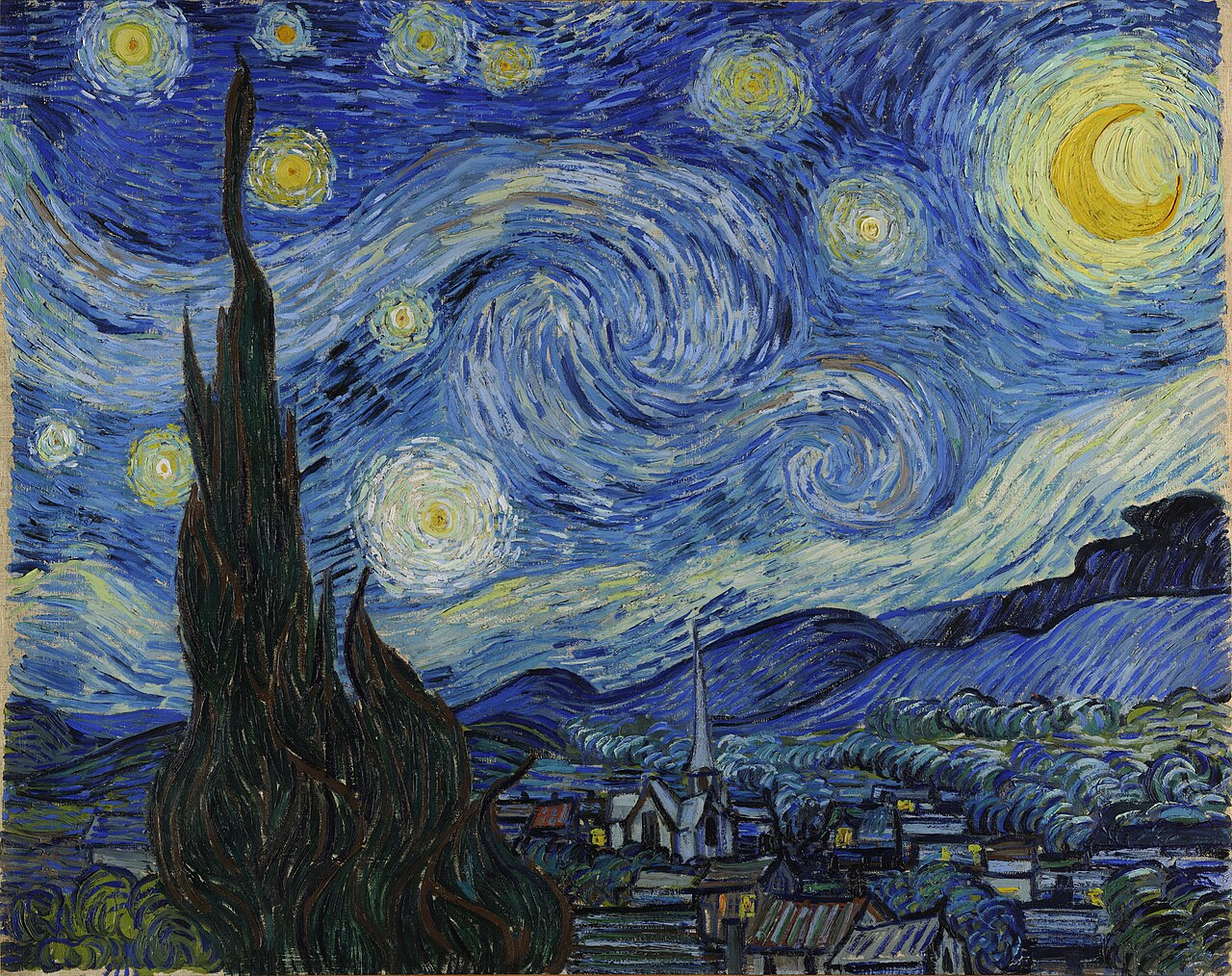
Vincent Van Gogh (of starry night fame, among other paintings), would be labeled with bipolar disorder, schizophrenia, and a host of other illnesses (those who want to point to his missing ear as possible evidence of mental illness may need to reconsider recent interpretations of events though).
Recently, I've had a cello tune by Robert Schumann visiting my head with vigor. I first learned and listened to Schumann's music via a recording of his "five pieces in folk style" performed by the cellist Natalia Khoma. The piece that really stood out was the first from piece in the set labeled with a brief suggestion in German: "With Humor" (Mit Humor). I really liked the tune, but always imagined it had an adversarial kind of sound to it. Now, with the benefit of many years of new experience in performing and the wonders of youtube, I've listened to several other performances of the piece and decided that the piece is challenging to play with humorous conviction unless you're in a REALLY good mood.
While searching for other recordings of the piece, I noticed one youtube playlist that contained a lot of Schumann's music was titled "Music for a troubled mind." After a brief search on Wikipedia (and elsewhere, but Wikipedia was most accessible so I'm giving it credit foremost) about his life, I had confirmed my suspicion that he too, had a rough time grappling with life on the now and then.
In some ways, I was disappointed, there's a research article with a disempowering title called "the dark side of creativity:" and a subtitle that says "vulnerability and negative emotions lead to greater artistic creativity"[1], Schumann reaffirmed its findings. At the same time, I was relieved: over a hundred years later, living people actually perform and presumably enjoy listening to his music.
Realizing that, I'm reminded of a pondering that started earlier this summer: how many people actually wanted to be with Van Gogh or Schumann not because they enjoyed their works, but because they knew they were ill and truly wanted to understand, or possibly help them?
The current media buzz from recent shootings suggest that we as a public are quick to impose a label and therefore, imbue an identity onto another person. When we refer to people with mental illness who behave poorly around others or worse yet, commit injustices, we strip away the complexities of their history, circumstance, and potential as people. In light of shootings like the Colorado shooting that took place in the theatres, or the recent shooting at Sandy Hooke elementary, people say "that's sick" with sneering hate in their voice and tones of disbelief. Yet they forget what it means to be sick. Killings of that sort are certainly inexcusable and unjust acts. But in saying someone is sick under most circumstances, we'd hopefully recognize sickness as a state of poor health with the intent to improve it to a better condition. We rarely say someone's an absolute loss and dead already.
In instances of the shooters in the aforementioned incidents, one of them (James Holmes) looked like he was in disbelief about his circumstance and actions during the trials, the other (Adam Lanza) had been killed before he went to trial.
While it might not be accurate or true to the circumstances of the previously mentioned criminals, I'll offer an unusual perspective as a possible ingredient for empathy:
Some people hurt so much that they wish they'd do something to deserve the pain and shame they've felt. Why? Because they don't understand where it truly came from, why it happened, or what they can meaningfully do about it. Sometimes the confusion, pain, and anger are a legacy of outcomes from bullying, terror, neglect--abuse.
At the same time, recovery has little space to exist in our society. We delegate responsibilities of care by sending people to hospitals or rehabilitation centers. Often, they're cut off from people whom they might actually need for humane interaction that goes beyond vital statistics, food delivery, and psychiatric testing. This is a similar challenge that prisoners face. Granted, they're frequently inexcusable and still responsible for their own actions, but I've met enough to know that there are some who also want to live as better human beings for the sake of others in their community or family. One of them is a mentor of sorts to me and many others at the University of Michigan-Dearborn.
Furthermore, we're in a society where meeting sophisticated social needs frequently becomes a rare occurrence--mental healthcare for many is inaccessible if it means we must invest burdensome financial capital and traverse great distances to reach whom we'd hope are vigorously trained and keenly attentive health specialists. But what happens if therapy amounts to paying for the privilege of talking to someone who just might choose to offer you medication instead of helping you embrace and resolve your conflicts? Our fundamental intentions with most of these sessions come from a deep desire to meaningfully communicate with another person in a safe environment, and know that someone else cares about your well being. These "specialized services" happen to be many of those that people ought to expect out of a good friend.
Let's consider a line of questions:
1) When someone we know grieves because a loved one died, what's the likelihood that they'll do so in a way that can't be described as some kind of illness?
2) What accurate ways exist to gauge one's mental health?
3) Will that person remain an injured and fatally broken person forever?
4) Does a state or institution have the right to take them (and in turn, impinge upon their freedoms) away from the rest of the world away by labeling them as "sick" or "mentally ill" for suffering humane experiences?
Sometimes, you'll discover that they too, deeply wish to get better. I suspect in severe cases, more often than not, they've had to confuse themselves into believing they're unworthy of aid and redemption. In my case, I think it's a form of shame and self-hatred that some people are willing to perpetuate because they don't really grasp an alternative reality to how they can live and who they can be.
When someone is ill, the rest of us also have choices that actually challenge our perceptions of responsibility as a community:
Do you take up apathy?
Will you let them continue to suffer?
Will you embrace their challenge and aid them to get better?
If you want to live in a better world, these questions become your charge and duty. If you're preparing for fields in medicine or justice, this is the challenge you're charged to meet at any moment, sometimes through witnessing subtle realities slip in and out of a window of opportunity many times in one day.
I started to write this post around December 19th of 2012 in reaction to realizing that a talented and fun loving person who quickly and, likely, genuinely considered me a friend did so as I was still wondering if I was in stable mental and emotional health.
This brings me to a quote from Bill Moyers which you've seen at the beginning of this post:
“What we need to match the science of human health is what the ancient Israelites called ‘hocma’—the science of the heart. . . the capacity to see. . . to feel. . . and then to act. . . as if the future depended on you. Believe me, it does.”-Bill Moyers
You may be the only individual with the privilege of interacting with someone who suffers from mental illness. Recognizing that possibility exists, even brief encounters with other people can define your relationship if it's no longer sustained. I've come to believe we're obligated to make sure we've made a positive difference in other people's lives whenever we're privileged to reach another person.
"Depression is real. Just because you’ve never had it doesn’t make it imaginary. Compassion is also real. And a depressed person may cling desperately to it until they are out of the woods and they may remember your compassion for the rest of their lives as a force greater than their depression."-an excerpt posted on an online social network by someone who pulled a quote from the depths of another social network
I'm convinced that many people with mental health challenges also contributed some of the most profound ideas, expressions, and acts of compassion known to history.
Van Gogh, Schumann, I've mentioned before. There are more I can list, but I'll choose Buckminster Fuller as the closing example for his resolve to do something out of what began as despondent angst:
"He ultimately chose to embark on 'an experiment, to find what a single individual [could] contribute to changing the world and benefiting all humanity.'"
Just read about him, he made amazing things and had great insight for design/complex systems theory.
[I don't completely agree with his techno-centric vision, but he was certainly prolific and lived a life worth knowing something about-read the section on his depression and epiphany for the segment that most.]
Now on the converse, you don't need to be sad, immensely depressed, or ill to do great things. If that's where you're at great! As human beings however, we're capable of it all. Can you make the most of life and see what you can do with the hearts of other people?
Research doesn't tell us the answer, the actions you choose to live for do. It's up to you to hone hearts, to do what the future depends on you for.
[1] The Dark Side of Creativity: BiologicalVulnerability and Negative Emotions Lead toGreater Artistic CreativityFor just the abstract: http://www.ncbi.nlm.nih.gov/pubmed/18832338
Drawing from the public's attention on the violence of recent events (particularly talk of escalation between Israel and Palestine, the shootings at Sandy Hooke, and a shooting I was in), I wrote a note to colleagues encouraging them to familiarize themselves with the emergency procedures, and to begin developing a department-specific emergency plan. However, I still think the best thing we can do comes from being kind and sincere in our encounters with people.
This year I've been around malicious gunfire that was so close I could taste the gunpowder shortly after the aroma reached my nose. The incident I was in happened between extended family members, and it didn't surprise me to see and hear it happen. Violence swiftly escalated from language into physical pushing, shoving, and punching which eventually turned into gunshots and a brutal beating in response to the shooter.
I suspect the notion of love is antithetical to this situation. I understand compassion, it's been illustrated in tremendous experiences for me this year. Yet what if people don't know love? I appreciate peace, but similarly, what if most people actually don't know peace? Despite popular assertions that they can be found in simple expressions, peace and love are complicated concepts to substantiate, and it's almost inconceivable for those who lived much of their lives with an oppressive and abusive environment. If anything, we human beings fundamentally understand the notion of hope before we understand the nature of peace and love.
I'll say it again: More people probably understand hope better than they do love.
Truly, not everyone knows what love is or grew up with meaningful exposure to it and therefore, more people lack meaningful understanding of it than we’d assume or wish. People do, however, recognize compassion and reprieve from hostile situations on a more frequent basis.
Look at international relations as an example of a similar misunderstanding between war (analogous to hate) and peace (analogous to love):
Reprieve from dire hostility (i.e. war/sectarian violence, etc.) becomes labeled improperly (and thereby assumed/presumed understood) as “peace”; similarly, peace-keeping forces (actually security forces) designated by the UN aren’t actually an authentic indication of peace, they provide a crucial opportunity for fostering authentic peace by creating a more secure environment.
Hostility, and hatred, both still allow for hope—a special kind of opportunity with positive possibilities, at least for a particular individual or group of entities who carry the same hope(s).
Hatred is a choice to engage in certain behaviors present within our nature, but does not constitute our nature in its entirety. Hatred operates upon unreasonable hostility, and a deep inclination for humans (and other species) to reciprocate perceived behaviors tit-for-tat.
[War: communication and artificial environment (creates structure) Hatred: unreasonable consciousness/mindset/worldview that perpetuates the circumstances necessary for war.] For local examples of environments and histories that have strong influence over how an individual perceives their choices and behaviors:
A few friends of mine confessed to me that they had seriously considered suicide in the past, or present. One of them considered it out of shame, the other out of frustration in knowing that his intimate partner only wants the relationship to satisfy her physical desires. The first lived in a neighborhood of Detroit where the average lifespan of his friends and family was about 35 years old due to systemic violence. The other also grew up in Detroit, and has a family history of suicide, bipolar disorder, and/or manic depression. Those are real questions: will I need to accept the legacy of the place I grew up in or family I come from as the trajectory of my own life?
In retrospect, both of them are the first in their families in several generations to leave the area they grew up in, graduate high school or earn a G.E.D., they're also the first of their families to attend a University.
I considered the same and share the same question too, though I know I'm about 8 steps ahead thanks to a few friends who've astutely pointed out that: you are not your family. Similarly, we, as individuals, aren't our cities or communities. We have choices and new opportunities While I'm not vigorously trained in the physical aspects of the martial art known as aikido, I strive to live its principles. In aikido, one acknowledges and embraces an assailant's momentum to direct it elsewhere for a mutually favorable outcome. It's a profound alternative to traditional thinking in fighting and conflict resolution: normally the only way to end a fight is to prevent it or combat power with power to win. That's how war and most fights start to devolve until threats are eliminated.
We have choices and new opportunities now. Let's start with the hope we'll create peace for everyone involved.
Roughly translated, the martial art Aikido stands for "the way of harmonious energy": Ai=harmony ki=energy/spirit (AKA Chi/Qui in Chinese) do= way/"an artful path to discovery" (I like how the site articulated "do")
Foremost, aikido has compelling appeal to me because it's centered on a win-win approach to drastic situations. Opponents don't (or rather more accurately, shouldn't) exist, a practitioner simply acknowledges the situation, momentum, and redirects it to a more favorable outcome for everyone. Reading up on the philosophy of the art again, I found the following quote:
"We believe that since we all share a common energy source, that in some important way we are all truly members of the same family, and truly sharing our lives with all of nature. We do not have an attack form in Aikido, because attacking an opponent would be like attacking a family member that you love." (source)
Those familiar with Aldo Leopold or beliefs frequently held among First Nations people might find this concept familiar: we share fundamental similarities and needs, and thus merit respect for one another and across species. Leopold's essays use common sense to lay out nuanced wisdom, and it strikes a chord with people of very diverse backgrounds. I know hunters, vegans, conservative and liberal friends who continue to appreciate the writings found in his essays. Of particular pertinence to the quote found above in Aikido, Leopold's Land Ethic came to mind immediately.
While Leopold undoubtedly held a different paradigm about life and his relationship to the world prior to writing many of the essays found in his "Sand County Almanac", it's interesting to note how his views developed and the development of Aikido as a martial art share a similar story of transcendence. Read Leopold's "Thinking like a mountain" essay and then read his "Land Ethic" essay to get a chronological sense of Leopold's discoveries. Then recognize that Aikido emerged out of combative martial arts for samurai--life/death techniques which went from a mentality of winning via attacker/defender to a co-creative ethos revolving around redirecting force for favorable outcomes.
In accessible English, Aldo Leopold expounds on the scientific matter-life-energy processes of ecology and builds up to an ethos that considers how we rely upon and share our existence with other living things. For those with biological/ecological/environmental science backgrounds, it's a familiar foundation to our education, but it can be a daunting challenge to make clear and accessible for any reader--Leopold describes it well. From this he advances the idea that we live with the land, not just on it or as owners of land. Leopold then adds that our notion of ethics ought to extend toward considering those we share the land as neighbors in a community.
This may be the first time I've written about Aikido and the Land Ethic, but it's been in my mind for a long time. The concept is among one of my core principles for conflict resolution and problem solving, and friends might even recognize threads of it in my musings and research. All of it frequently examines this kind of collaborative/embracing participatory approach. More to come...
How frequently do we contemplate what we find sacred among each other? Does the notion of "sacred" need to be reserved to a religious deity? At what point do we treat events in our lives and gatherings with one another as sacred encounters?
Considering life as an ongoing process, I imagine the life and death of an individual or community alike are sacred. One can find sublime mystery in the reality of our existence, if we look or perhaps listen carefully enough. In this photo, I played a then-incomplete tune of mine called "Lament of the Virtues" for the 2007 Virginia Tech Vigil (photo credit to the Dearborn Press and Guide). I used this photo as my profile picture on September 11th too because to me, they categorically reflect the same kind of problem: Some of the perpetrators who caused harm did so with fervor probably because they believed they had good reason to do so and a sense of greater purpose. But by acting in isolation or with people of similarly narrow interests, did they really know what they were doing?
Lament of The Virtues is a sacred piece. It's a call for sustained ethical action that starts and ends in the silence beyond the music:
Traumatic and tragic events can consume our reality, but if you're fortunate to survive, there's more to life than crisis—as far as I can tell, do your best to mindfully acknowledge their significance and keep moving.
There comes a point when one grapples with conflicting virtues. Strive to be good and righteous, but what happens when all your choices for ethical action compromise other ethical values of equal significance—which value inflicts the least harm? We’re forced to triage. These proximal problems yield no completely satisfying resolve. Complex as they are, hot-button political issues in the media like war, abortion, euthanasia, and almost anything else I can think of that leads to vehement entrenchment are proximal problems on a societal scale. Murders and massacres perpetrated by individuals reflect proximal problems on an individual level.
I believe these problems are a symptom of something bigger. Complex systems scientists might refer to them as part of a “wicked problem”—they’re integral to a system that’s challenging to define, and the system changes in ways that escape definition and perception as you interact with it.
The best solution to them emerges through prevention. At the least, reliable crisis prevention necessitates thoughtfully informed, authentically understood, creative, compassionate, and constructive vision and action. I suspect glimpses of love and joy emerge from an environment of this sort--it's a fleeting visionary ideal for living in a way that embraces the spectre of death and defies terrorism. In any event, to make that happen with some measurable impact, you must bring your best to every day and act upon the opportunities that matter. Somewhere between your individual actions and those of other people through community cognizance, making that vision a more tangible reality is possible. That's the quiet pause between each pulse: it's the silence between the music.
[Edit August 2013: I've linked to a guide I created for embracing/navigating complex systems and wicked problems based on my research on complex systems and risk governance between 2012 to early 2013.]
Tuesday, June 5, 2012
Music actually starts in the last ten seconds. The tune is called "Courage in Complexity" and was completed this summer (I won't go into depth about the piece here though). Chelsea, Dima (the one singing) and I retreated to the parking structure after watching a substantial part of the Transit of Venus take place in Michigan. In conversation with Chelsea and Dima, I mentioned how I had hacked together some rhythms from disparate sources to try finishing this tune on viola. One of the motifs in this tune (not heard in this clip) uses a common rhythm heard in some dubstep music (which is why they said "dubstep"), and coincidentally was figured out in the same parking structure a day before the Detroit Electronic Music festival.
Attendance for the Transit of Venus event was unprecedented--an audience of people well into the hundreds came to see Venus cross over the sun on the University's telescopes. Celestial events with large public audiences always prompt me to ponder "WWSD?" AKA, what would [Carl] Sagan do? At the time, I was a little distracted by how the campus observatory missed a huge opportunity to give people a quality "The Meaning of Humanity via the celestial bodies ala Carl Sagan" moment. To make things even more existential, we had just gotten done discussing about the phrase "YOLO" (You only live once) and what it was like to prepare for going to a prison for class.
Later on I found out a brutal beating took place on our campus, possibly within a few hundred yards of where we stood just hours before this was recorded. While the two events are so disparate that they'd seem unrelated, there's a definite privilege to recreational learning and our capacity for creativity which shares a common root: both require security. When it comes to preventing and minimizing violent altercations, I'm certain that education, even scientific, requires some ethical context to foster compassion.
[note, this post was back-dated to the time of the video's recording for archival purposes]
Marie Colvin (1956-2012) with John Le Carré at the presentation of the Martha Gellhorn Prize, May 2010. (Image from the Martha Gellhorn Prize site)
I'm not sure why I regularly worry about issues far beyond my regional geography and connection, but knowing that some people die because they have a burning desire to tell the truth about other peoples' suffering is thoroughly sobering.
To my knowledge, I've not examined any of Marie Colvin's work, but Colvin was awarded the Martha Gellhorn prize for journalism. The Gellhorn prize "challenges secrecy and mendacity [lies] in public affairs" and "raises 'forgotten' issues of public importance, without fear or favour." (Aside: Gellhorn had a really interesting life too, I live similarly to how she did)
I noticed Colven on the Gellhorn website Saturday (when I started writing this post), and that she had an eyepatch--the result of a rocket propelled grenade intentionally fired at her in Sri Lanka--and that she was killed in Syria this March according to the Guardian UK.
There's a conflicting account about how she died on wikipedia, but in the spirit of her interests, that shouldn't matter--Marie's a strong woman worth knowing about in any case and a killing of this kind is still an injustice. What strikes me about her is that she's way under the radar, but I think her efforts are as heroic as many noted civil rights activists like Dr. Martin Luther King Jr.