Showing posts with label Significant dialogues. Show all posts

Wednesday, November 6, 2013

[He]artful dialogue: Co-creating artful conversation with courage


New life-challenge: turn curiosity into courageous questions quickly.

Not so new but still challenging for me to do: elicit passion and wisdom from other people as soon as appropriate.

“Art ain’t about paint. It ain’t about canvas. It’s about ideas. Too many people died without ever getting their mind out to the world.” — Thornton Dial, SR.

Art, as I’ve come to understand, exists as a special form of communication. It’s communication that inspires a sense of wonder—a deep curiosity that has us ponder the encounter and ideas behind what we engage. It compels us to activate our curiosity as we wonder about the possible implications an encounter can have on our lives or the that of others.

I saw Thornton Dial SR.’s quote in the Smithsonian American Art Museum’s folk artist exhibit. It was liberating as much as it was validating: To make art, one requires no rigorous history of training, art degree, special materials or extraordinary circumstances to start. To me, Thornton Dial’s quote was an invitation to make whatever was on my mind if I so wished to do so. Better yet, it comforted me to know there’s boundless opportunity to share any idea, including those that can’t be experienced in writing. Perhaps what we have to share comes forth as good and beautiful. Whatever we choose to do, the act of honestly communicating our ideas certainly brings us closer to truth for our minds and hearts. Whenever that happens, it’s an invitation to live life artfully.

Looking at Mr. Dial’s quote again, it also applies to how I look at living life when speaking with and listening to people. There’s an art to good conversation and dialogue. If we consider Seth Godin’s distinction between the characteristics of work and art, artful conversation becomes a palpable ideal. Godin believes that work can be recognized as something people want to do less of, while art is something people want to make more. In that sense, we can all strive to make artful conversations. Both are important, good work can be necessary for creating better art.

.      .      .

I believe everyone benefits being in and moving from a place of passionate curiosity. Being as Rachel Carson describes, in a “sense of wonder”. When activated, it entices profound intrigue straight from the spirit. Whether mentally or physically, that place could be our own, among others, or perhaps better yet: shared. What matters most is that we speak with the flames of inspiration, those burning deeply from within our being to create that place.

If there’s dead space or if confusion nags at your attention in a way that prevents peace for everyone in the conversation, call it out and help shake things up. Time and life in the presence of another person are too precious an opportunity to squander. For anyone who grants me the privilege of sharing a conversation, this applies to us too. Call me out if I don’t do so first. Just because I’m familiar with the recesses of awkward pause doesn't mean I necessarily need or want us to stay there.

Perhaps the cost of very good conversation comes from committing yourself wholly to the people you speak with by thoroughly listening and keeping the courage to share what really matters to you. But do so in the greater interest of co-creating an enriching dialogue for everyone involved. Live boldly. Don’t be cautious, but be considerate with presence, intelligence, and equal heart. With this in mind, we can strive to create heartful conversations.

I’m still learning how to do so with excellence. But I like the idea that it’s an endeavor to live and share.

Sunday, October 20, 2013

RAW REFLECTION: Post-TEDX Public Speaking

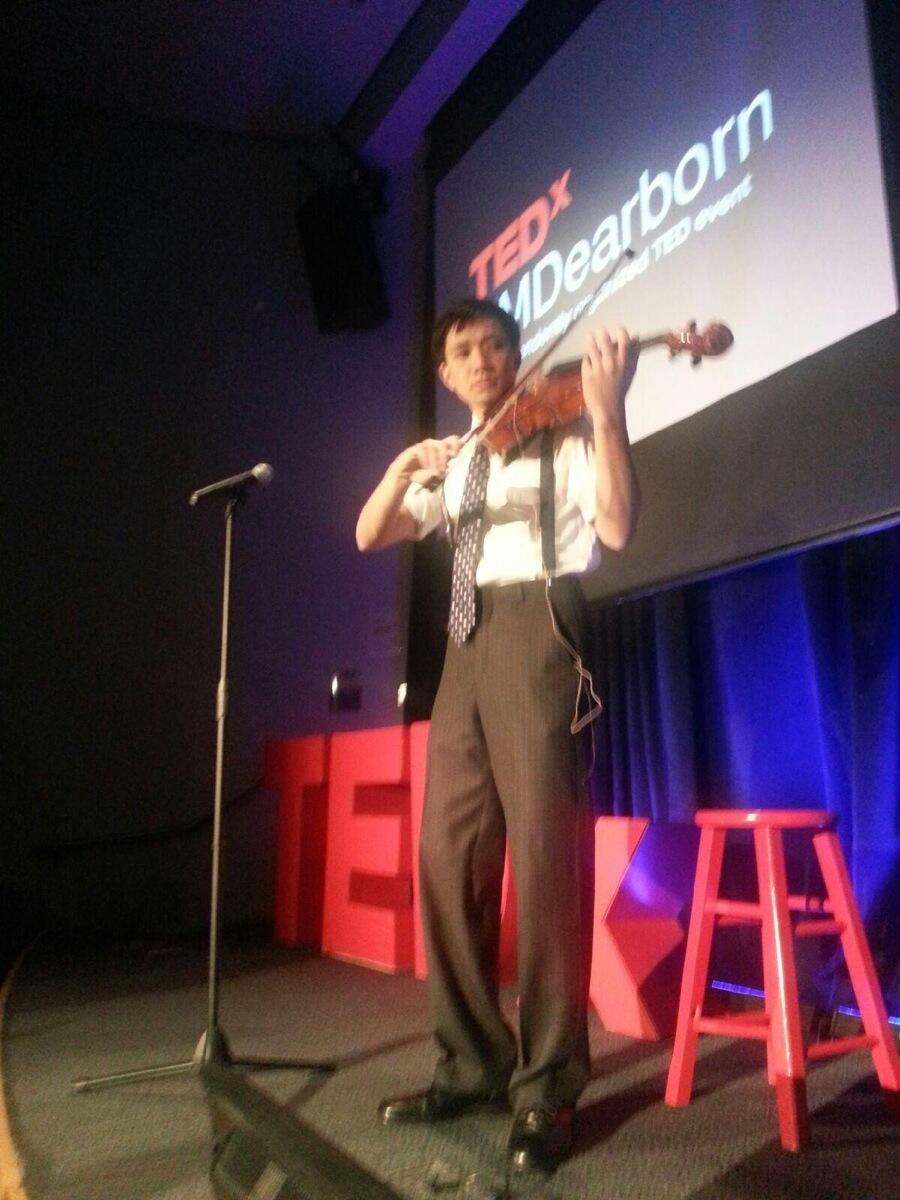
Yesterday I presented and performed two pieces for TEDX UM-Dearborn.  Here are my observations from the event:
Image credit to Greg Ezzo on Twitter

-As with every performance, I learn about who I really am in the moment from what I actually prepared and what I chose to use

-Virtue in performance (for what I mean, here's a statement on virtue in music): 
Everything I really prepared for came through fairly intuitively.  What I hoped but failed to thoroughly prepare for didn't manifest itself clearly when spoken under pressure.  I'll acknowledge that I didn't project my voice sufficiently too.

Granted, there were a fair number of curveballs thrown just before I got on stage:
I was asked to shave 5 minutes off of my time minutes before I walked on from a 12-15 minute timeframe, equipment wasn't readied for me to speak or play (amplifier and receiver was unplugged), and the timer was never started until I requested it about halfway through my set.  But what I've learned from this and previous trials and performances: you find yourself when you push yourself.  I learned on stage what exactly I had internalized and what I had yet to embody.  I'm certain learning to prepare for that better comes with time, additional exposure, and follow-through on not repeating the same mistakes.
My remarks were written in strategy language--they represented the content I sought to intellectually convey, but they didn't represent what I needed to say to human beings.  In my strategy work with the Ismotion/WorldByCycle team we've realized the same thing: every time we got stuck in crafting our business pitch, it was because we no longer wrote words that meant something to most English speaking human beings.  To bring stories to life, one needs verbs, not nouns to move us forward.


-I'm getting better at building emotional solidarity with audiences, but there's a threshold where the enthusiasm and emotion stirred up in my performance-presentations needs to match the integrity of the wisdom I strive to convey.  My intentions for the performance was to show that attendees had both a privilege and responsibility to take whatever they found inspiring or useful and share it with others.  At the same time, I hoped that bringing statistics about environmental health and air quality in Detroit/Southwest Detroit, and the "digital divide" (how the event required online applications in an area where digital literacy and access to the internet remains very low) would also spur lasting attention to bigger systemic environmental and digital justice issues.

-At an event like today's, innovations in emotional technology (how we get people to connect and humanely relate to each other) ought to be coupled with ethical intellectual food for thought of equal or greater quality as well.  I have an opportunity to educate a community.  Using new devices for engagement stays in the heart's memory, but sometimes a clear logical statement can help the mind stir the heart as people wind down from an event.  As a former debater, I know what a logical presentation and argument looks like.  While I wasn't at TEDX UM-Dearborn to debate, I did come with a message to assert.  I don't think it was done as clearly as I'd like, but I'm at peace with it for now.

I'm pleased to learn from various attendees who shared their thoughts (especially from Alex) that the concept of taking inspiration and carrying it forward beyond the event was clear.

-Seek out and listen to the people who didn't get your message(s)
Accolades and enthusiasms are wonderful and deeply appreciated, but in finding ways to refine how I communicate, it's best to engage those who didn't appreciate or grasp the points I hoped to convey.

-Prepare 2x more
For performance presentations that require solid grounding in data and ethics, it certainly takes twice as long to prepare.  In order to use the opportunity well, I need to do two things: Prepare the speech and practice the speaking/audience engagement, prepare the music and practice performing it too.

-That said, I enjoyed sharing it--in the future to prepare for events that charge a fee for attendees, I'll be sure to offer more opportunities to friends/the public for test-running my presentations/performances in progress.

-Unlike featured speakers for the event, I didn't have a dedicated speaking coach assigned to me and have yet to find one I'd trust on my own.  However, thanks to the generosity and attention of friends and the broader community, I was able to practice my remarks (a brief 3 minute or less speech), and sketch out how the presentation aspect blends into the audience participation & performance aspect.  

If you know what to look out for and can ask others to keep you accountable, it's possible to sharpen what you do without a professional coach.  I've been fortunate to have various professors, classes, and extracurriculars which helped hone what I pay attention to for better public speaking.  But without the keen attention, enthusiasm, and support of many friends and amicable acquaintances, I don't believe I'd have refined my message as well as I did.

Many thanks to Sara C., Megan M., Bear, Scotty, Thomas M., Marty S. and all those who shared their attention and insight.


Also: sometimes straightening out another person's collar when they're unaware can be as good as getting a hug from a dear friend.  I really appreciated Ryan K's keen eye in helping make sure I had my tie under the collar before I went onto state.

Pushups helped, I don't mind how odd it looks to others, I did a quick set of pushups a bit before going onto stage and it was worth it.

Friday, April 19, 2013

Buzzword or Fuzzy Concept?

I think people (especially the author of this "article") confuse buzzwords with "fuzzy concepts"--ideas or words that can mean a lot of things depending on who you are and what you know. But here's the good news: when you hold the people slinging these "buzzwords"--which may actually represent something transformative and invigorating or simply reflect superficial frenzied hype in our communication--accountable through intentional dialogue (yes, another "buzzword"), eventually you'll find common ground. That's the whole issue with sustainability: people say "we want a sustainable future" and don't actually want things to continue as they do. They want something better. I champion (another buzzword?) for comprehensive sustainability--which means it coheres social well-being along with prudent economic action and environmental integrity. Many people might assume sustainability means installing twirly CFL light bulbs to end anthropocentric climate change and recycling to solve all our other environmental challenges. It's a "wicked problem" or "wicked process".

For full link to above mentioned "article": http://www.deadlinedetroit.com/articles/4564/jason_lorimer_addresses_meme_without_actually_addressing_it

People seem take issue with not seeing the words he uses in the way that the community of foundations and community investment institutions do, but I suspect that's why he talks about dialogue and participation--so that everyone can find common ground and language to move together with. Pardon the contrary opinion, but I think Jason's statement is probably the most respectful approach to action: to explicitly declare actions beyond seeking participation and dialogue would be arrogant--he'd have to impose initiatives and look like he's doing so on behalf of Detroit. If people's participation and involvement are there, it's a bit simpler, but looking at his work, I think he recognizes that lasting change requires an inclusive co-creative approach. At this point figuring out sound actions probably matter more than imposing grand statements and agendae. For those whom the statements and agendae do matter, he's opened the door to discuss it and establish some degree of trust with them. That makes a lot of sense for the wicked problem/risk governance/democratic/restorative practice processes I've come across.

I've never met the guy in person, nor do I know his tendencies beyond the few items of information I've seen so far. That said, I don't think anyone's in a position to judge an individual in such a context. Have we had the opportunity to meet and maintain some degree of meaningful dialogue with the guy? Very few of us can say so. In sustaining our relationship with the person, is it possible and can we know whether our interactions have shifted their character and ideas over the course of a few years? People can change. Can you help highlight better paths for them to engage?

Yes, and for the sake of where and how we all live, I hope you'll strive to do so. Let's dialogue?

(buzzword?  I think not, link goes to a thoughtful definition posed by the Public Conversations Project.)

Tuesday, December 11, 2012

What would Colvin do? Go to Avalon.


Don't want to disappoint, don't want to freak you out. Don't want to resurrect all of your buried doubt. But if you wanna know where I’m going to: Avalon.
...
I leave you facing life--in the face of death. There is no deeper truth, there is no truer rest--Avalon.

-Lyrics to Storyhill’s "Avalon"

When relapsing into rougher states of morale, I frequently wonder “what would Colvin do?”  Marie Colvin was a journalist who was willing to die because she had a burning desire to tell the truth about other peoples’ suffering.  [I've written about this realization before in my musings about dour optimism]  She also understood the profundity of presence, and lived that wisdom.  She recognized and promoted the empowering participatory aspect of journalism:  everyone has the privilege of presence, and with social tools that most everyone can use like twitter for broadcasting information, we're even called to acknowledge our obligation and the power of our own presence as witnesses to misfortune, crisis, and tragedy.

I've seen and experienced beautiful and joyous stuff, witnessed significant events in peoples' lives and their communities.  I've also lived through terrifying realities, and helped other people literally survive amid disputes, gunshots, and beatings.

At this point, I question where the wisdom I once took comfort in recent months went.  At this point I can only look back at the year as a comfort which stems from knowing the extent of one's endurance.  As Bear Gryllis (whom I don't admire but can appreciate in some ways) had remarked: the only reward of hardship is pride.

So long as we're able to--and do--help others, we are rich.
In many ways, it's true:  We're privileged to share knowledge of rich places and people--but it's fleeting.  

Perhaps that's an aspect of life that the lyrics to Avalon captures:  amidst fear, we strive for a fantastic ideal that leaves us restless for so long as we live.

Tuesday, October 30, 2012

Keeping people cool during weather agitated by climate change

Mi (original post--names are shortened for confidentiality):
global warming my ass

Mar:
talk to the astronomy professor at UMD... the man is totally against this global warming nonsense. and yeah, that wind's a blowin out there

Me (Ian):
Hate to be that guy but I learned too much science to let this slide by:
Mar, most academic astronomers are theoretical physicists. They deal with mathematical models and rarely deal with real-life long-term biological and atmospheric systems (climate is not the same as weather--weather is a short-term occurrence). What people worry about is severe weather agitated by climate change and our possible effect on accelerating it. Any causal arguments about climate change that beguile people to say "it's not true" or "it's part of a natural cycle" don't hold muster to those literate with basic atmospheric science. For those seriously engaged in the atmospheric/environmental scientific and economic communities, the most important concern comes from the ethical consequences of inaction. New York city had 10,000 911 calls per hour last night, ten times above its average. People live in areas that are unprepared for severe weather. There are at least 16 deaths [edit Nov. 1st 2012: during Hurricane Sandy. {death toll in the U.S. and Canada as of today is 82, don't forget places in the Caribbean like Haiti got hit too, with approximately 71 deaths there.}], and this incident certainly will put a dent in coastal economies that weren't ready to deal with the damage.
For common [climate skeptic] arguments refuted with good research:
http://www.skepticalscience.com/argument.php
In some way, many people realize that the severity of the weather--and thereby, the death toll--can be mitigated or reduced through our actions, even those that can contribute to likelihood of future events like the weather.

I posted the above dialog because it lists what I think it takes to responsibly and civilly respond to a situation like this.

I think what most people involved with climate change advocacy really work on and worry about severe weather agitated by climate change.  I don't mind if a person's liberal or conservative, I believe our political choices are fundamentally motivated by a desire to live well--if not for ourselves, than for future generations (my father says he wants to vote for a candidate whom I disagree with because he thinks it's important for my future).

Could a responsible conservative who recognizes the national debt and deficit being on an unsustainable course justify financial apathy?  The same principle idea applies to environmental conservativism.  What I don't appreciate about most global warming/heating/climate change advocacy is that many people tend to articulate it in ways that disempower people, and in that capacity, distracts people from connected tangible and real issues of public health, environmental justice, and the problems that arise when considering the economics in context with the science and ethics (read here for an example).  Furthermore, many advocate from a position that bolsters defensiveness and entrenchment when education and compassion are most needed.


While brandishing sticks might be a valuable tool in policy, when it comes to interacting with conscientious people whom you rub elbows with in the community, I think the greatest privilege one can have, and the greatest respect one can extend to another, is through education that respects their own autonomy as individuals.  To my pleasant surprise, the reply from Mar was positive (liked it) and appreciative (Thanks for the comment!).