Showing posts with label appreciation. Show all posts

Monday, December 8, 2014

Art guidelines for the uninspired

"Artist friends,When you are feeling hopelessly uninspired (and frustrated/desperate enough about it to post a Facebook status asking for help), how do you fix it? Any and all advice appreciated." -K
I take comfort in the following guidelines when making art for myself. Hopefully they're useful in showing possible paths to making meaningful work for others and pulling the uninspired out of their ruts:

0) Approach art as a form of communication that stirs curiosity and wonder. Curiosity for yourself, or for others--it's up to you.


How? Choose one, some, or all of the following as a start:
1) suffer and/or empathize
2) explore, experiment, play
3) mix all of the above


0) Consider art a form of communication that evokes a deep curiosity—about yourself, about the world around you.
Do you have something to say or convey to the world? Make it so.


“Art ain’t about paint. It ain’t about canvas. It’s about ideas. Too many people died without ever getting their mind out to the world.” — Thornton Dial, SR.

1) Suffer or/and empathize
If you find nothing compelling within your imagination and memory, then expose yourself and empathize with genuine suffering or an injustice that can capture your heart's attention. OR re-imagine something familiar from a different perspective or through a different medium. It might be an analytic endeavor at first, but sometimes those will yield artful discoveries too. In any case, find the contents of a story worth telling/making/re-presenting.

In the sense of finding and creating stories worth sharing, good artful acts of creation can exist in conversation too.

2) Treat creating as an act of play or experimentation--where the process of exploration matters more than the outcome [1], then revisit with intention.

3) Sometimes, you'll mix all of the above, or discover integral themes emerge, or poetic parallels.I may hear a snippet of melody that compels me to experiment. At the same time, I may witness or work on something that galvanizes the idea in time with current events and overarching themes of human endeavor [2]. I then set out to bridge meaning between the two. Sometimes it's an organic blend from the start, others I force together before they melt into one, and sometimes, it's creation without attachment or any explicit meaning necessary.


Angular study in azure--familiar subjects and experimentation.

Compelling outcome? Perhaps not to most.

I did, however, learn that corners of rooms can be

interesting for experiments with image composition.
[1] I really enjoyed hearing Eric Gordon's characterization of play (where process matters more than the outcome) at the IADB's 2014 Demand Solutions summit in DC. Imitating play (whoa, meta!), by playing around with odd notes on a piano? Yes, you can do that too!

[2] Emotive Mechanics started with me pondering experiences in life, and then sitting down to improvise on a tune of mine as my mind processed the ideas (see video description for initial circumstance).

Edit: I recently read Sabina Berman's [most excellent] novel, "Me, Who Dove Into the Heart of the World" and really appreciate the notion of "letting the world think through you." That's exactly what I'd use as the core principle for the above: let the world think through you. That said, I believe my guidelines can remain useful for retroactively thinking about what you've done or getting into a frame of mind that allows creative processing.

Wednesday, February 5, 2014

Emotive Mechanics in East Detroit

Yesterday I met with an East Detroit school principal at his school. Few things ground human relationships like concern for the safety of people who have been harmed, and you could see it in his face as he spoke about the number one thing his students ask for help with: safety from violence in and outside of school.

You can read about that in the news or a policy report. Hearing it directly from Detroit youth, or taste gunpowder in the air from a recent shooting, and see it momentarily tug at a grown man's composure takes the experience to a different level.

The issue moves him and his staff, he's doing things to cultivate a culture of empathy and appreciation to help the most "at risk" youth in the school move forward from within and beyond the city. I call that emotive mechanics. We aim to change the way people look and feel about the world with tangible actions, but we're guided by a judicious mix of our own emotions and tools for making sense of the world. In that sense, we're emotive mechanics too.

Wednesday, November 6, 2013

[He]artful dialogue: Co-creating artful conversation with courage


New life-challenge: turn curiosity into courageous questions quickly.

Not so new but still challenging for me to do: elicit passion and wisdom from other people as soon as appropriate.

“Art ain’t about paint. It ain’t about canvas. It’s about ideas. Too many people died without ever getting their mind out to the world.” — Thornton Dial, SR.

Art, as I’ve come to understand, exists as a special form of communication. It’s communication that inspires a sense of wonder—a deep curiosity that has us ponder the encounter and ideas behind what we engage. It compels us to activate our curiosity as we wonder about the possible implications an encounter can have on our lives or the that of others.

I saw Thornton Dial SR.’s quote in the Smithsonian American Art Museum’s folk artist exhibit. It was liberating as much as it was validating: To make art, one requires no rigorous history of training, art degree, special materials or extraordinary circumstances to start. To me, Thornton Dial’s quote was an invitation to make whatever was on my mind if I so wished to do so. Better yet, it comforted me to know there’s boundless opportunity to share any idea, including those that can’t be experienced in writing. Perhaps what we have to share comes forth as good and beautiful. Whatever we choose to do, the act of honestly communicating our ideas certainly brings us closer to truth for our minds and hearts. Whenever that happens, it’s an invitation to live life artfully.

Looking at Mr. Dial’s quote again, it also applies to how I look at living life when speaking with and listening to people. There’s an art to good conversation and dialogue. If we consider Seth Godin’s distinction between the characteristics of work and art, artful conversation becomes a palpable ideal. Godin believes that work can be recognized as something people want to do less of, while art is something people want to make more. In that sense, we can all strive to make artful conversations. Both are important, good work can be necessary for creating better art.

.      .      .

I believe everyone benefits being in and moving from a place of passionate curiosity. Being as Rachel Carson describes, in a “sense of wonder”. When activated, it entices profound intrigue straight from the spirit. Whether mentally or physically, that place could be our own, among others, or perhaps better yet: shared. What matters most is that we speak with the flames of inspiration, those burning deeply from within our being to create that place.

If there’s dead space or if confusion nags at your attention in a way that prevents peace for everyone in the conversation, call it out and help shake things up. Time and life in the presence of another person are too precious an opportunity to squander. For anyone who grants me the privilege of sharing a conversation, this applies to us too. Call me out if I don’t do so first. Just because I’m familiar with the recesses of awkward pause doesn't mean I necessarily need or want us to stay there.

Perhaps the cost of very good conversation comes from committing yourself wholly to the people you speak with by thoroughly listening and keeping the courage to share what really matters to you. But do so in the greater interest of co-creating an enriching dialogue for everyone involved. Live boldly. Don’t be cautious, but be considerate with presence, intelligence, and equal heart. With this in mind, we can strive to create heartful conversations.

I’m still learning how to do so with excellence. But I like the idea that it’s an endeavor to live and share.

Sunday, October 20, 2013

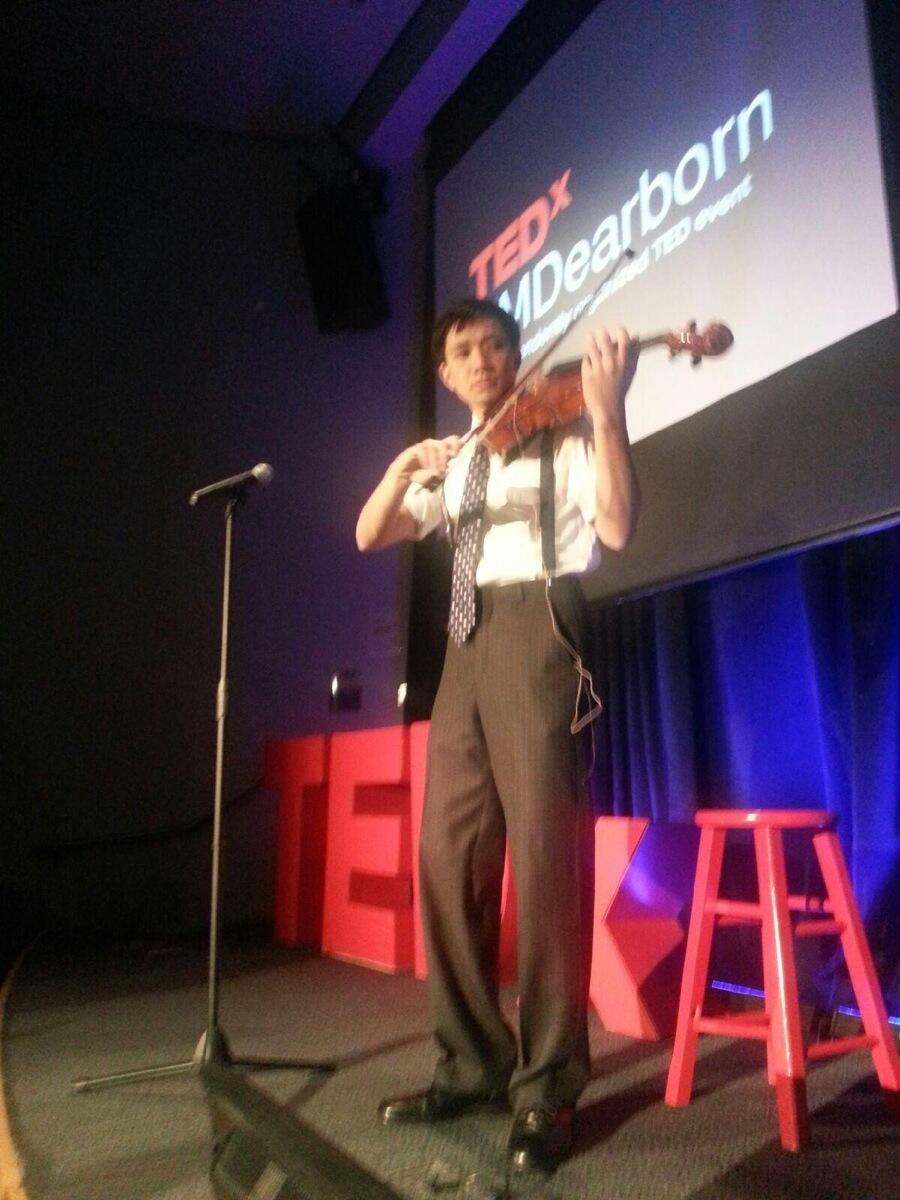
RAW REFLECTION: Post-TEDX Public Speaking

Yesterday I presented and performed two pieces for TEDX UM-Dearborn.  Here are my observations from the event:
Image credit to Greg Ezzo on Twitter

-As with every performance, I learn about who I really am in the moment from what I actually prepared and what I chose to use

-Virtue in performance (for what I mean, here's a statement on virtue in music): 
Everything I really prepared for came through fairly intuitively.  What I hoped but failed to thoroughly prepare for didn't manifest itself clearly when spoken under pressure.  I'll acknowledge that I didn't project my voice sufficiently too.

Granted, there were a fair number of curveballs thrown just before I got on stage:
I was asked to shave 5 minutes off of my time minutes before I walked on from a 12-15 minute timeframe, equipment wasn't readied for me to speak or play (amplifier and receiver was unplugged), and the timer was never started until I requested it about halfway through my set.  But what I've learned from this and previous trials and performances: you find yourself when you push yourself.  I learned on stage what exactly I had internalized and what I had yet to embody.  I'm certain learning to prepare for that better comes with time, additional exposure, and follow-through on not repeating the same mistakes.
My remarks were written in strategy language--they represented the content I sought to intellectually convey, but they didn't represent what I needed to say to human beings.  In my strategy work with the Ismotion/WorldByCycle team we've realized the same thing: every time we got stuck in crafting our business pitch, it was because we no longer wrote words that meant something to most English speaking human beings.  To bring stories to life, one needs verbs, not nouns to move us forward.


-I'm getting better at building emotional solidarity with audiences, but there's a threshold where the enthusiasm and emotion stirred up in my performance-presentations needs to match the integrity of the wisdom I strive to convey.  My intentions for the performance was to show that attendees had both a privilege and responsibility to take whatever they found inspiring or useful and share it with others.  At the same time, I hoped that bringing statistics about environmental health and air quality in Detroit/Southwest Detroit, and the "digital divide" (how the event required online applications in an area where digital literacy and access to the internet remains very low) would also spur lasting attention to bigger systemic environmental and digital justice issues.

-At an event like today's, innovations in emotional technology (how we get people to connect and humanely relate to each other) ought to be coupled with ethical intellectual food for thought of equal or greater quality as well.  I have an opportunity to educate a community.  Using new devices for engagement stays in the heart's memory, but sometimes a clear logical statement can help the mind stir the heart as people wind down from an event.  As a former debater, I know what a logical presentation and argument looks like.  While I wasn't at TEDX UM-Dearborn to debate, I did come with a message to assert.  I don't think it was done as clearly as I'd like, but I'm at peace with it for now.

I'm pleased to learn from various attendees who shared their thoughts (especially from Alex) that the concept of taking inspiration and carrying it forward beyond the event was clear.

-Seek out and listen to the people who didn't get your message(s)
Accolades and enthusiasms are wonderful and deeply appreciated, but in finding ways to refine how I communicate, it's best to engage those who didn't appreciate or grasp the points I hoped to convey.

-Prepare 2x more
For performance presentations that require solid grounding in data and ethics, it certainly takes twice as long to prepare.  In order to use the opportunity well, I need to do two things: Prepare the speech and practice the speaking/audience engagement, prepare the music and practice performing it too.

-That said, I enjoyed sharing it--in the future to prepare for events that charge a fee for attendees, I'll be sure to offer more opportunities to friends/the public for test-running my presentations/performances in progress.

-Unlike featured speakers for the event, I didn't have a dedicated speaking coach assigned to me and have yet to find one I'd trust on my own.  However, thanks to the generosity and attention of friends and the broader community, I was able to practice my remarks (a brief 3 minute or less speech), and sketch out how the presentation aspect blends into the audience participation & performance aspect.  

If you know what to look out for and can ask others to keep you accountable, it's possible to sharpen what you do without a professional coach.  I've been fortunate to have various professors, classes, and extracurriculars which helped hone what I pay attention to for better public speaking.  But without the keen attention, enthusiasm, and support of many friends and amicable acquaintances, I don't believe I'd have refined my message as well as I did.

Many thanks to Sara C., Megan M., Bear, Scotty, Thomas M., Marty S. and all those who shared their attention and insight.


Also: sometimes straightening out another person's collar when they're unaware can be as good as getting a hug from a dear friend.  I really appreciated Ryan K's keen eye in helping make sure I had my tie under the collar before I went onto state.

Pushups helped, I don't mind how odd it looks to others, I did a quick set of pushups a bit before going onto stage and it was worth it.

Sunday, October 14, 2012

Good Grief (in a truer sense)

Grief is a profound iteration of humane appreciation.  A friend of mine called me this past weekend to tell me that his mother suddenly passed away.  I could tell he was really shaken by her death.  While he brought the conversation to lighter notes toward the end and we hung out a few days later discussing gentlemanly adventures in literature and existentialism, his wavering voice from the phone call lingered in my memory throughout the week.

I never met his mother, and we actually only hung out a handful of times, but I really appreciated that he reached out to let me know about recent developments in his life.  I also think the things we appreciate about people are things we can strive to hone and exemplify in continuation of the legacy that individual had created.  If we trace our influence from mourning far enough back, it's a legacy of our deeper humanity which we really perpetuate.

Monday, April 23, 2012

Marie Colvin, biology, and the dour optimist. [Hooray!]

Marie Colvin
Marie Colvin (1956-2012) with John Le Carré at the presentation of the Martha Gellhorn Prize, May 2010. (Image from the Martha Gellhorn Prize site)
I'm not sure why I regularly worry about issues far beyond my regional geography and connection, but knowing that some people die because they have a burning desire to tell the truth about other peoples' suffering is thoroughly sobering.

To my knowledge, I've not examined any of Marie Colvin's work, but Colvin was awarded the Martha Gellhorn prize for journalism. The Gellhorn prize "challenges secrecy and mendacity [lies] in public affairs" and "raises 'forgotten' issues of public importance, without fear or favour." (Aside: Gellhorn had a really interesting life too, I live similarly to how she did)
I noticed Colven on the Gellhorn website Saturday (when I started writing this post), and that she had an eyepatch--the result of a rocket propelled grenade intentionally fired at her in Sri Lanka--and that she was killed in Syria this March according to the Guardian UK.

There's a conflicting account about how she died on wikipedia, but in the spirit of her interests, that shouldn't matter--Marie's a strong woman worth knowing about in any case and a killing of this kind is still an injustice.  What strikes me about her is that she's way under the radar, but I think her efforts are as heroic as many noted civil rights activists like Dr. Martin Luther King Jr.

On Biology and Compassion