Showing posts with label contemplation. Show all posts

Wednesday, December 2, 2020

Going to be: Heart Sutras, Enlightenment and Bizaan'imin

Been slowly returning to parts of myself that I let go of and thinking about this beatboxing monk and his stuff lately among other things. Enjoy.


Related (and partly copied/pasted from the comment section) too:

To me, wisdom is about reliable truths. What makes a lot of zen/buddhism [in general] challenging is they speak more to arriving at a sort of ideal state of "being" and leave it to folks to "be" there in whatever way they find themselves. Peace happens whenever we realize our ability to take genuine action in and from a place of love. This includes taking genuine action to surface, embrace, and transform conflict. It also includes the ability to simply be in and from a place of love.

For that last one, which I often found challenging, there's an Ojibwemowen word 'bizaan' that roughly translates to sitting in quiet/tranquility/calm/peace which really helps make a way for arriving at that ideal outcome of "just being" seem a bit more feasible than just suddenly "activating" or "achieving enlightenment" as it's often portrayed.

Some folks who study buddhist logic will say are 5 sorts of logical states--a thing can be:
1. true,
2. false,
3. true and false,
4. neither true nor false,
5. or undefinable because language+thought limits our ability and skews our paradigms for perceiving things as soon we try engaging with them

Being at peace and presence with those, especially that last notion, basically sums up the chunk of text below and what it's like to experience it even as a moment for me:

"...whatever son or daughter of the lineage wishes to engage in the practice of the profound perfection of wisdom should look perfectly like this: subsequently looking perfectly and correctly at the emptiness of inherent existence of the five aggregates also. Form is emptiness; emptiness is form. Emptiness is not other than form; form also is not other than emptiness. Likewise, feeling, discrimination, compositional factors and consciousness are empty. Shariputra, like this, all phenomena are merely empty, having no characteristics. They are not produced and do not cease. They have no defilement and no separation from defilement. They have no decrease and no increase. Therefore, Shariputra, in emptiness there is no form, no feeling, no discrimination, no compostional factors, no consciousness. There is no eye, no ear, no nose, no tongue, no body, no mind, no form, no sound, no smell, no taste, no tactile object, no phenomenon. There is no eye element and so forth, upto no mind element, and also upto no element of mental consciousness. There is no ignorance and no exhaustion of ignorance, and so forth, upto no ageing and death and no exhaustion of ageing and death. Likewise, there is no suffering, origin, cessation or path; no exalted wisdom, no attainment and also no non-attainment. Therefore, Shariputra, because there is no attainment, all Bodhisattvas rely on and abide in the perfection of wisdom; their minds have no obstructions and no fear. Passing utterly beyond perversity, they attain the final state beyond sorrow...." -Youtube comment by Dak pinned to the page

Wednesday, February 20, 2019

Iterations of grief and intentional gratitude

Grief is a profound iteration of gratitude that entails latent recognition of unidentified or yet to be realized loss which leads to mourning within oneself and/or a community.

Guilt can be a kind of grief where the wrongdoing in the absence of action or trespass of one's values entails a profound sense of loss to oneself and those the guilty individual may have (or may not have but perceived to have) harmed. Guilt is a form of grief over an action that the individual or community perceives as "wrong"...

Shame is a kind of guilt that happens as a kind of loss of connection to one's sense of self. It's often characterized by the sense that there's something deeply (harsh personal narratives might even say irreparably) wrong with who the individual is as a person by essence of their existence. Maybe shame is also a sign of blind self-grief. That blindness is what perpetuates a toxic negative feedback loop -- ergo my expression that "shame is the leukemia of mental health." when left in isolation without supportive signals that help ashamed individuals see qualities of their truest selves more completely in healthy light.


Yet what is "wrong" and what would be good in contrast to it?

Adopting a significant part of Aldo Leopold's maxim in his Land Ethic essay, I characterize as follows:

A thing tends to be good when it tends to preserve and advance the beauty and integrity of the biotic and abiotic community.
[biotic = living organisms, abiotic = non-organisms like rivers, mountains, rocks, etc.]

So "wrongs" are only useful insofar as they are used to guide us toward what typically will preserve and advance the beauty and integrity of the communities we live with--and since we are integral to those communities, it means "wrongs" must also preserve and advance our own beauty and integrity with respect to the communities we live with as well.

Beauty was a tricky thing for me to grasp, but thanks to a Kyudo demonstration and talk from two Japanese exchange students studying in Hawaii, they've illustrated a fundamental trio of Eastern concepts used in the martial art and even in my mother's line of family members:

Zen, Bi, Shin
Truth, Virtue, Beauty
In that sequence. Begin with truth. It can be a challenging and messy process, but committing to finding the "correct" or "good" form and developing a consistent relationship with goodness brings us into virtuous practice. Beauty emerges from recognizing the complete relationship between truth and what makes finding truth consistently a process. As a relationship, we then create the possibility for ethical consideration to exist--how we might improve our relationship with a truth using systemic processes for discerning and replicating "goodness" as guidance--in other words, we apply an iteration of science to our existential endeavors.

Recognizing the complete arc of truth, virtue, and beauty is the process for realizing grace. How elegance can manifest from the mundane.

Wisdom comes from our reliable truths. It's an incarnation of beauty that comes from a place of intelligence be it cognitive, kinesthetic, intergenerational, or otherwise.

Gratitude as I practice it comes from choosing to acknowledge something from an experience and/or relationship as an endowment--a gift, considering what that quality says about the situation/individual from a place of appreciation, how it brings out something genuinely worthy of appreciation in me, and expressing it in a way that's meaningful, hopefully relevant and visceral to all parties concerned.


I'll link back to older posts, but I'm glad to know and share that there's an arc toward healing and I've been able to document much of it over the past few years.

If you've the time and interest, go ahead and search this blog for the following keywords:
[good grief]
[shame: the leukemia of mental health]
[an emotional list + etc.]
[coping with tragedy -- gratitude exercise embedded]
[zin bi shin, kyudo]
[grace]

Be well or on the path to better, onward.

Sunday, February 1, 2015

An emotional list

I started looking at mental health and some emotional states like habits--we don't always notice when we start doing things, and left to its own or when isolated, the mind has its own tendencies too.

Hope can be found in knowing how to change habits, and in creating a clear vision for a healthier and more desirable way of being.

Aside from this guide for coping when isolated or among others, the following are possible first steps for recognizing what you might experience and how to shift out of it in-the-moment. Longer-term changes can come from changing your environment and how you're supported in pursuing better habits, as well as from shifting how you perceive your environment and actions.

Anxiety - focus/isolate attention to very simple sensation & senses--concentrate on one sensation or stimulus at a time and selectively add/reduce what's going on around you, try to embrace something
[rampant, toxic] Shame - make the suffering tangible and put it into context with something worthwhile; reconnect with people who can help you do so/help see yourself more completely
Depression - push yourself/reconnect with what matters

[for the above three, the following cycle and long-term intervention objectives  to prevent them from consistently feeding into one another. Note that other loops and cycles may exist with any of these mental states/emotions too, I'm only familiar with the above.]

Grief - deep gratitude
Unrelenting Anger - focus it toward constructive/disruptive engagement, energetic outbursts, seek humbling
Fear - (how to distinguish from anxiety?) what is the courageous choice? Acknowledge heightened body function as aid/reframe as excitement, accept and focus on overarching intention/purpose

Dead numbness/emotionally hollow - *?
Breathe sharply and deeply, note Sabina Berman's passage (last three paragraphs of p. 239 "I am Me, but what's new is that I am..." -240 "Which means, plug back in to the real world with every sense" below),
push yourself/try these (among the simplest: seek healthy sources of pain, physical activity, try to activate empathetic thinking and if/when possible, actually empathize)
[*I'm still figuring this out]

A few overlapping areas I've yet to sort out:
Inert/indifference/apathy/definite lack of clarity or recurring uncertainty/ambiguity - commit to something aligned with higher intentions and dive in.
Despondent - see above + depression


(images above: excerpted pages 338-341 of "Me, Who Dove into the Heart of the World" by Sabina Berman)

Tuesday, January 6, 2015

Coping with various degrees of agency

One thing I was reminded about myself last year: when unmet with care, mental health challenges can link closely to abuse, it's actually more subtle and prevalent than the public (even most people I know) make it out to be, and most people are less competent at intervening with detrimental behavior than they'd like to acknowledge—even when it’s their own behavior.

It's sometimes upsetting, but it’s somewhat comforting to know overwhelming suffering isn’t the same as unbearable suffering. You’re cognizant of overwhelming suffering—frustration, anger, fear, anxiety, apathy—you can observe it come and go. If you're at the brink, it's a good time to call anyone for help.

When something's overwhelming yet bearable, the line between what we're able to withstand versus what we're willing to tolerate blurs. At that point one compromises their own quality of life, and in a terribly negative feedback loop, it also takes down others', which tends to make their situation worse.

The guide linked below's helpful for roughly recognizing and coping with some behaviors, but it's missing some nuance and 40% of it feels condemning still--maybe because it focuses on what behaviors fail to fit with a "normal" or "healthy" individual rather than how those behaviors might be exercised to an advantage, and acknowledge that choosing to work through mental health issues is a healthier choice. In October I concluded (but in some part refuse to accept) that some things don't ever really heal, we just get better at managing circumstance and how we respond to suffering until we reach the end of our line. Failures and suffering are inevitable, but you can make them necessary to your life's path and fail forward—fail in a direction aligned with your most genuine aspirations.

The best tweaks for reactively handling stress I can share tend to be (listed from simplest/smallest and most desperate starting point to most significant):

1) Find presence/regain clarity of mind and attention by doing simple things that engage your senses (touch/motion, sound, smell, etc.)

e.g. feel pain (a safe alternative to harming oneself: eat a lot of hot sauce, quickly), try to hold something/someone tightly, cook, garden/farm, do dishes by hand, create music

2) Find your "flow states" and do what's needed to get there--things that immerse and engage your attention in ways that you lose sense of effort, time, and self (aka, get "into the zone" athlete/musician/artist/dancer/physicist etc.)—create the environment or circumstances necessary for you to get engaged to re-stabilize.

3) To alleviate anxiety and nerves and increase your capacity to cope with stress, push yourself through intense if not stressful situations (especially exercise and intensive work) earlier in the day, and devote time to de-escalate from them (intentional breathing/meditate, read a paper book, hike slowly outdoors, etc.)

4) Find and let yourself fail safely in the presence of caring (actually, if possible loving--in the sense they're willing to help you be at your best or celebrate you as you are if you're already living as yourself at your fullest) people (or animals) to talk it/feel it through with, or at least knowing that they're present, so it can help you re-examine the parameters and mechanisms of your own mental threshold.

"Courage cannot be taught, but when it’s scaffolded, it’s encouraged."

5) Redirect your own awareness of anger/anxiety/sadness/apathy toward preventing recognizable circumstances that contribute to other peoples' or your own unnecessary suffering

http://www.nami.org/Content/ContentGroups/Programs/Family_to_Family/PTSD_Module_Pevised_Feb_2011.pdf

Note: The five points are also listed for starting in situations where one might have little agency for leaving their surroundings (e.g. isolated.stuck) to situations that allow more time, attention, and space with various privileges or luxuries assumed (e.g. if you're fortunate to have people you can trust). #4's particularly rare and most challenging to find for me--I'm basically resorting to #5 in hopes of creating #4.

Sunday, October 20, 2013

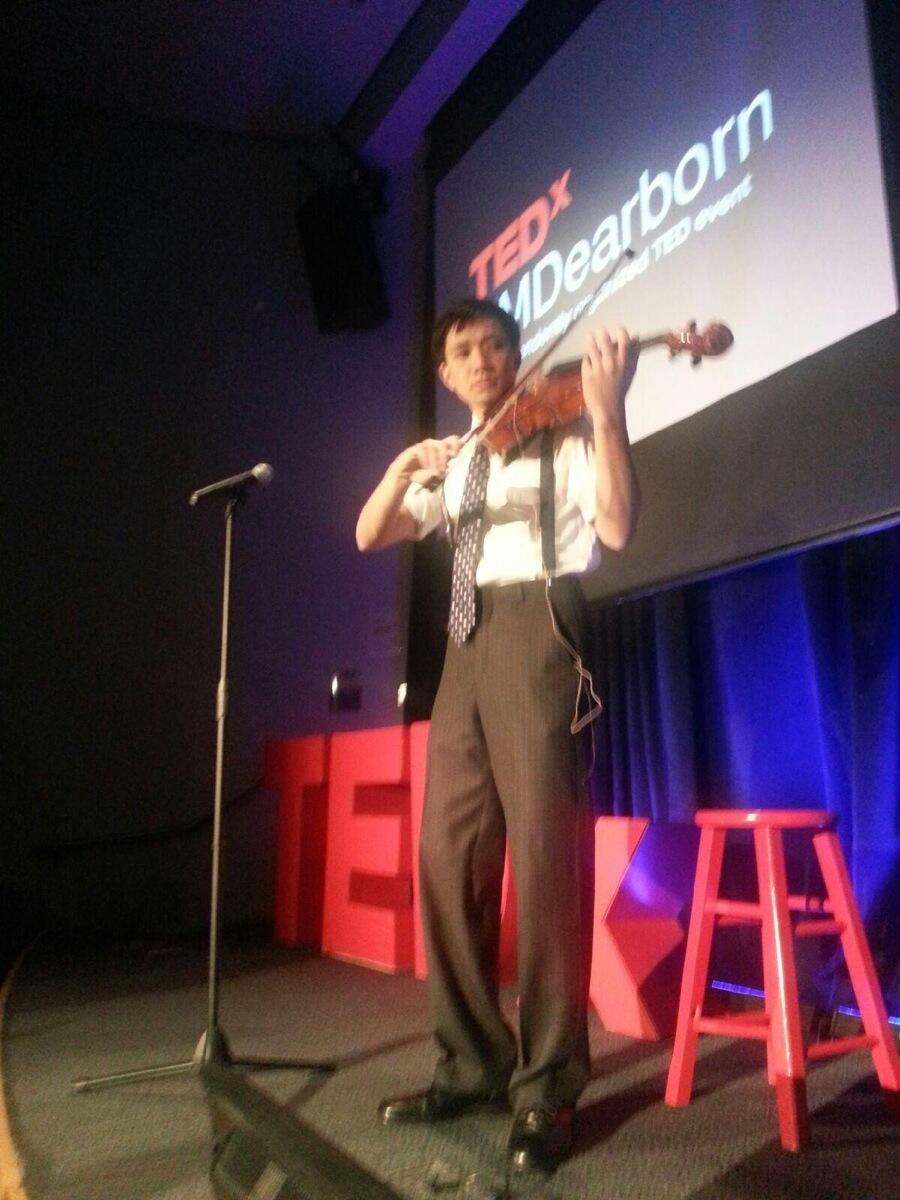
RAW REFLECTION: Post-TEDX Public Speaking

Yesterday I presented and performed two pieces for TEDX UM-Dearborn.  Here are my observations from the event:
Image credit to Greg Ezzo on Twitter

-As with every performance, I learn about who I really am in the moment from what I actually prepared and what I chose to use

-Virtue in performance (for what I mean, here's a statement on virtue in music): 
Everything I really prepared for came through fairly intuitively.  What I hoped but failed to thoroughly prepare for didn't manifest itself clearly when spoken under pressure.  I'll acknowledge that I didn't project my voice sufficiently too.

Granted, there were a fair number of curveballs thrown just before I got on stage:
I was asked to shave 5 minutes off of my time minutes before I walked on from a 12-15 minute timeframe, equipment wasn't readied for me to speak or play (amplifier and receiver was unplugged), and the timer was never started until I requested it about halfway through my set.  But what I've learned from this and previous trials and performances: you find yourself when you push yourself.  I learned on stage what exactly I had internalized and what I had yet to embody.  I'm certain learning to prepare for that better comes with time, additional exposure, and follow-through on not repeating the same mistakes.
My remarks were written in strategy language--they represented the content I sought to intellectually convey, but they didn't represent what I needed to say to human beings.  In my strategy work with the Ismotion/WorldByCycle team we've realized the same thing: every time we got stuck in crafting our business pitch, it was because we no longer wrote words that meant something to most English speaking human beings.  To bring stories to life, one needs verbs, not nouns to move us forward.


-I'm getting better at building emotional solidarity with audiences, but there's a threshold where the enthusiasm and emotion stirred up in my performance-presentations needs to match the integrity of the wisdom I strive to convey.  My intentions for the performance was to show that attendees had both a privilege and responsibility to take whatever they found inspiring or useful and share it with others.  At the same time, I hoped that bringing statistics about environmental health and air quality in Detroit/Southwest Detroit, and the "digital divide" (how the event required online applications in an area where digital literacy and access to the internet remains very low) would also spur lasting attention to bigger systemic environmental and digital justice issues.

-At an event like today's, innovations in emotional technology (how we get people to connect and humanely relate to each other) ought to be coupled with ethical intellectual food for thought of equal or greater quality as well.  I have an opportunity to educate a community.  Using new devices for engagement stays in the heart's memory, but sometimes a clear logical statement can help the mind stir the heart as people wind down from an event.  As a former debater, I know what a logical presentation and argument looks like.  While I wasn't at TEDX UM-Dearborn to debate, I did come with a message to assert.  I don't think it was done as clearly as I'd like, but I'm at peace with it for now.

I'm pleased to learn from various attendees who shared their thoughts (especially from Alex) that the concept of taking inspiration and carrying it forward beyond the event was clear.

-Seek out and listen to the people who didn't get your message(s)
Accolades and enthusiasms are wonderful and deeply appreciated, but in finding ways to refine how I communicate, it's best to engage those who didn't appreciate or grasp the points I hoped to convey.

-Prepare 2x more
For performance presentations that require solid grounding in data and ethics, it certainly takes twice as long to prepare.  In order to use the opportunity well, I need to do two things: Prepare the speech and practice the speaking/audience engagement, prepare the music and practice performing it too.

-That said, I enjoyed sharing it--in the future to prepare for events that charge a fee for attendees, I'll be sure to offer more opportunities to friends/the public for test-running my presentations/performances in progress.

-Unlike featured speakers for the event, I didn't have a dedicated speaking coach assigned to me and have yet to find one I'd trust on my own.  However, thanks to the generosity and attention of friends and the broader community, I was able to practice my remarks (a brief 3 minute or less speech), and sketch out how the presentation aspect blends into the audience participation & performance aspect.  

If you know what to look out for and can ask others to keep you accountable, it's possible to sharpen what you do without a professional coach.  I've been fortunate to have various professors, classes, and extracurriculars which helped hone what I pay attention to for better public speaking.  But without the keen attention, enthusiasm, and support of many friends and amicable acquaintances, I don't believe I'd have refined my message as well as I did.

Many thanks to Sara C., Megan M., Bear, Scotty, Thomas M., Marty S. and all those who shared their attention and insight.


Also: sometimes straightening out another person's collar when they're unaware can be as good as getting a hug from a dear friend.  I really appreciated Ryan K's keen eye in helping make sure I had my tie under the collar before I went onto state.

Pushups helped, I don't mind how odd it looks to others, I did a quick set of pushups a bit before going onto stage and it was worth it.

Friday, June 7, 2013

Resilience: a function of strength and commitment?

Perhaps a truer test of strength comes from resilience.  It's an act of strength through fortitude.  In times of duress, we learn most from our body, mental acumen, character, integrity of the team, community, etc.

Surges in our strength can surprise us when considering our momentary capacities to handle a situation, but our sustained commitment and endurance allows us to glean a more authentic understanding and confidence for ourselves.

Friday, April 12, 2013

Last week I briefly attended an event held at the N'Namdi gallery by artist ____ fleur, who discussed how the future of Detroit's aesthetic will likely move from a grungy/gritty presentation to something brilliant and colorful--she pointed to traditional African aesthetics, and even the diversity of existing architecture in Detroit.  I used to think about parallels between abuse and the Detroit aesthetic--its music, a lot of its art, the stories in the news.  There's something about some people who experienced deep and sustained harms where we find an attitude that's a mix of resilience and a weary-worn frankness.  Sometimes, an element of guarded shame stands as a likely possibility.  It's often comfortable to recognize it.  You know you're at peace in their company but there's a certain darkness to how they live--unanswered or seldom explored questions remain like mysterious gashes:  no one can tell whether they're still wounds to be healed or closed scars, and we've either developed habits for moving in ways that don't aggravate them, or are too afraid to move any further.  Knowing that a lot of media and negative imagery already exists for both, I never expressed it to anyone before.

However, I happen to know several people who endured sustained abuse, sometimes terrifying in its truest sense, who can embody the most vibrant aspects of life.  They often define what's possible for living in a better world, or demonstrate how to carry on by living amid its realities.  In spite of misfortune, they continue, we live well.  I also had the privilege to know so many brilliant people who know Detroit as their home do brilliant things.  Their actions and the communities they create exist as the tinder and fuel aflame--the growing feathers of a phoenix--through which the city finds itself amid its ashes.  While I've been through gunshots on the East side, I've also been to the Alkebu-Lan Village which soon celebrates a 35 years of exceptional karate in Detroit and sustained community enrichment that's drawn the attention and admiration of companies known for their mid-town investment presence like Quicken Loans.

Stigma in mental health and Detroit in the media

Spurred by comments on this: https://www.facebook.com/LiteraryDetroit/posts/446844592058214

Going back to the idea of parallels in mental illness and community: In a lot of ways, the negative media and identity stigma that many Detroiters loath mirrors the same imposition of identity a person undergoing mental health challenges meets when labeled with a certain disorder/illness.  Identity becomes objectified by another, opportunity for change is denied in the reality constructed by those who impose/accept it as such.

Wednesday, March 20, 2013

Wisdom to be

Wisdom as it is.

I recently gave feedback on the draft speech of a fellow social entrepreneur who was invited as a keynote speaker for the Jane Goodall Vision 2020 symposium.

While I won't be there for the symposium (it's in Australia), I can imagine the following for events of this caliber and magnitude:  people are privileged to attend, and the event organizers bring in some of the best speakers they can find to leave all their attendees charged with the finest of rekindled hearts and solid wisdom.

While I was more or less familiar with various strategies she explores in her speech, I'm starting to realize how tremendous an opportunity it's been to have access to her speech and organization: due to the nature of the organization's programs, I've been privileged to learn about some of her organization's deepest challenges in ways that most people would never imagine possible for someone working with it in such a short amount of time.  I know that in some way, the things they might have struggled with are the very same things I struggle with too.  They probably boil down to very simple (but tremendous!) things that were affirmed at the end of her speech: perseverance, commitment, and belief in your own success before you begin.

If you're left with the same things you had questioned before, it's time to get moving--sometimes you must live to understand them, rather than know them to live.  Some ideas retain resilience even when we don't feel we have a complete grasp of reality or the concepts in our minds.  Those come from learning by undergoing the most trying challenges of fully living our lives.

Heed your vision to find your bearings before committing, keep your eyes open, and dive in

Saturday, March 2, 2013

An integrative cognative disposition

Despite my efforts to frequently communicate complex ideas in derivatives.

This is what I call the application of "life-calculus".  I'm adopting a mathematical sense of derivative toward language: i.e. tweet-sized statements and one-line assertions which preserve the integrity of complex systems--i.e. the 30 second soundbite in the news which represents a complicated 5 year process of international negotiations fairly accurately.  If you derive too much--as in, try to find meaning in something that's been simplified too much--we get past a strange and confusing existential threshold where we can no longer answer "why does this matter?" with satisfaction.

I currently tend to think in integrals and then need to derive essential meaning from them to comfortably communicate in concise statements among others.

I, and I suspect most people are too, am at a point where it's a matter of knowing the appropriate scale to engage another person with a concept or an idea.  We're intelligent, possibly very good at knowing what to say, but give the boiled-down derivative answer and someone's liable to take it as fact and move on.  Give the full story--a complete integration of information--right away and you're likely going to lose their attention and you'll probably lose your breath from trying to say it--even for those who care.  Thus, I try to respond with a mid-range answer that integrates what they ask for.  In many cases, it's a bit too much. But in accord with my "youth verbose" strategic resolution, I'm willing to make that my typical disposition (though not without concern) since it seems to me that many people take information consumptively and for granted.  In some ways, it's an invitation to re-examine what I say.  The challenge comes from doing so in a pithy and concise manner regardless of the scale...

#00:39 16 III 2013

Wednesday, January 23, 2013

Life and the Life Sciences Orchestra

Hi Sharon,

There's one more thread of thought I'd like to share about the program and my experience with the LSO and how it can relate to audiences. Even if the article will be printed tomorrow without it, I think it's important to share as it adds some depth to what I was trying to capture in our conversation yesterday.

In essence: we're privileged to discover glimpses of what drives the nexus of art and science, and we have the opportunity to experience profound reminders about the nature of life as part of the symphony.

I vividly remember one of the French Horn players rushed out of rehearsal to attend to one of his patients during rehearsal this season. Last year in the summer, our piccolo/flutist passed away after a long grapple with breast cancer and chemo therapy shortly after performing in the spring concert. Our director, Oriol Sans, sent the following letter to members of the symphony:

"At this moment I want to share a few words with you. Last week I went tosee Lisa at the hospital, and it was an experience that I will neverforget. The open and honest way she talked about her cancer and what wasgoing to happen to her, made a deep impression on me. Among other things,she told me that for the last year music made her forget about all thehealth problems she was going through. Music didn't cure her, she said, butit helped her to get through that.
I told her what a great example she was for all of us. She came to ourrehearsals with a crutch, without it, with a wig, without a wig, with longhair, with short hair... But she was always there, and I never heard asingle complaint from her. Until the very end, the illness never stoppedher to do one of the things that she most loved: making music. The sameweek of our last concert she didn't agree to a last round of chemo untilthe doctors promised her that she would be ready to play for our dressrehearsal and the concert.
I think that I can speak from all of us when I say that seeing her examplewas truly a gift. I am glad that my last words to her before I left herroom at the hospital were thank you."
Medicine and health care are intimately connected tied to the life and environmental sciences. Given that the causes of cancer are an interconnected mix between genetics, diet, and environmental factors ( http://www.niehs.nih.gov/health/materials/cancer_and_the_environment_508.pdf ), the past experiences are a reminder to me about some of the people and things we love and strive to creatively improve about the world we live in.

One last note: Curiosity and experience drive the arts and sciences alike: "The most beautiful thing we can experience is the mysterious. It is the source of all true art and science." - Albert Eistein

As mentioned in the program notes written by Oriol for our upcoming concert, the Mahler symphony was deeply influenced by themes from nature and our relationship with it--it features bird calls (of a cuckoo) in its opening movements, and the story of a hunter's funeral--attended by animals. Shostakovich's Festival Overture was performed as a fanfare for the 2009 nobel prize. The LSO presents an opportunity for audiences and participants alike to entice a shared sense of wonder.

Thank you again for sharing your time to consider my thoughts, I hope I was able to share this in time with you.

All the best,
Ian D. Tran

---
B.S. Environmental Science, Political Science Minor Class of 2012 The University of Michigan-Dearborn

Wednesday, January 9, 2013

Mandatory Compassion

What's the difference between compassion and love? When does compassion become mandatory for good character? I started exploring those questions through this tune and the stories behind it. [Edited: 19 IX 2013]

Willie (in reply to a complement about him as a tremendously compassionate person): "Ian, I appreciate that.  I'll humbly accept that, but in some ways I didn't have a choice--you know how my life's been..."

Some people become notably extraordinary in response to or as a product of extraordinary circumstance and exposure.  He had gone to prison three times, and started turning his life around through his determination to be who he knew he was capable of becoming--a better person and an artist.

If you get a chance to hear to his story there several key moments during his final time in prison:
1) choosing not to eat meat (at a time when vegetarian options were almost non-existent) while in prison as a way to prove he had control over something in his life
2) one night, a neighboring cell mate who had a reputation for drawing passed one of his pieces over to one of Willie's cellmates, and from then forward he knew he could draw and started sketching
3) seeing the sense of peace that painting brought to one of the inmates
4) a moment where another inmate noticed he was drawing and sat down to show him how to draw with three dimensions for about 5 minutes

He ended his addiction to drugs and later earned his GED, then a college degree, ran 3 Detroit Free Press marathons, and worked at the University of Michigan-Dearborn Wellness Center for a little over 20 years before retiring early to live the wisdom he preaches and pursue his art with greater focus.

It's important to acknowledge that his addiction had negative impacts for other people beyond himself--and that's at the core of his statement "but in some ways, I didn't have a choice--you know how my life's been..." He'll be one of the first to acknowledge and warn people about addiction and the realities of prison and its role in criminal justice. At the same time, he also understands that many of the events which led up to addiction could have been circumvented in many ways--whether it was through the attitudes instilled in him by others as a child to having an earlier exposure to healthier and creative means for expression.

Willie has been a mentor and a champion for my own efforts.  I learned so much about compassion and artistry from sporadic visits with him in the past year as he Worked at the Wellness Center--sometimes just from watching him sketch as he told some of the stories I shared above. Or by the way he remained relentless about encouraging me and finding opportunities that could advance my musicianship even as I focused on other kinds of work.

Willie attributes the magnitude of his compassion in large part to his experiences, though I could say there's a fair amount of credit due to his character and commitment too.  His life story's tremendous, and I wish more people have met him or can spend time with him to learn about it firsthand.

However, through his reply to my appreciation for what he does and how he lives, I realized he noted a distinction in gauging one's character: there's more to being and becoming a great person than just meeting circumstance with magnanimous compassion.  Perhaps actively seeking opportunity to help others becomes the next distinguishing gradation in our humanity.  While it's something both Willie and I do, the extent of which that it happens as a regular basis is something new for me to focus on.  Not necessarily because I didn't care about or didn't do it before, but because I hadn't seen life with this degree of clarity until I meditated over Willie's reply.

Another question arises about actively helping others: at what point do we let another person be as they are?

Perhaps it behooves us to examine a maxim of life:  be as you are unless you yourself find compelling reason to change.   I suspect many try to live by it, yet what does this maxim say about our relationship with other people?  A distinction and balance exists between seeking--active, and intentional form of aid--to help and helping as an outcome of a reactive/passive or perhaps something simply receptive to opportunity.

I'm still exploring this concept, and I've also titled a new piece "Mandatory Compassion" based on this conversation.

Start 9 I 2013, # 12:24 pm 18 I 2013

.  .  .

I've since realized the difference between love and compassion.  Love is a proactive endeavor which exists in the interest of helping others be at their best.  Compassion tends to be reactive and circumstantial.  We may help others upon recognizing some need that can be met, but if not, we might empathize for a moment and move on. I also attribute some of this to sharing lunch with a homeless man, Mr. Westberry, at a time when I just happened to have enough extra food to share a hot meal during a very cold December day in Ann Arbor.  That event ran through my head as I started playing the opening notes of the piece, and Willie's conversation versus my encounter with Mr. Westberry galvanized concept behind this title.  [#edited 19 IX 2013]

Friday, December 21, 2012

You, simple questions, squirm-worthy discoveries

I'm starting to suspect iterations of good personal questions also make good interview questions: they challenge your character and if you're unprepared, you're challenged to truly face yourself.

"What's your day like?"- Anna

"What do you think you want to develop about yourself?" - Chelsea

In some cases, people probably have a ready answer.  I've asked myself an iteration of both of these questions before, but hearing it articulated or simply being asked by another person who does not know your answers sheds light on how another person can hold you accountable for your own life.

The funny thing is that I might have asked other people similar questions not long ago.  I may have recently examined these facets of who we are and am ready to answer them--the stars align and I feel pretty good about it.  Sometimes, it's been a bit too long and the salience of the question becomes especially incisive.  You start to squirm, sometimes not even because of the person asking it--you might trust them a lot--but rather it's because you realize you never knew, or no longer know who you are at this time.

Self-help guru Stephen Covey, probably best known for his Franklin-Covey planners and his book(s) _# Habits of Highly Successful People (the number changes, last I checked I think it was at  7), talks about "Sharpening the Saw" as one of the habits and principles of self-improvement.  In essence: make your own self-restoration a regular priority.

From contemplating these two questions from friends, I realize my biggest challenge comes from finding an appropriate time frame.

Friday, November 23, 2012

Heavy thinker drowning in the depths


I could drown in your thoughts.
concepts envelop, engulf, press,
spritely imagination loses its supple flexibilities in those crushing depths

Who are you?  Oh, that's me.