Showing posts with label music. Show all posts

Saturday, April 11, 2020

ATCQ's space program(s)

Everyone might not be ready to see and hear it, but the messages are essential for everyone to recognize what's at the root of so much struggle.

Listen and observe for the story being told and for the stories yet to be made.


A Tribe Called Quest
"The Space Program"

(feat. Vincent Price)
I'mma deal with a bigger insult, man
The heat, the heat, the heat, the heat
It's comin' down hard
We've got to get our shit together

It's time to go left and not right
Gotta get it together forever
Gotta get it together for brothers
Gotta get it together for sisters
For mothers and fathers and dead niggas
For non-conformists, one hitter quitters
For Tyson types and Che figures
Let's get it together, come on let's make it
Gotta make it to make it, to make it, to make it, to make it
To make something happen, to make something happen
To make something happen, let's make something happen

Word to Phifer
Gonna bring it to the overlord, drinkin' Cisco
Chilling with the gold microphone cords
And we grip our balls every time we stuntin' on tour
'Cause we never bore, responding to the ready crowd's roar
And promoters try to hit us with the art of war
We about our business, we not quitters
Not bullshitters, we deliver—we go-get it
Don't be bitter 'cause we not just niggas
Jarobi, my fiber wove into different cloth
Ain't nothing forbidden, this nigga get his written off
Hardest spit in the city y'all niggas spitting kitten soft
Confused and amazed, shook up with your brain missing lost
They planning for our future
None of our people involved
Pouring Henny and Smirnoff to get it cracking off
Cracking off a Smirnoff to quickly turn to Molotov
Molotov the spaceship doors before that bitch is taking off
It always seems the poorest persons
Are people forsaken, dawg
No Washingtons, Jeffersons, Jacksons
On the captain's log
They'd rather lead us to the grayest water poison deadly smog
Mass un-blackening, it's happening, you feel it y'all?
Rather see we in a three-by-three structure with many bars
Leave us where we are so they can play among the stars
They taking off to Mars, got the space vessels overflowing
What, you think they want us there? All us niggas not going
Reputation ain't glowing, reparations ain't flowing
If you find yourself stuck in a creek, you better start rowing
Used to see the TV screen as the place to land my dream in
And the car stereo where they would promote the show
Optimistic little brother with a hope you know

(Move on to the stars)
There ain't a space program for niggas
Yeah, you stuck here, nigga
(Move on to the stars)
There ain't a space program for niggas
Yeah, you stuck here nigga
(Move on to the stars)
There ain't a space program for niggas
Yeah, you stuck here, nigga
(Move on to the stars)
There ain't a space program for niggas
Yeah, you stuck, stuck, stuck
(Move on to the stars)

Sit and wonder sometimes, I read the paper every day
All these happenings is cycular, just happen different ways
And the president's refined, in her wing she's confined
With about thirty Percocets and five bottles of wine
Carolina nothing finer than a Black woman who climbs
To the top of the State building claiming that that flag is mine
Now, people on top of people, feels like we can't breathe
Put so much in this muthafucka, feel like we shouldn't leave
Put it on TV, put it in movies, put it in our face
These notions and ideas and citizens live in space
I chuckle just like all of y'all, absurdity, after all
Takes money to get it running and money for trees to fall
Imagine for one second all the people are colored, please
Imagine for one second all the people in poverty
No matter the skin tone, culture or time zone
Think the ones who got it
Would even think to throw you a bone?
Moved you out your neighbourhood, did they find you a home?
Nah cypher, probably no place to
Imagine if this shit was really talkin' about space, dude

Time to go left and not right
Gotta get it together forever
Gotta get it together for brothers
Gotta get it together for sisters
For mothers and fathers and dead niggas
For non-conformers, won't hear the quitters
For Tyson types and Che figures
Let's make somethin' happen, let's make somethin' happen
Gotta get it together for brothers
Gotta get it together for sisters
For mothers and fathers and dead niggas
For non-conformists, one-hitter quitters
For Tyson types and Che figures
Make make make
Let's make somethin' happen, let's make somethin' happen
Gotta get it together forever
Gotta get it together for brothers
Gotta get it together for sisters
For mothers and fathers and dead niggas
For non-conformists, one-hitter quitters
For Tyson types and Che figures
Let's make somethin' happen, let's make somethin' happen
Gotta get it together for brothers
Gotta get it together for sisters
For mothers and fathers and dead niggas
For non-conformists, one-hitter quitters
For Tyson types and Che figures
Make, make, make
Let's make somethin' happen, let's make somethin' happen

The danger must be growing
For the rowers keep on rowing
And they're certainly not showing
Any signs that they are slowing!
"We're there!"
"Where?"
"Here!"
A small step for mankind
But a giant step for us
Oompa, loompa, doopa dee doo
I've got another puzzle for you


...
 To muse on the lyrical meanings with others online:
https://genius.com/A-tribe-called-quest-the-space-program-lyrics

Saturday, January 26, 2019

The Mekong Musical Connection

While I was in college, a band featuring a Khmer lead vocalist (Cambodian retro-psychadelic pop) called Dengue Fever -- and the most haunting tune on their featured album was one called "Sleepwalking on the Mekong"

As a language among Asians, Vietnamese is supposedly described as the most melodic -- and from a pure tonal linguistic point of view, I can agree as it's got numerous nuances to tone and inflection in ways that can differ even from some Chinese languages and dialects (though I'll note it's not necessarily the smoothest in flow compared to something like Shanghainese).

So starting from a musical frame of mind, Khmer is easiest to distinguish from Vietnamese (at least to me as a relatively foreign listener) by the hard constonant gracenotes at the beginning of certain words and phrases. At a glance, attempting to pronounce the Cambodian capitol, Phnom Penh, might be the most visible example-- the "P" sound runs directly into the "n" right away. So to an English speaker, it sounds a bit like like a stutter between two consonents.

Vietnamese however tends to be pretty straight forward and feels relatively simplistic in its conciseness--one starting consonant per syllable. No rhythmic complexity at the start of any words.


ANyhow, I brought all this up to highlight some interesting similarities (and my sort of sibling-like love for what little I understand about the Khmer language, culture, music, and people) because there are a few South Vietnamese songs from the 1960s-70s that shares a very similar cadence to Dengue Fever's song "Sleepwalking on the Mekong" and I wanted to put the two here side by side for us to listen and compare as they share some interesting similarities in aesthetic and maybe composition too if not by aesthetic.

[will post links here later when I'm not supposed to be sleeping]


As a far off side note:
I was curious about Baltimore's (greetings from the region) incinerator and assumed that they had the situation quietly under wraps--it turns out the state of Maryland recently came down on the operators and require it to reduce emissions by 1/5th as recently as August of 2018 haha

With the newly elected governor and other officials in Michigan's executive and legislative branch, I suspect we'll have new advocacy opportunities that might sway how we can shift the landscape of air pollution in communities afflicted by it (especially in Detroit).

Gretchen Whitmer, Garlin Glichrist, and Stephanie Chang here we come! Save us a slot in your calendars for a phone call or meeting won't you please?

https://www.baltimoresun.com/news/maryland/environment/bs-md-trash-incinerator-pollution-20180820-story.html

Wednesday, December 26, 2018

The Chumbawamba Case Study

In the 90s, a British band called Chumbawamba suddenly became a hit in the U.S. (and probably worldwide, too) with a song called "Tubthumping", in which the energetic chorus "I get knocked down, but I get up again, and you'll never ever keep me down." becomes the soundtrack to the lives of youth as countless shows and radio stations play it on repeat.

Yet when you listen to the rest of their album, pointed and political statements fill the songs with themes that would be relevant to a lot of politically active people even today. I still recall hearing a recorded sample from one of the tracks with someone asking in testy tones: "what about free speech!?" and some bizzare training audio for washing out the brains of a cow, likely a suggestive nod to brainwashing in media.

Which brings me to wonder: of all the people who bought their album, how many actually listened to the rest of the album and its content?

So I looked up the band not too long ago and found they disbanded around 2014 to focus on -- guess what? -- their activism.


Most people in the U.S. are inclined to write the band off as a one-hit wonder, and the commercial stations and media spheres that surrounded its sudden popularity certainly made it so--but it seems like it answers a question I and many others tend to ponder:
At what point can the reach of your platform, storytelling, or media outweigh the need for impact?

If we consider Chumbawamba's commercial radio and record store (at that point, cassettes and CDs where the primary medium) success, their story might point us to an answer:
Some people were certainly switched on by the band when they realized how "music could be a political tool" (as one youtube user comments), but the novelty effect of becoming an overplayed hit on the radiowaves sometimes overshadows the genuine message and story of the group by the time it reaches certain audiences.


Friday, December 14, 2018

3 Years In: Groovin' Like a Garden with the Groove Thang

When farmers plant new crops, it's often wise to rely on other crops or food sources rather than hope to reap from the first harvest. Why? Because the first few seasons often amount to learning, conditioning, and stewarding the soil's community of micro and macrobiota--you're prepping for the magic to happen, you're not going to see it finished until much later.

[By the way, some vocabulary for non-ecologists:
microbiota = all the microorganisms like fungi and
macrobiota = the larger than microscopic organisms like worms, etc. that help plants access nutrients, "communicate", and rotate/circulate soil nutrients and humus in the topsoil.]

And swinging around to reflections about music and creative processes from the lens of a gardener or a farmer (but mostly as a gardener), I'm starting to appreciate the development of one of my recurring groove-tunes as a creative demonstration of the above metaphor.

Years ago (about 3 to be specific) on a soggy winter/spring evening, I jammed out an idea for a tune I called the "Balkan Groove Thang" at about 1:15am while I was working through a fever (and no, not the kind of fever that's conducive for disco). It was fun to play even when my energy was down, and hearkened to the possibility of bridging one's heritage with more "modern" aesthetics while still representing a little bit of both, plus I figured out I could add a Mongolian exclamation ("Tuh!") in substitution for the traditional James-Brown-esque "Ungh!" and "Ow!" shouts:


Without a doubt, this tune was inspired by the existence and performances of an Ann Arbor "Balkan Funk" band called (at the time East, later Ornamatik, and later still Rhyta Musik -- which I think is the band's current name). In fact, the melody's rhythm is based on the second part of the Gankino Hora, a Bulgarian tune.

.   .   .


A few years later, likely toward the winter of 2017 though I unfortunately forget when at this moment as I type, I started to practice and improvise with a blend of the musical modes.

For non-music readers, modes are basically knowing what part of a word you'd want to emphasize when speaking with a different accent or in a different language. In the music world, the scales are the "accent" of a dialect or language--the bunch of pitches that make the notes you hear which often distinguish various kinds of folk tunes; while rhythm and the emphasis we hear on the words (in speech, elocution and cadence; in music they call these accents--very convoluted reuse of words but that's what it is) is a lot like learning the grammar found in a language

So we already combined notes you often hear with the blues and funk to couple with the Balkan style, and found adding a few notes onto the blues scale suddenly turns it into a traditional Japanese scale called Miyako-Bushi -- which has notes common enough that similar scales can be found in other cultures too, but it's very distinct in a lot of famous traditional Japanese folk tunes like Sakura Sakura (often on the Koto string instrument or Shakuhachi flute), Tsugaru Jonkara Bushi (often on shamisen), etc. -- which brings us a fairly nice melting pot of traditions into one Groovy Thang.

In this particular session late in August of 2018 I had just found another way to play with the clash between tri-tones (the notes that make the groove sound a bit more funky, rhythmic bow-chops aside) while taking a break at work in the Detroit Hispanic Development Corporation's immense back room/robotics area (imagine a warehouse with skylights, and fantastic graffiti from local Southwest Detroit youth on the walls in the middle of a community center--it has wonderful acoustics and it's an interesting space to play in).

Trying to make my way to a friend's harp concert in Ann Arbor, I ran out and didn't find the place until it was well done, but was able to enjoy the acoustics of this sort of arcade or alley (architects, feel free to take me to task on misnaming whatever this corridor might be called).

As I had recently returned from helping out family, I was still very well fed and fairly fit which made for good creative conditions, and the instrument I played on had an interesting alternative tuning which seemed to make the body of the violin resonate better too.

So all that backstory to share that 3 years later, we have this little jam that luckily didn't get deleted when my hard drive crashed.


Wednesday, November 14, 2018

Performance/Practice Notes: Sept 2018 Structure and Agency improvisation session

An early stylistic exploration--while Bruce Lee might fear the person who practices 1 kick 10,000 times, this session is the equivalent of hearing a violinist/violist practice 10,000 kinds of kicks about 2 to 34 times so there's a lot of work to do in refining any of the vectors we might choose to pursue before something radically developed on a stylistic or compositional level emerges.


Early in the video you'll hear: 
-an unnecessarily aggressive take on part of a Japanese children's song (Oedo Nihonbashi -- at least the part I could remember) where I tried to replicate my memory of a raw and jarring koto melody by maintaining ponticello technique on the instrument. [After finding the original reference recording -- in the Favorite/Nostalgic Melodies of Japan album, the perceived jarring sound came from being unfamiliar with some non-western tunings] 
-influences from traditional shakuhachi flute stylizations [as heard in Minoru Minuoka's Japanese Koto Funk] Ponticello technique on violin, viola, or any bowed string instrument that you can play with ponticello lends itself well to imitating the smoky wind style heard in shakuhachi playing if done with subtlety -- I was somewhat successful in maintaining character and can do a lot to develop a more compelling sound with it further 
-As a side note, I'm experimenting with ways to normalize or make the scratchy sound that comes with ponticello on a stringed instrument interesting and "beautiful" in its own right, the shakuhachi emulation is probably the closest thing I've found beyond using it for textural purposes or as an aggressive distortion in sound 
-Flexing in and out of traditional intonation with microtonal fluctuations to explore beat patterns that sometimes emerge from playing sympathetic strings that are slighly out of tune together 
-One surprise: the "beat effect" that comes when playing two notes that are very close to each other in intonation don't carry to the microphone well compared to what you can feel on the instrument as the player. I'd be interested to hear how the same effect gets picked up in professional recordings where I did that same effect on multiple occasions with Synergistic Mythologies at the DSO Cube for the 2018 Strange Beautiful Music Festival in September 
-Discovering the strings are already out of tune to each other without any help ; ) 
-Finding ways to "play with the environment" -- a swelling overtone in the parking structure amplifies when playing just mildly sharp of the D natural that's unique to that particular part of the structure 
-A brief quote of an ascending motif from an Alfredo Piatti Cello Caprice -- with a daring microtonal twist that makes it sound a little less good than I thought it would!
-Improvisation in Balkan and Roma-esque modes with some non-western intonation 
-A quick quote from a motif in a pan flute melody (called “pan flute melody” when translated out of French) from the group called Djelem -Later you'll hear simple 1 degree templamatic derivations of traditional Balkan tune(s) like the Gankino Hora--likely played in the wrong meter--and another one I've yet to learn the name of titled on youtube as "Bud Vibe" via kungfudru's youtube account [ the drummer playing in a group that would eventually become the Balkan funk band Ornamatik/RytaMusik's] -An attempt to play in non 4/4 time signatures (probably a 7/8) -- and sometimes straying back into 4/4 after forgetting the attempt or getting rhythmically lost altogether with the counting and grooving 
-A new jam pattern(!!) 
-An appreciative audience member shouting from several stories below 

FIN (due to space constraints and a crashed hard drive) Also, accelerometer in the phone somehow didn't read the horizontal orientation and now I'm not sure how to rotate the video short of getting more sophisticated video editing software. Might reupload in the future when we can take care of that. 

Tuesday, June 30, 2015

Allston & Ann Arbor


Still piecing the tune (working title, Grasping Oppression) together--there's a rambling story in its origins which someday will come together:

If you've ever been to Allston, MA--parts of it can be a really heavy town depending on where you live. Even though it was a good experience, the place had a weighty, almost burdensome or oppressive quality to the environment.
e.g. 100% pavement-to-brick urban apartments, almost no space to breathe in hot humid summers, nearly zero trees for shade.

A friend living there and I jammed and I came up with the second quarter-whole note motif while there. My friend and I were both figuring out how to work our ways out of abusive situations at the time too.

Later, I came up with the opening motif while exploring an open stairwell in Ann Arbor and was recovering from various health challenges. During that time, I also started remembering and realizing things I was unable to recognize from the past that had a lot to do with how I saw and experienced the environments I grew up in.

For both places where the music came from and the travels in between, it was an endeavor in grasping oppression in a very domestic sense.

So perhaps the tune's a story about blind determination and the intention that goes behind stewarding one's recovery.

Wednesday, February 5, 2014

Emotive Mechanics in East Detroit

Yesterday I met with an East Detroit school principal at his school. Few things ground human relationships like concern for the safety of people who have been harmed, and you could see it in his face as he spoke about the number one thing his students ask for help with: safety from violence in and outside of school.

You can read about that in the news or a policy report. Hearing it directly from Detroit youth, or taste gunpowder in the air from a recent shooting, and see it momentarily tug at a grown man's composure takes the experience to a different level.

The issue moves him and his staff, he's doing things to cultivate a culture of empathy and appreciation to help the most "at risk" youth in the school move forward from within and beyond the city. I call that emotive mechanics. We aim to change the way people look and feel about the world with tangible actions, but we're guided by a judicious mix of our own emotions and tools for making sense of the world. In that sense, we're emotive mechanics too.

Tuesday, November 19, 2013

A Devil's advocacy and simple actions

Yesterday morning I had a dream that I was at work and a lab user told me a story about "the devil's advocate".  Normally, the expression "Devil's advocate" refers to someone who offers insightful reason for a contradictory if not controversial position in a debate.  But in this story, the person spoke about immense hope and changing the world--and before anything conclusive about what the first step to take toward making a better world might be, he added another condition and new story.  It was endless.

His advocacy led to nothing.

In that case, the Devil's advocate advocates to move us emotionally, while hacking emotional sensation and rapid dependency on the next detailed caveat. In lulling our being into the next caveat, the Devil's advocate shifts our attention from any prospect of moving forward to look for the next caution and item to fear. We're smitten by grandiose prospect, while simultaneously disempowered by its monolithic complexity and our loss of self-agency when relying on someone to create a vision and path for us to follow.

Conversely (and in waking life), I spoke with another person about mantras and music as both means and ends to sensing spirit and confidence yesterday.  I think it ties in really well with the same practice of self-empowerment by scaling down big initiatives into something you can act on. There was a lot of great insight from the discussion I'll share another time, but for now I'll send some links.

Converting grand intentions (like new years resolutions) into habits that are tangible and actionable:
http://blog.bufferapp.com/the-science-of-new-years-resolutions-why-88-fail-and-how-to-make-them-work

http://blog.bufferapp.com/what-the-research-on-habit-formation-reveals-about-willpower-and-overall-well-being

The academic research it's based on:
http://psyserv06.psy.sbg.ac.at:5916/fetch/PDF/10978569.pdf

Sunday, October 20, 2013

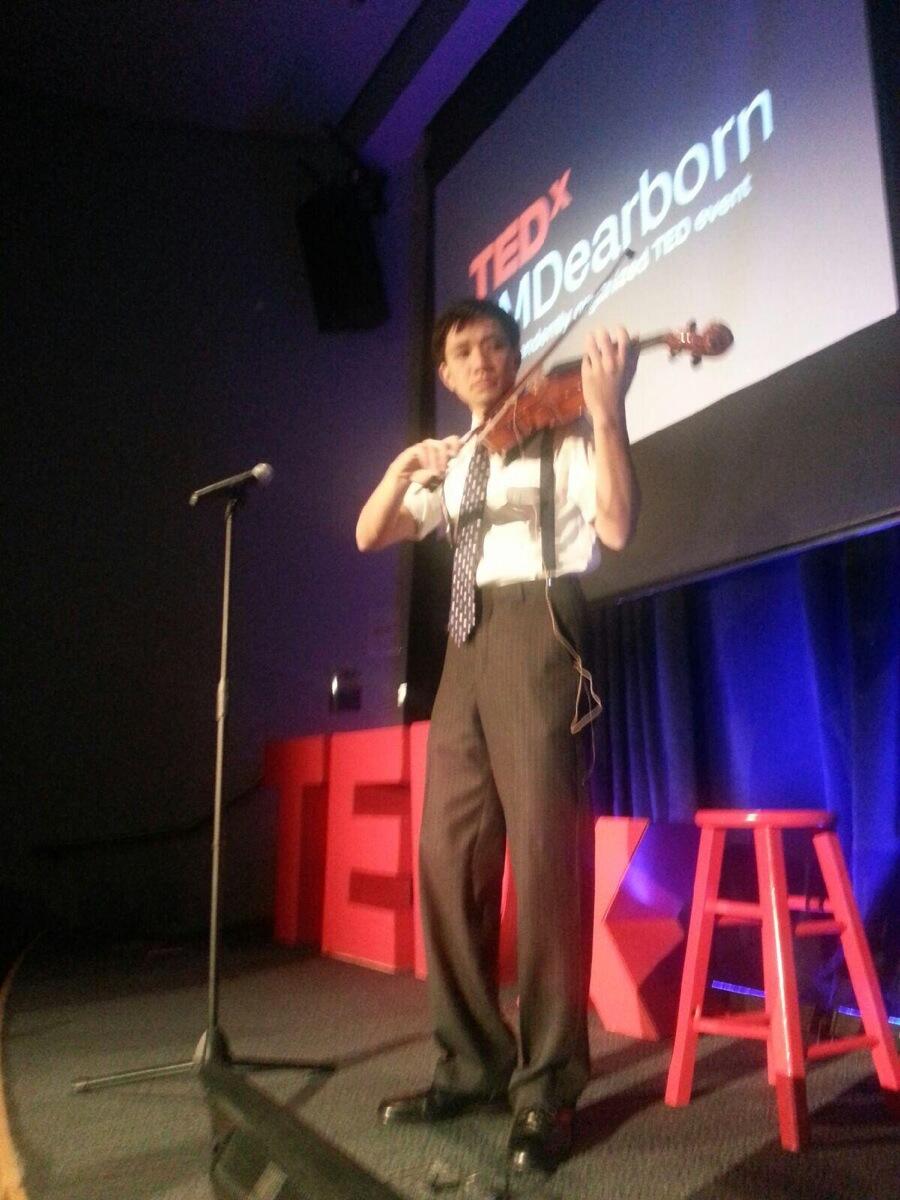
RAW REFLECTION: Post-TEDX Public Speaking

Yesterday I presented and performed two pieces for TEDX UM-Dearborn.  Here are my observations from the event:
Image credit to Greg Ezzo on Twitter

-As with every performance, I learn about who I really am in the moment from what I actually prepared and what I chose to use

-Virtue in performance (for what I mean, here's a statement on virtue in music): 
Everything I really prepared for came through fairly intuitively.  What I hoped but failed to thoroughly prepare for didn't manifest itself clearly when spoken under pressure.  I'll acknowledge that I didn't project my voice sufficiently too.

Granted, there were a fair number of curveballs thrown just before I got on stage:
I was asked to shave 5 minutes off of my time minutes before I walked on from a 12-15 minute timeframe, equipment wasn't readied for me to speak or play (amplifier and receiver was unplugged), and the timer was never started until I requested it about halfway through my set.  But what I've learned from this and previous trials and performances: you find yourself when you push yourself.  I learned on stage what exactly I had internalized and what I had yet to embody.  I'm certain learning to prepare for that better comes with time, additional exposure, and follow-through on not repeating the same mistakes.
My remarks were written in strategy language--they represented the content I sought to intellectually convey, but they didn't represent what I needed to say to human beings.  In my strategy work with the Ismotion/WorldByCycle team we've realized the same thing: every time we got stuck in crafting our business pitch, it was because we no longer wrote words that meant something to most English speaking human beings.  To bring stories to life, one needs verbs, not nouns to move us forward.


-I'm getting better at building emotional solidarity with audiences, but there's a threshold where the enthusiasm and emotion stirred up in my performance-presentations needs to match the integrity of the wisdom I strive to convey.  My intentions for the performance was to show that attendees had both a privilege and responsibility to take whatever they found inspiring or useful and share it with others.  At the same time, I hoped that bringing statistics about environmental health and air quality in Detroit/Southwest Detroit, and the "digital divide" (how the event required online applications in an area where digital literacy and access to the internet remains very low) would also spur lasting attention to bigger systemic environmental and digital justice issues.

-At an event like today's, innovations in emotional technology (how we get people to connect and humanely relate to each other) ought to be coupled with ethical intellectual food for thought of equal or greater quality as well.  I have an opportunity to educate a community.  Using new devices for engagement stays in the heart's memory, but sometimes a clear logical statement can help the mind stir the heart as people wind down from an event.  As a former debater, I know what a logical presentation and argument looks like.  While I wasn't at TEDX UM-Dearborn to debate, I did come with a message to assert.  I don't think it was done as clearly as I'd like, but I'm at peace with it for now.

I'm pleased to learn from various attendees who shared their thoughts (especially from Alex) that the concept of taking inspiration and carrying it forward beyond the event was clear.

-Seek out and listen to the people who didn't get your message(s)
Accolades and enthusiasms are wonderful and deeply appreciated, but in finding ways to refine how I communicate, it's best to engage those who didn't appreciate or grasp the points I hoped to convey.

-Prepare 2x more
For performance presentations that require solid grounding in data and ethics, it certainly takes twice as long to prepare.  In order to use the opportunity well, I need to do two things: Prepare the speech and practice the speaking/audience engagement, prepare the music and practice performing it too.

-That said, I enjoyed sharing it--in the future to prepare for events that charge a fee for attendees, I'll be sure to offer more opportunities to friends/the public for test-running my presentations/performances in progress.

-Unlike featured speakers for the event, I didn't have a dedicated speaking coach assigned to me and have yet to find one I'd trust on my own.  However, thanks to the generosity and attention of friends and the broader community, I was able to practice my remarks (a brief 3 minute or less speech), and sketch out how the presentation aspect blends into the audience participation & performance aspect.  

If you know what to look out for and can ask others to keep you accountable, it's possible to sharpen what you do without a professional coach.  I've been fortunate to have various professors, classes, and extracurriculars which helped hone what I pay attention to for better public speaking.  But without the keen attention, enthusiasm, and support of many friends and amicable acquaintances, I don't believe I'd have refined my message as well as I did.

Many thanks to Sara C., Megan M., Bear, Scotty, Thomas M., Marty S. and all those who shared their attention and insight.


Also: sometimes straightening out another person's collar when they're unaware can be as good as getting a hug from a dear friend.  I really appreciated Ryan K's keen eye in helping make sure I had my tie under the collar before I went onto state.

Pushups helped, I don't mind how odd it looks to others, I did a quick set of pushups a bit before going onto stage and it was worth it.

Monday, October 14, 2013

Greatness in your voice

There is greatness in your voice.

I can hear it.  You can feel it.  We know it.

If it quavers and shakes in fear:
let it be for the reasons we share with you.
Speak your truth with courage, and all your heart.

Inspire, then move us--with each word you expel, and each breath you spend.  We'll catch our breaths, and then we'll respire.

We'll breathe as we move closer toward something worth every spirited breath of speech, story, and song before our lives expire.

But it ends not at your life, nor ours.  Greatness flows over and through endeavors of legacy everlasting.

Free it with your voice and contribution to the world.
Let it ebb and flow from heart to heart: yours to mine, theirs to yours.

Call again!

Through sacred passage of wisdom in your call and listening--let your curiosity open the greatness of others, share your reliable truths, and always ask for the greatest of truth even when the only answer may be silence from your fellows.

The echoes of utterance will be great, and the world may quaver and shake in new movement as it awakens with the warmth of your voice for the reasons we share with you.

Share our Truth with courage and all hearts.


Hollow tree in Interlochen State Park, MI

#09:34 16 X 2013

Sunday, March 3, 2013

I've been privileged to play for and with noted musicians who seek to tell stories from unheard of people or under privileged places.  It takes a fair amount of courage for some to ask for help (note Amanda Palmer's talk on "the art of asking"[1]), and the excellent Nate May's asking for support to create a nuanced portrait of Appalachia.  Hailing from West Virginia, he represents his roots and curiosities with dignity, and it convinces me that we've missed so much in the history books about America's Appalachian heritage.  I'd be interested in seeing what comes of his project.  If it fancies your interest too, perhaps you'd be up for donating?

http://www.kickstarter.com/projects/1367182816/dust-in-the-bottomland

[1] http://www.ted.com/talks/amanda_palmer_the_art_of_asking.html

Tuesday, February 12, 2013

Swingin' musings of love

After a day contemplating existential ethics of romance and time-sensitive self-promotion, here's my say: There's a possibility I'll perform a cookin' handful of early jazz and blues tunes for a Valentines swing dance night with Alex Belhaj (or with him and his quartet) this Wednesday evening in Ann Arbor [1].

Even for those without a valentine, Ann Arbor has one of the best swing dance scenes in Michigan where you can pick up the basics of swing dance--no partner or previous experience required! For me at least, dancing and music yield vibrant moments and memories in life. There are some who’d argue that that’s what love’s really about. More than the romance, it’s about finding ways to embrace life to its fullest with other people whom you can trust [2]. In a vague way, I suppose that’s a shallow iteration of love to everyone reading--it’s not always obvious, but there’s a community willing to step forward, take your hands, and go for a dance. There’s a community willing to share the best music that they can make. And if instead of finding content in your solitude you suffer loneliness [3], I hope you’ll recognize and offer solace to another who shares a similar state, as you've got an opportunity to improve the community at large with fundamental compassion.

That said, I’ll hope the music and dance are enough to content the hearts of several who do attend.

[1] https://www.facebook.com/events/523669560995472/?ref=14
[2] http://www.theschooloflife.com/blog/2013/02/romantic-love-busting-the-myth/
[3] http://www.theschooloflife.com/blog/2013/02/the-pleasures-and-pains-of-solitariness/

Wednesday, January 23, 2013

Life and the Life Sciences Orchestra

Hi Sharon,

There's one more thread of thought I'd like to share about the program and my experience with the LSO and how it can relate to audiences. Even if the article will be printed tomorrow without it, I think it's important to share as it adds some depth to what I was trying to capture in our conversation yesterday.

In essence: we're privileged to discover glimpses of what drives the nexus of art and science, and we have the opportunity to experience profound reminders about the nature of life as part of the symphony.

I vividly remember one of the French Horn players rushed out of rehearsal to attend to one of his patients during rehearsal this season. Last year in the summer, our piccolo/flutist passed away after a long grapple with breast cancer and chemo therapy shortly after performing in the spring concert. Our director, Oriol Sans, sent the following letter to members of the symphony:

"At this moment I want to share a few words with you. Last week I went tosee Lisa at the hospital, and it was an experience that I will neverforget. The open and honest way she talked about her cancer and what wasgoing to happen to her, made a deep impression on me. Among other things,she told me that for the last year music made her forget about all thehealth problems she was going through. Music didn't cure her, she said, butit helped her to get through that.
I told her what a great example she was for all of us. She came to ourrehearsals with a crutch, without it, with a wig, without a wig, with longhair, with short hair... But she was always there, and I never heard asingle complaint from her. Until the very end, the illness never stoppedher to do one of the things that she most loved: making music. The sameweek of our last concert she didn't agree to a last round of chemo untilthe doctors promised her that she would be ready to play for our dressrehearsal and the concert.
I think that I can speak from all of us when I say that seeing her examplewas truly a gift. I am glad that my last words to her before I left herroom at the hospital were thank you."
Medicine and health care are intimately connected tied to the life and environmental sciences. Given that the causes of cancer are an interconnected mix between genetics, diet, and environmental factors ( http://www.niehs.nih.gov/health/materials/cancer_and_the_environment_508.pdf ), the past experiences are a reminder to me about some of the people and things we love and strive to creatively improve about the world we live in.

One last note: Curiosity and experience drive the arts and sciences alike: "The most beautiful thing we can experience is the mysterious. It is the source of all true art and science." - Albert Eistein

As mentioned in the program notes written by Oriol for our upcoming concert, the Mahler symphony was deeply influenced by themes from nature and our relationship with it--it features bird calls (of a cuckoo) in its opening movements, and the story of a hunter's funeral--attended by animals. Shostakovich's Festival Overture was performed as a fanfare for the 2009 nobel prize. The LSO presents an opportunity for audiences and participants alike to entice a shared sense of wonder.

Thank you again for sharing your time to consider my thoughts, I hope I was able to share this in time with you.

All the best,
Ian D. Tran

---
B.S. Environmental Science, Political Science Minor Class of 2012 The University of Michigan-Dearborn

Tuesday, January 22, 2013

Plan to Overcome


"Today there is no longer a choice between violence and nonviolence. It is either nonviolence or nonexistence." -Dr. Martin Luther King
"It springs rather from my conviction that, if our civilization is to survive, we must break with the habit of deference to great men." - Karl Popper

I think Dr. Martin Luther King Day (which I learned is not his birthday! That happened January 15th) is an appropriate opportunity to reflect upon and reinvigorate our commitment to the timeless legacy and vision of justice exemplified by Dr. King instead of giving deference to him as an idol of noble aspirations.

More than that, I think we foremost benefit from recognizing our ability to empower ourselves and each other (all people, of course not just men).

Another quote, this time from the living Bill Moyers, shares this belief that action is up to you: 
“What we need to match the science of human health is what the ancient Israelites called ‘hocma’—the science of the heart. . . the capacity to see. . . to feel. . . and then to act. . . as if the future depended on you. Believe me, it does.”

In that regard, all of us are capable of discovering greatness in ourselves and one another.  Among their accomplishments, civil rights proponents like King succeeded in empowering people by promoting awareness and opportunity to engage in justice through democracy with disciplined planning and steadfast implementation. I recently met the Reverend Dr. James Lawson, who worked closely with Dr. King, in the autumn of 2012 after he gave a speech about non-violence. By miraculous coincidence, I met him one day after I tasted the gunpowder from a gunshot meant to kill a person less than 8 feet away.

At first blush, non-violence can seem like a fairly simple, even vague if not hollow, term.  If someone draws a gun with malicious intent, what other choices do we have?  Guns, much like nuclear weapons, can almost guarantee mutual destruction.  Yet if we ask why one would draw a gun to potentially kill extended family, or even carry one in the first place, the answer had to revolve around personal security and insecurity when you boil the situation down it to its essence.

Security is a sophisticated need.  It’s inherently dependent upon complex systems which are beyond the full control of an individual.  Even one’s perception can skew our judgment of an already shifting reality.

I suspect an answer to dealing with potentially absolute violence lies in interventions that meet the following condition: overcome our human tendency to engage in rules that necessitate the reciprocal escalation of powers.  Undermine or reshape the entire premise of our value system for fighting—the “rules of the game”—by changing the perceptions and paradigms which shape how and why we think about combative engagement in the first place.

People are complex; fortunately, science helps us find ways to effectively work with complexity, including social codes and personal beliefs.  Complex systems scientists recognize tangible behaviors as necessary for persuading peoples’ values, paradigms and worldviews  (see the list of 12 leverage points for intervening in a complex system here: http://www.sustainer.org/pubs/Leverage_Points.pdf ).

When appropriate, non-violence may need to employ the use of non-lethal protective use of force (check out Marshall Rosenberg's well-earned wisdom: http://youtu.be/21g1S7stoQI ), but no matter what, non-violence is exercised without malice in our actions.  The way we communicate ideas, or even notions, in language (can we speak without engaging in abuse or instigating escalation?) usually becomes the first symptom for a potential intervention. To astute observers, it may be expressed visually in our physical posturing and gestures (can you assert your presence without resorting to making it threatening to others?) as well, and of course in how we physically interact with one another (can you embrace and redirect a person's attack rather than impose force onto them? That's what the martial art Aikido focuses on).

Adding Popper’s contention about the notion of “great men”, I gleaned another note for non-violence from Dr. Lawson:  Non-violence operates via empowerment as its primary principle.

“Non-violence is premised on the idea that all people have power to act beyond the influence of their circumstance.”  But in this, there's a challenge: unlike violence, which can quickly and easily interfere with the integrity of an ideal like peace, trust, or love, non-violence requires discipline, careful planning, and patient dedication.

We must act from a hope to overcome, we must plan to overcome.

Which leads us to another nuance of non-violence from Reverend Lawson: 
“Non-violence is the moral equivalent to war.  It requires organization and discipline.” 

Consider the planning and commitment that went into what we now see as watershed events:  Coordinated planning took place for the sit-ins from 1959-1964.  The Montgomery Bus Boycott officially began on December 1st of 1955, some of us heard that in the history books or on television programs, but few of us realize the tenacity of the cause: the boycott was sustained for over a year—381 days.

An ideal is a lot like other life-processes: education, communication and the arts, design, even ethics.
All of these activities involve intentions, actions, and consequences.

Among seasoned practitioners like Reverend Lawson, the term "non-violence" actually isn't representative of what people really strive for. Non-anything implies reaction and work that runs directly against something. If anything, I suspect people really strive to love--create it and do it. It's a noun, but most importantly a verb.

Love exists as a plausible ideal. We may bear compassionate and loving intentions. Caring actions may manifest loving intentions, and perhaps the desired consequence of compassion and love creates a legacy that reaffirms the intention and fosters more love.

Yet as an ideal, it becomes so expansive to act upon that many find--and take--temptation in believing ideals cannot happen in reality.  Furthermore, it's possible, potentially even reasonable [using the word in a very strict sense, link goes to various definitions] though never justifiable, that a person can love the person whom they abuse. Their intentions may be true, but the actions they know or choose to express care through compromise the dignity and autonomy of another being.

This remains the challenge of Dr. King and many other notable living visionaries of our time: to truly validate worthy ideals such as peace, justice, and love all three aspects of the ideal must be good and present. That takes visionary planning to manifest dreams from ideal to real. When society-shaping, you need to do so with people, not just on behalf of them, and certainly not independent of them.

Keep it up, we shall overcome someday, but let’s discover the someday together, every day in our actions with one another.


.  .  .


Notes about music in the video above:


Minor variations and improvisations on the Civil Rights song "We Shall Overcome" recorded in the University of Michigan-Dearborn Wellness Center on January 21st 2013.

A few weeks ago I played it spur of the moment and it was a profound rendition if I say so myself, but I don't remember what I did and I didn't have anything to record it with at the time.  There's some irony to the notion of playing a social justice song, solo, to no one but yourself on MLK day.  I was somewhat disappointed that I missed a few opportunities including a symposium on social justice that day, so as I practiced other tunes, I decided to give the song another try in observation of the day as well.

I suspect playing a song used for civil rights alone doesn't quite contribute to making the dream manifest, but hopefully sharing it here might be worth your while. I'm drawing memory from a rendition I heard on a cd by Peter Paul and Mary when I was in second grade-fifth grade, and hadn't really prepared my playing as much as I now think I should have. Ongoing process...

Thursday, January 17, 2013

Speculating suicide and swingin' the night

A jam-packed day, but I'll start with the evening's events:

Into the evening, I received a text message from a friend who had reached out for help.  He was fighting long-standing suicidal desires and a on Sunday evening/Monday morning I reached him as I suspected and realized it was severe.  We hadn't spoken or seen each other possibly since elementary school-he was the older brother of a classmate of mine, but he reached out to me sometime during college and I accepted his invitation for the opportunity to touch base, and then between late in December and mid January I finally communicated with him.

On Monday morning (as in 03:00-06:00), he mentioned his frustration with life and his ongoing turmoil between severe anger, angst and depression.  He was, sometimes maybe is still, feeling  despondent--so much that he wondered if he should "take a mouthful of sleeping pills" to end his life.  Yet he also expressed to me that he knew it wasn't good, knew there were people who love him, and he actually wanted to live.  With a few exceptions to my circumstances, I had recently gotten over that sense of despondence.  This winter, I was surprised and rather glad to realize that one who endures--and possibly the privileged few who overcome--prolonged suffering earns more than a sense of pride that comes from enduring hardship.  Eventually, some find themselves endowed with a new caliber of empathy and humanity that allows them to work with others who have suffered similarly.

Today I briefly sent him a message after realizing he tended to stay up very late: I recommended ways for him to sleep earlier (research points to less severe/reduced frequency of depression for those who sleep well and earlier at night).  I lost contact with my friend for approximately 6 hours, and realized he had written a confusing statement on his social network profile.

After attempting to reach him and his brother by every means I could find between phones and the internet, I finally called 911.  When I called 911 to request for the police to check on him, I was asked by the dispatcher if my friend had mentioned anything about how he might have planned to commit suicide.  The police do this for several reasons, part of it involves safety--for the officers to prepare appropriately--and part of it is probably to screen the severity of a case.  I knew and gave a likely means: a potential overdose on sleeping pills.  My friend later (around 11:30 pm) sent me a message to inform me that he was well and that he appreciated my concern and initiative.  Ironically, he told me he was sleeping--early during all of the commotion until the police came to his house!

Had anyone asked me in December through March of 2012 where or what I would do a year from then, meaningfully empathizing with people who'd trust me enough to express their concerns and anguish was far from my imagination.


I also wouldn't have thought I'd be fit to participate in swing and blues dancing either.

.   .   .

As another poetic loop, I realized that the elements of the earliest ballroom dances I had ever learned trace their steps to Lindy Hop (dancing with my mum at Eastern University when I was in second grade) and the Tango (dancing with a South American friend at a time that I had never been so close to a female before, not to mention in a situation where I was attempting to learn dance steps from a very competent dancer).

From performing with Amanda Palmer as part of the Grand Theft Orchestra, I learned a valuable nuance about professional rock stars:  they know and live all-out at the times that it matters most.  In other words, they recognize their "greatness", and can tap into it in relatively short order so that they operate at their best by burning through any anxieties almost right away.  The music they (professional celebrity musicians in general) play might not be the most intricate or thoughtfully crafted, but they know how to "maintain the energy" throughout the performance (as articulated by the ladies of the phenomenal Norwegian band Katzenjammer in some interview seen online).

With blues/early swing dance, it's very similar.  Even though I was brand new and was content to hang out at the edge of the dance floor to watch and learn the history of the dances, I was pleasantly--warmly--greeted and asked to dance by many people, several of whom were outstanding dancers in their own right.  In many cases I had long since lost track of the steps and made up my own motions.  Because I've long appreciated the goofy and exaggerated swinging motions and bounce of dances like Lindy Hop and Charleston (there exists a more subtle form of Charleston), I had some exciting moments doing things that seemed like they would make sense.  That said, I suspect it's similar to the principle gleaned from the Amanda Palmer gig I played at St. Andrews hall this past November.  Within reason, I remained rather energetic throughout and probably spent over 4 hours doing dance related things.

At the same time, I realized that I occasionally had no conception of what I could/should/wanted to do next with many of my motions.  This can be scary--I recall realizing that the biggest differences between those on the politically conservative/liberal identity spectrum was their degree of exposure and emphasis of value to possibilities--when we refer to a conservative disposition, it sometimes happens because we really have no way of imagining/conceiving the possibility of an alternative opportunity and/or reality.

With both events said and examined, I think it's really important to know the people in your community--especially those whom might consider you a friend--well enough that you can help

I started this day at 06:28, had a brief but powerful nap, and it's now 02:15.  Easy day, onward to the next!

Monday, January 7, 2013

Blues lexicon | industrious but not so luminous

I just realized that blues music has its own lexicon.  A singer isn't necessarily limited to these words, but hearing words like "rollin'", "crossroads", and "river" is a lot more comforting in familiarity than words like "transcend".  Yet if you do it right, you can slip a few words that we don't always find among the usual company of words.

Keep on rollin'
You know that we can all transcend time.
If only I knew solfège or the chords to what's in my head well enough to convey the tune in writing...

.   .   .

Also, again "Industry does not behoove humanity..."  I had a remarkably productive day, but if asked whether I enjoyed it, I know I barely settled in enough to savor its many bright moments.  That's disappointing, you can say to yourself: look at all of these things I've checked off a list!  How industrious of me!  Yet at day's end, when you've calmed yourself just enough to start to appreciate the day, you realized you've lost something.  It's the humane side of things that warms the memory of a day.

.   .   .

Wednesday, December 19, 2012

Mit Humor: Mental illness and our capacity for hocma


“What we need to match the science of human health is what the ancient Israelites called ‘hocma’—the science of the heart... the capacity to see... to feel... and then to act... as if the future depended on you. Believe me, it does.”-Bill Moyers

Some of the most evocative artists also happened to have very severe mental health challenges.

Vincent Van Gogh (of starry night fame, among other paintings), would be labeled with bipolar disorder, schizophrenia, and a host of other illnesses (those who want to point to his missing ear as possible evidence of mental illness may need to reconsider recent interpretations of events though).

Recently, I've had a cello tune by Robert Schumann visiting my head with vigor.  I first learned and listened to Schumann's music via a recording of his "five pieces in folk style" performed by the cellist Natalia Khoma.  The piece that really stood out was the first from piece in the set labeled with a brief suggestion in German: "With Humor" (Mit Humor).  I really liked the tune, but always imagined it had an adversarial kind of sound to it.  Now, with the benefit of many years of new experience in performing and the wonders of youtube, I've listened to several other performances of the piece and decided that the piece is challenging to play with humorous conviction unless you're in a REALLY good mood.

While searching for other recordings of the piece, I noticed one youtube playlist that contained a lot of Schumann's music was titled "Music for a troubled mind."  After a brief search on Wikipedia (and elsewhere, but Wikipedia was most accessible so I'm giving it credit foremost) about his life, I had confirmed my suspicion that he too, had a rough time grappling with life on the now and then.

In some ways, I was disappointed, there's a research article with a disempowering title called "the dark side of creativity:" and a subtitle that says "vulnerability and negative emotions lead to greater artistic creativity"[1], Schumann reaffirmed its findings.  At the same time, I was relieved:  over a hundred years later, living people actually perform and presumably enjoy listening to his music.

Realizing that, I'm reminded of a pondering that started earlier this summer:  how many people actually wanted to be with Van Gogh or Schumann not because they enjoyed their works, but because they knew they were ill and truly wanted to understand, or possibly help them?

The current media buzz from recent shootings suggest that we as a public are quick to impose a label and therefore, imbue an identity onto another person.  When we refer to people with mental illness who behave poorly around others or worse yet, commit injustices, we strip away the complexities of their history, circumstance, and potential as people.  In light of shootings like the Colorado shooting that took place in the theatres, or the recent shooting at Sandy Hooke elementary, people say "that's sick" with sneering hate in their voice and tones of disbelief.  Yet they forget what it means to be sick.  Killings of that sort are certainly inexcusable and unjust acts.  But in saying someone is sick under most circumstances, we'd hopefully recognize sickness as a state of poor health with the intent to improve it to a better condition.  We rarely say someone's an absolute loss and dead already.

In instances of the shooters in the aforementioned incidents, one of them (James Holmes) looked like he was in disbelief about his circumstance and actions during the trials, the other (Adam Lanza) had been killed before he went to trial.

While it might not be accurate or true to the circumstances of the previously mentioned criminals, I'll offer an unusual perspective as a possible ingredient for empathy:

Some people hurt so much that they wish they'd do something to deserve the pain and shame they've felt.  Why?  Because they don't understand where it truly came from, why it happened, or what they can meaningfully do about it.  Sometimes the confusion, pain, and anger are a legacy of outcomes from bullying, terror, neglect--abuse.

At the same time, recovery has little space to exist in our society.  We delegate responsibilities of care by sending people to hospitals or rehabilitation centers.  Often, they're cut off from people whom they might actually need for humane interaction that goes beyond vital statistics, food delivery, and psychiatric testing.  This is a similar challenge that prisoners face.  Granted, they're frequently inexcusable and still responsible for their own actions, but I've met enough to know that there are some who also want to live as better human beings for the sake of others in their community or family.  One of them is a mentor of sorts to me and many others at the University of Michigan-Dearborn.

Furthermore, we're in a society where meeting sophisticated social needs frequently becomes a rare occurrence--mental healthcare for many is inaccessible if it means we must invest burdensome financial capital and traverse great distances to reach whom we'd hope are vigorously trained and keenly attentive health specialists.  But what happens if therapy amounts to paying for the privilege of talking to someone who just might choose to offer you medication instead of helping you embrace and resolve your conflicts?  Our fundamental intentions with most of these sessions come from a deep desire to meaningfully communicate with another person in a safe environment, and know that someone else cares about your well being.  These "specialized services" happen to be many of those that people ought to expect out of a good friend.

Let's consider a line of questions:
1) When someone we know grieves because a loved one died, what's the likelihood that they'll do so in a way that can't be described as some kind of illness?
2) What accurate ways exist to gauge one's mental health?
3) Will that person remain an injured and fatally broken person forever?
4) Does a state or institution have the right to take them (and in turn, impinge upon their freedoms) away from the rest of the world away by labeling them as "sick" or "mentally ill" for suffering humane experiences?

Sometimes, you'll discover that they too, deeply wish to get better.  I suspect in severe cases, more often than not, they've had to confuse themselves into believing they're unworthy of aid and redemption.  In my case, I think it's a form of shame and self-hatred that some people are willing to perpetuate because they don't really grasp an alternative reality to how they can live and who they can be.

When someone is ill, the rest of us also have choices that actually challenge our perceptions of responsibility as a community:

Do you take up apathy?
Will you let them continue to suffer?
Will you embrace their challenge and aid them to get better?

If you want to live in a better world, these questions become your charge and duty.  If you're preparing for fields in medicine or justice, this is the challenge you're charged to meet at any moment, sometimes through witnessing subtle realities slip in and out of a window of opportunity many times in one day.

I started to write this post around December 19th of 2012 in reaction to realizing that a talented and fun loving person who quickly and, likely, genuinely considered me a friend did so as I was still wondering if I was in stable mental and emotional health.

This brings me to a quote from Bill Moyers which you've seen at the beginning of this post:

“What we need to match the science of human health is what the ancient Israelites called ‘hocma’—the science of the heart. . . the capacity to see. . . to feel. . . and then to act. . . as if the future depended on you. Believe me, it does.”-Bill Moyers

You may be the only individual with the privilege of interacting with someone who suffers from mental illness.  Recognizing that possibility exists, even brief encounters with other people can define your relationship if it's no longer sustained. I've come to believe we're obligated to make sure we've made a positive difference in other people's lives whenever we're privileged to reach another person.
"Depression is real. Just because you’ve never had it doesn’t make it imaginary. Compassion is also real. And a depressed person may cling desperately to it until they are out of the woods and they may remember your compassion for the rest of their lives as a force greater than their depression."-an excerpt posted on an online social network by someone who pulled a quote from the depths of another social network
I'm convinced that many people with mental health challenges also contributed some of the most profound ideas, expressions, and acts of compassion known to history.

Van Gogh, Schumann, I've mentioned before.  There are more I can list, but I'll choose Buckminster Fuller as the closing example for his resolve to do something out of what began as despondent angst:
"He ultimately chose to embark on 'an experiment, to find what a single individual [could] contribute to changing the world and benefiting all humanity.'"
Just read about him, he made amazing things and had great insight for design/complex systems theory.
[I don't completely agree with his techno-centric vision, but he was certainly prolific and lived a life worth knowing something about-read the section on his depression and epiphany for the segment that most.]

Now on the converse, you don't need to be sad, immensely depressed, or ill to do great things. If that's where you're at great! As human beings however, we're capable of it all.  Can you make the most of life and see what you can do with the hearts of other people?

Research doesn't tell us the answer, the actions you choose to live for do.  It's up to you to hone hearts, to do what the future depends on you for.


[1] The Dark Side of Creativity: BiologicalVulnerability and Negative Emotions Lead toGreater Artistic CreativityFor just the abstract: http://www.ncbi.nlm.nih.gov/pubmed/18832338
For the paper: http://psp.sagepub.com/content/34/12/1677.full.pdf+html
This might be useful solace for some:
http://www.storiedmind.com/recovery/patterns-recovery-depression-ptsd/
On the composer Robert Schumann:
http://en.wikipedia.org/wiki/Robert_Schumann

Link to Schumann's five pieces in folk style, with humor (the video's already embedded above):
http://youtu.be/DBDHOOBoNuA


Saturday, October 20, 2012

Vague connections: humanity and sweethearts in 7/8


"She heard my footsteps approaching in the corridor and found them intriguing. (I have a vague memory that I ran down the corridor in 7/8 time.)" -Richard Stallman

http://stallman.org/articles/childhood-sweetheart.html

It's odd though, there exists a research paper I despise, even if only for its title ("The Dark Side of Creativity: Biological Vulnerability and Negative Emotions Lead to Greater Artistic Creativity") which I think of frequently, and I suspect it ties closely to influence on Melynda Reid's work and artistry.  If anything one's creativity in this context indicates the breadth and depth of their capacity to experience and convey humanity.  However, it's unfortunate and sombering to recognize real stories about others who really struggle with keeping brighter moments in mind and sometimes, the stories of their lives don't capture the moments when they make it to the next peak.

The video above is a mind-blowing adaptation of a Macedonian love song adapted for two cellists on one cello.  If you're not taken by watching them play, watching their bows is like realizing how related rates in calculus work.  Coincidentally, the tune is also in 7/8 meter, much like Stallman's footsteps!

Sunday, September 16, 2012

We've witnessed the "Devil Music" era of Hip Hop, and we're climbing out...

Wisdom inspired by conversations with Willie of the Wellness Center: much like the thrilling days of Rock and Roll, Hip Hop entered its "devil music" phase circa the entry of Snoop Dogg [Lion] et al.  In particular, when they set precedent with prolific profanity by degrading people as "Bs and Hs".

Yet there exists a definite counter to the industry standard which bubbles up from the ground up.  Though spread out, there certainly are groups and individuals who strive to integrate a positive message into the music, and utilize the medium for community and societal transformation.  I'll point to the Hip Hop Congress, 5E Gallery, and Rap for Food as particularly notable organizations.  I heard an employee from the East Michigan Environmental Action Council (EMEAC) lay down his verses this evening too.  These aren't necessarily religious movements in themselves, but they certainly strive to bring light to their audiences, and I think it's much needed.  Utility music (Gebrauchsmusik) is alive and well...

[Whoo!  What a bunch of links.]

Edit 18 IX 2012:

I just realized an interesting irony.  Rock and Roll, which once was labeled as "devil music", now has its own sub-genre of "Christian Rock".  I'm sure there's something out there like "Christian Rap", though I mostly appreciate witnessing the relative clarity of movements and causes emerging in hip hop at this time.

Friday, August 24, 2012

Featured at Lawrence Street Art Gallery 24 VIII 2012


Fri. 24 Aug. 2012 ~8:00 p.m.
Featured Performer (Me!) for the Poetic Travelers open mic at the Lawrence Street Gallery, Ferndale MI
22620 Woodward Ave. Suite A Ferndale, MI 48220

Though I've played at a handful of open mics since 2006, this is the first time I can recall being the featured performer. If you're on facebook and want to share the event with friends, here's the event link:
https://www.facebook.com/events/474563675889871/

In an interesting loop of life events[1], I'll be the featured performer for the Poetic Travelers open mic at 8:00pm in the Lawrence Street Gallery of Ferndale hosted by Markita Moore.

The open mic officially starts at 6:30 and runs until 9:00pm (at which time lights go out and people are promptly ushered out of the gallery). I'll play a half hour set of dear and fresh tunes.

Markita Moore is one of the first people I met through the open mic circuit. Open mics with hosts like Markita are an important part of our communities--they're invaluable outlets for humanity. I can attest for some that they are precious opportunities to meaningfully and constructively communicate with other people in a safe environment, I've witnessed it firsthand in others and for myself in rougher times[2].

Back to the music: I plan to muster compelling music for my slot. I'll "officially debut" several of my newer tunes, add a pinch of explanation or storytelling, and plan for a dash of audience participation too.
As implied with the word "open", open mics are open to the public.

Hope to see you there!

[1] Why's it interesting to me? Find out at the open mic!

[2] There's a story behind this which you can read, though I won't be playing the meditation at this event: http://elementalmeaningmusic.blogspot.com/2011/05/meditation-on-middle-class.html

In recap:  I thought I'd try making an official premiere of a few new tunes with a dash of explanation or storytelling.  The initial working setlist (about 1/2 an hour of music):

Breathing
Stammer and Soar
Pensive Wail
Courage in Complexity
Lament of the Virtues
Guess who's keepin' it groovy?

Was shortened to about 20 minutes of music and story telling, and it was swell:

Breathing
An Feochan* (by Tommy Peoples)
Courage in Complexity
Guess who's keepin' it groovy?
[Note: the time of this post was chosen for archival purposes...]