Showing posts with label environment. Show all posts

Thursday, March 31, 2022

Love to the Lummi from roots across the sea

"In continuing to offer prayer for the repatriation of southern resident orca Sk’aliCh’elh-tenaut from the Miami Seaquarium to her home waters of the Salish Sea, Lummi Tribal citizens and the Bellingham, Washington community gathered Sunday, March 20, at the sacred site of Cherry Point — named Xwe’chi’eXen in the Lummi language."

https://indiancountrytoday.com/news/tribal-citizens-offer-prayer-cedar-for-the-return-of-orca

Wow, this is really close to the time that some Vietnamese villages celebrate their whale festivals too!

My maternal grandmother's village in Vietnam had responsibilities for mourning any deceased whales and annual celebrations for good fishing and support on the water. Based on what I've been able to read online however, it often gets portrayed more like a transactional or even extractive relationship where people hope for good fishing and safety etc. and whales are moreso harbingers of wealth and luck. Yet when someone finds a dead whale, there's a responsibility to take it ashore for proper burial and someone from the village would be tasked to mourn it like a direct relative for 100 days. In some villages, the bones even become enshrined and kept at a small temple.

But it's so good to see other nations like the Lummi with care for the return when one is taken away being done, especially for a pod like the Southern Residents which are sort of famous in the scientific community for their own cultural.

The Southern Resident population has led the way with sort of fashion/ways to play with their food (known for wearing a piece of salmon or other meat on the head in the 1980s), and their dialect of language plus matriarchal leadership roles are comparatively very well studied too.

Tuesday, January 1, 2019

Persuasive Resolutions


[transcribed directly from the main text in the notebook image]

1 I 2019 02:23                                         
[in small text to upper right corner: "Assess for complexity; * -> this statement lacks engagement w/ other systems of realtiy i.e. env. factors]

The most important thing for resolutions
to manifest is committed self-persuasion.

What if posing our resolutions as questions served us better? Better than at least,
the strain, tension, and repercussions
a binary imperative often creates in our lives.

Guidance:                                   Resolution:

How can I be
fully present w/
self, environs, & people?  --->   Be present.


What does being rpesent need to look like now for the situation & myself
to improve?


The most likely source of distress created by resolutions (the NYE type)
probably comes from the psychological barriers that accompany shame and guilt.
Couple it with one's inexperience or inadequate capacity to rebound from a
shortcoming, and it makes sense that so many people "fail" at what they
resolve to do--especially as they tend
to do it on their own rather than with
the support an intentional & caring community can provide.

Wednesday, November 14, 2018

Performance/Practice Notes: Sept 2018 Structure and Agency improvisation session

An early stylistic exploration--while Bruce Lee might fear the person who practices 1 kick 10,000 times, this session is the equivalent of hearing a violinist/violist practice 10,000 kinds of kicks about 2 to 34 times so there's a lot of work to do in refining any of the vectors we might choose to pursue before something radically developed on a stylistic or compositional level emerges.


Early in the video you'll hear: 
-an unnecessarily aggressive take on part of a Japanese children's song (Oedo Nihonbashi -- at least the part I could remember) where I tried to replicate my memory of a raw and jarring koto melody by maintaining ponticello technique on the instrument. [After finding the original reference recording -- in the Favorite/Nostalgic Melodies of Japan album, the perceived jarring sound came from being unfamiliar with some non-western tunings] 
-influences from traditional shakuhachi flute stylizations [as heard in Minoru Minuoka's Japanese Koto Funk] Ponticello technique on violin, viola, or any bowed string instrument that you can play with ponticello lends itself well to imitating the smoky wind style heard in shakuhachi playing if done with subtlety -- I was somewhat successful in maintaining character and can do a lot to develop a more compelling sound with it further 
-As a side note, I'm experimenting with ways to normalize or make the scratchy sound that comes with ponticello on a stringed instrument interesting and "beautiful" in its own right, the shakuhachi emulation is probably the closest thing I've found beyond using it for textural purposes or as an aggressive distortion in sound 
-Flexing in and out of traditional intonation with microtonal fluctuations to explore beat patterns that sometimes emerge from playing sympathetic strings that are slighly out of tune together 
-One surprise: the "beat effect" that comes when playing two notes that are very close to each other in intonation don't carry to the microphone well compared to what you can feel on the instrument as the player. I'd be interested to hear how the same effect gets picked up in professional recordings where I did that same effect on multiple occasions with Synergistic Mythologies at the DSO Cube for the 2018 Strange Beautiful Music Festival in September 
-Discovering the strings are already out of tune to each other without any help ; ) 
-Finding ways to "play with the environment" -- a swelling overtone in the parking structure amplifies when playing just mildly sharp of the D natural that's unique to that particular part of the structure 
-A brief quote of an ascending motif from an Alfredo Piatti Cello Caprice -- with a daring microtonal twist that makes it sound a little less good than I thought it would!
-Improvisation in Balkan and Roma-esque modes with some non-western intonation 
-A quick quote from a motif in a pan flute melody (called “pan flute melody” when translated out of French) from the group called Djelem -Later you'll hear simple 1 degree templamatic derivations of traditional Balkan tune(s) like the Gankino Hora--likely played in the wrong meter--and another one I've yet to learn the name of titled on youtube as "Bud Vibe" via kungfudru's youtube account [ the drummer playing in a group that would eventually become the Balkan funk band Ornamatik/RytaMusik's] -An attempt to play in non 4/4 time signatures (probably a 7/8) -- and sometimes straying back into 4/4 after forgetting the attempt or getting rhythmically lost altogether with the counting and grooving 
-A new jam pattern(!!) 
-An appreciative audience member shouting from several stories below 

FIN (due to space constraints and a crashed hard drive) Also, accelerometer in the phone somehow didn't read the horizontal orientation and now I'm not sure how to rotate the video short of getting more sophisticated video editing software. Might reupload in the future when we can take care of that. 

Sunday, October 20, 2013

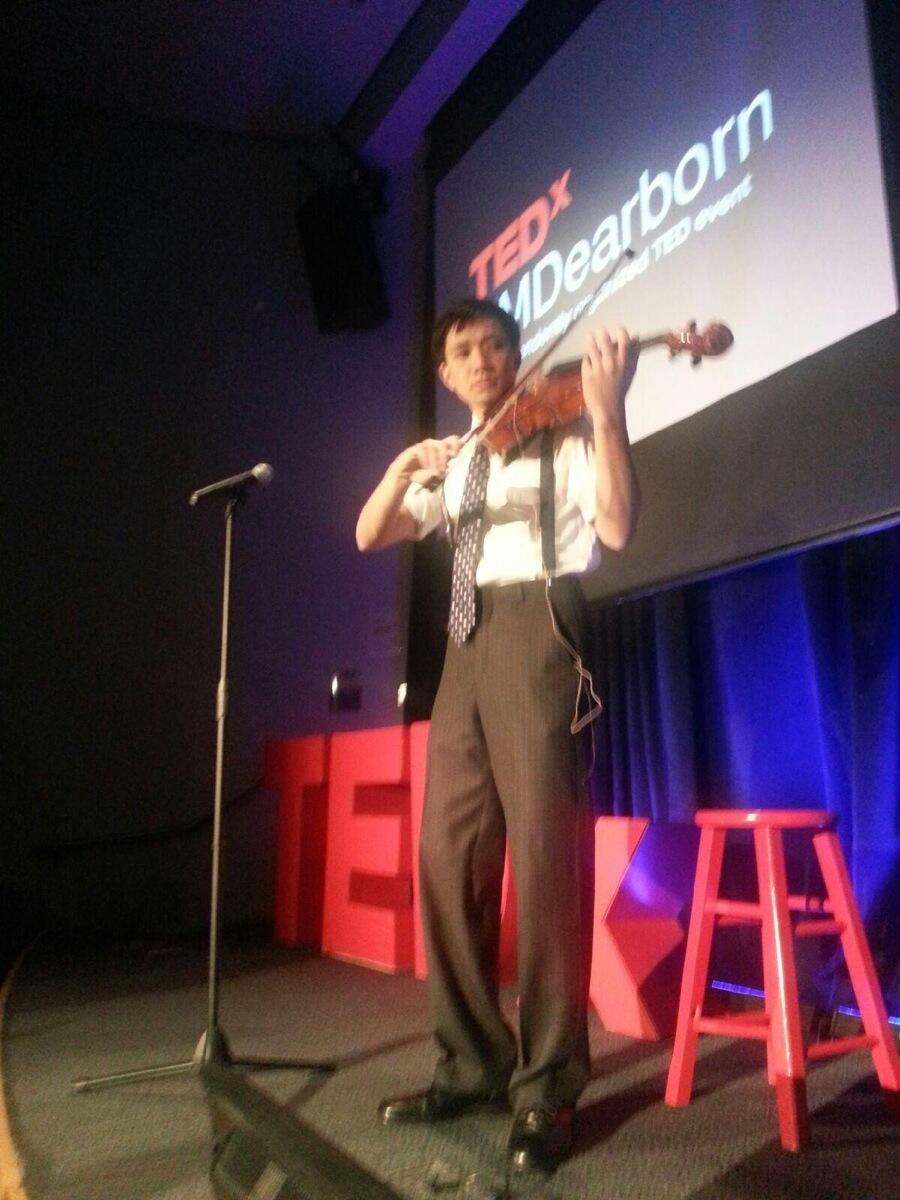
RAW REFLECTION: Post-TEDX Public Speaking

Yesterday I presented and performed two pieces for TEDX UM-Dearborn.  Here are my observations from the event:
Image credit to Greg Ezzo on Twitter

-As with every performance, I learn about who I really am in the moment from what I actually prepared and what I chose to use

-Virtue in performance (for what I mean, here's a statement on virtue in music): 
Everything I really prepared for came through fairly intuitively.  What I hoped but failed to thoroughly prepare for didn't manifest itself clearly when spoken under pressure.  I'll acknowledge that I didn't project my voice sufficiently too.

Granted, there were a fair number of curveballs thrown just before I got on stage:
I was asked to shave 5 minutes off of my time minutes before I walked on from a 12-15 minute timeframe, equipment wasn't readied for me to speak or play (amplifier and receiver was unplugged), and the timer was never started until I requested it about halfway through my set.  But what I've learned from this and previous trials and performances: you find yourself when you push yourself.  I learned on stage what exactly I had internalized and what I had yet to embody.  I'm certain learning to prepare for that better comes with time, additional exposure, and follow-through on not repeating the same mistakes.
My remarks were written in strategy language--they represented the content I sought to intellectually convey, but they didn't represent what I needed to say to human beings.  In my strategy work with the Ismotion/WorldByCycle team we've realized the same thing: every time we got stuck in crafting our business pitch, it was because we no longer wrote words that meant something to most English speaking human beings.  To bring stories to life, one needs verbs, not nouns to move us forward.


-I'm getting better at building emotional solidarity with audiences, but there's a threshold where the enthusiasm and emotion stirred up in my performance-presentations needs to match the integrity of the wisdom I strive to convey.  My intentions for the performance was to show that attendees had both a privilege and responsibility to take whatever they found inspiring or useful and share it with others.  At the same time, I hoped that bringing statistics about environmental health and air quality in Detroit/Southwest Detroit, and the "digital divide" (how the event required online applications in an area where digital literacy and access to the internet remains very low) would also spur lasting attention to bigger systemic environmental and digital justice issues.

-At an event like today's, innovations in emotional technology (how we get people to connect and humanely relate to each other) ought to be coupled with ethical intellectual food for thought of equal or greater quality as well.  I have an opportunity to educate a community.  Using new devices for engagement stays in the heart's memory, but sometimes a clear logical statement can help the mind stir the heart as people wind down from an event.  As a former debater, I know what a logical presentation and argument looks like.  While I wasn't at TEDX UM-Dearborn to debate, I did come with a message to assert.  I don't think it was done as clearly as I'd like, but I'm at peace with it for now.

I'm pleased to learn from various attendees who shared their thoughts (especially from Alex) that the concept of taking inspiration and carrying it forward beyond the event was clear.

-Seek out and listen to the people who didn't get your message(s)
Accolades and enthusiasms are wonderful and deeply appreciated, but in finding ways to refine how I communicate, it's best to engage those who didn't appreciate or grasp the points I hoped to convey.

-Prepare 2x more
For performance presentations that require solid grounding in data and ethics, it certainly takes twice as long to prepare.  In order to use the opportunity well, I need to do two things: Prepare the speech and practice the speaking/audience engagement, prepare the music and practice performing it too.

-That said, I enjoyed sharing it--in the future to prepare for events that charge a fee for attendees, I'll be sure to offer more opportunities to friends/the public for test-running my presentations/performances in progress.

-Unlike featured speakers for the event, I didn't have a dedicated speaking coach assigned to me and have yet to find one I'd trust on my own.  However, thanks to the generosity and attention of friends and the broader community, I was able to practice my remarks (a brief 3 minute or less speech), and sketch out how the presentation aspect blends into the audience participation & performance aspect.  

If you know what to look out for and can ask others to keep you accountable, it's possible to sharpen what you do without a professional coach.  I've been fortunate to have various professors, classes, and extracurriculars which helped hone what I pay attention to for better public speaking.  But without the keen attention, enthusiasm, and support of many friends and amicable acquaintances, I don't believe I'd have refined my message as well as I did.

Many thanks to Sara C., Megan M., Bear, Scotty, Thomas M., Marty S. and all those who shared their attention and insight.


Also: sometimes straightening out another person's collar when they're unaware can be as good as getting a hug from a dear friend.  I really appreciated Ryan K's keen eye in helping make sure I had my tie under the collar before I went onto state.

Pushups helped, I don't mind how odd it looks to others, I did a quick set of pushups a bit before going onto stage and it was worth it.

Friday, February 1, 2013

Mermaids with cancer

This morning (Jan. 31st) I dreamed I was traveling with a companion (I don't remember whom, it might have been my mum, for the sake of description in this, I'll say it was), walking through a relatively old Western European town that had large stone alleys and walls.  We were supposed to meet with somebody and found the door to his house.  As the man was just entering his home and his door was still open, my mum knocked on the door frame of the house.  At the same time, I noticed another door, white, and almost completely hidden as part of an intricately patterned wall adjacent to the door, standing with waning magic to its right.  I knocked on that.

The man greeted my mum and opened the other door for me.  I saw he had a flaring salt-and-pepper streaked beard shaped a bit like Arvo Part's (the person looked a bit like Arvo Part too).  I stepped into a room laden with large smooth stones for the floor and wall--it almost looked like part of a castle.  In it, I noticed what I knew were a few Arthurian relics--part of a crown, a scabbard--and I stepped in.  There was definitely magic to the place, but it was mostly bare with stone.  I was also greeted with an enthusiastic cry from the ground and saw an attractive pallid mermaid with long, dark black, curly hair, dark blue/green scales, and tattoos across the top of her chest, on her forearms, and part of her obliques laying on a cot.  She cast a large down comforter off of her body as she leaned to look up and greet me.

She recognized me (or at least claimed to recognize me with genuine conviction) as an old friend whom she hadn't seen in a very long time--at least 8 years.  She had a fine English/British accent too.  I quickly accepted her assumption and wondered (I'm pretty sure I also asked her in good spirits) what she was doing so far from a body of water, and then (quietly to myself) why/how she got tattooed.   I learned, perhaps from her caretaker (the same person who let me into the room), who was also the curator and guardian of the relics and room, that she was ill with cancer.  I knew right away I could only give my heart's attention to her challenge even though I had not immediate or substantive ways to help her out or prevent it from happening to others.  I also started to imagine other potentially complicated challenges for water dwellers like noise pollution...
. . .

First off, I have no idea how I came to dream about a mermaid.  Nothing in my recent memory (or prior) makes me consider mermaids.  Giant squid? Maybe.  I might have eaten part of a trout not long ago.

Second, I normally don't share dreams like this with other people--some stories can only be told once or twice before losing their magic.  In some cultures, you're encouraged not to tell anyone about powerful visions/dreams you've had at all. In most cases, it seems like acceptable fantastic myths no longer have appropriate reasons to exist without a franchise or burgeoning industry or institution to support them.

Finally, I can be slow to trust some people, especially those whom seem to qualify me as a friend unusually quickly.  At this point in time, I'm skeptical and would even be surprised that anyone actually would warmly regard me as an old friend in that light.  But I think I might have figured out a thread that would affirm her confidence by looking back at one of my actions from today:
.  .  .


Later this morning, after a treacherous drive to campus, I noticed a post from Friends of the Rouge remarking about the rising water level in the Rouge River. When I checked the USGS data, I saw the discharge was around 1090* (*I think, out of a previous record which I think* I recall reading was at 1270--the data changes by day and often by the hour), which compelled me to post this to the Student Environmental Association page:
Hey, check out that Rouge River data! It's edging up to the 1971 record maximum daily discharge.
http://waterdata.usgs.gov/mi/nwis/uv/?site_no=04166500&PARAmeter_cd=00065%2C00060"In honor of what's been happening with the river over the past few days, here is a song by Johnny Cash." - Friends of the Rouge
A little bit of permeable landscape/green roofs upstream in the broader Wayne/Oakland County area can make a big difference downstream.

And later try my hand at broadcasting a reduced announcement on twitter, which led to an updated "cover" photo:
https://twitter.com/GreatLakesIan

I was rather satisfied with the balanced counterpoint of urban & natural features in all the photos I used (all my own)--a silver maple leaf with water droplets resting on concrete pavement, a pigeon peaking out of a rain gutter, and a photo of me looking at a snake in a natural area as I wore a nylon windbreaker and backpack.

Recently, I've returned to thinking a lot about the nexus between genetics, medical health, environment, and cancer too. There was a time when I wanted to bring light to this phenomenon in Relay for Life events, among cancer researchers, and also in the neighborhood I grew up in (which has an unusually high prevalence for people who had breast cancer and is located near a landfill and industrial corridor which had emissions ranked 4/5 for poor air quality by the EPA).

These may not be the exact things that led to my dream or a privileged visit from a mermaid who'd consider me an old friend, but they certainly make me wonder...

Returning to another thought about the photos on my twitter profile: All of the photos have something to do with rivers and watersheds. Both the silver maple (Acer saccharinum) leaf background photo and the profile picture were taken in fairly close proximity to the Lower Rouge River, in Michigan. The photo of the pigeon (Dover Pigeon--Columba livia) was taken in San Antonio, Texas. San Antonio, for those who haven't been there, has a famous river walk paved into its downtown tourist area. Their river is terribly stagnant, it's stiff and can no longer move about due to their intensive channelization and lock system and you can smell the effluent (sewage) discharge. Call me biased, but the Lower Rouge River has a sweeter smell (this time from treated effluent), can freely flow and meander about its banks, and has far less channelization until it unites with its sisters to become the Rouge River in Dearborn. Granted, given fair river literacy, you'll note its banks are stressed by upstream development as well, but unlike the San Antonio River, it can change, and gradually, with far less revision to the man-made infrastructure which currently influences its behavior. At the least, both are richly storied water bodies stressed by heavy development.

An educated land planner will acknowledge that dense development can be important and have a lower environmental impact than sprawled development--it's never to be interpreted as a case of people-vs.-environment. However, most developers/construction firms tend to use pavement and roofing materials which cover up parts of the land that once slowed the flow of water (and all of the things that get carried by stormwater) from land quickly into streams, tributaries, and eventually lakes, etc. Viable alternative landscaping techniques (use native plants to capture rainwater and reduce chemical application/mowing, create "riparian buffers"/"no-mow zones" near open waters, etc.), pervious pavement (sponge-like pavement that allows water to seep through and into the ground), and different paradigms for roofing technology ("living" rooftops/greenroofs) can help mitigate this. Of course, there's no substitute for a quality wetland/swamp when it comes to filtering water. In the bigger picture, stormwater from flashy rivers--typically, rivers located in areas with 10-20% of the land covered with non-permeable paved/roofed surfaces--contributes to algal blooms which can be toxic, or at least will deplete the lakes of oxygen as they die off (bacteria digesting the decaying algae wind up using much of the oxygen in the water), which leads to large-scale fish-kills. For anyone wondering, this process is called eutrophication. It happens in small inland lakes, in the Great Lakes, and even in the Gulf of Mexico.


Note the green in agricultural areas like Saginaw Bay
and the Northern shores of Ohio--that's an explosion of algae.
Too much fertilizer from land washing into tributaries and rivers eventually
goes into the Great Lakes. The Mississippi/Gulf of Mexico "dead zones"
have similar challenges (see http://bit.ly/14w6eJg
for well-illustrated explanations ) Image from NASA Earth Observatory.


These are fairly technical details, but it's something I've comfortably worked to educate the public about for several years as it's a reasonable issue to convey (in bite-sized pieces) without making people feel threatened or overwhelmed, and I can easily point out social and economic bearings. Note that in Metro Detroit, waste water is dumped upstream of our drinking water collection facilities. The cleaner we keep the water from upstream by preventing raw pollutants and sediments from rushing into the river due to flash flooding (like the recent events witnessed in late January by those who looked at the Rouge River directly, or at its data in the link posted way above), the less intensively we have to invest (AKA, pay taxes) in our municipal infrastructure, and the less we need to worry about indirect health concerns like salt and pharmaceutical drugs that the water treatment plant is unable to effectively strain out of our drinking water.

I'll edit this post to provide direct pointers to better watershed practice soon.

.  .  .

Back to dreams about a mermaid with cancer:  Hopefully, putting all this information into writing and action meets the merit of doing things worthy of being a friend to mermaids even if it's in a distant and roundabout way.

Interesting coincidence: tomorrow is World Wetlands Day. Start 00:20 ; #23:21 1 II 2013

Wednesday, January 23, 2013

Life and the Life Sciences Orchestra

Hi Sharon,

There's one more thread of thought I'd like to share about the program and my experience with the LSO and how it can relate to audiences. Even if the article will be printed tomorrow without it, I think it's important to share as it adds some depth to what I was trying to capture in our conversation yesterday.

In essence: we're privileged to discover glimpses of what drives the nexus of art and science, and we have the opportunity to experience profound reminders about the nature of life as part of the symphony.

I vividly remember one of the French Horn players rushed out of rehearsal to attend to one of his patients during rehearsal this season. Last year in the summer, our piccolo/flutist passed away after a long grapple with breast cancer and chemo therapy shortly after performing in the spring concert. Our director, Oriol Sans, sent the following letter to members of the symphony:

"At this moment I want to share a few words with you. Last week I went tosee Lisa at the hospital, and it was an experience that I will neverforget. The open and honest way she talked about her cancer and what wasgoing to happen to her, made a deep impression on me. Among other things,she told me that for the last year music made her forget about all thehealth problems she was going through. Music didn't cure her, she said, butit helped her to get through that.
I told her what a great example she was for all of us. She came to ourrehearsals with a crutch, without it, with a wig, without a wig, with longhair, with short hair... But she was always there, and I never heard asingle complaint from her. Until the very end, the illness never stoppedher to do one of the things that she most loved: making music. The sameweek of our last concert she didn't agree to a last round of chemo untilthe doctors promised her that she would be ready to play for our dressrehearsal and the concert.
I think that I can speak from all of us when I say that seeing her examplewas truly a gift. I am glad that my last words to her before I left herroom at the hospital were thank you."
Medicine and health care are intimately connected tied to the life and environmental sciences. Given that the causes of cancer are an interconnected mix between genetics, diet, and environmental factors ( http://www.niehs.nih.gov/health/materials/cancer_and_the_environment_508.pdf ), the past experiences are a reminder to me about some of the people and things we love and strive to creatively improve about the world we live in.

One last note: Curiosity and experience drive the arts and sciences alike: "The most beautiful thing we can experience is the mysterious. It is the source of all true art and science." - Albert Eistein

As mentioned in the program notes written by Oriol for our upcoming concert, the Mahler symphony was deeply influenced by themes from nature and our relationship with it--it features bird calls (of a cuckoo) in its opening movements, and the story of a hunter's funeral--attended by animals. Shostakovich's Festival Overture was performed as a fanfare for the 2009 nobel prize. The LSO presents an opportunity for audiences and participants alike to entice a shared sense of wonder.

Thank you again for sharing your time to consider my thoughts, I hope I was able to share this in time with you.

All the best,
Ian D. Tran

---
B.S. Environmental Science, Political Science Minor Class of 2012 The University of Michigan-Dearborn

Thursday, December 27, 2012

Outdoor recess for k-6 and education

We have been asked to share our research with a community school district in Michigan and we want to hear your response. Why is recess important? What is the importance of outdoor recess vs. indoor recess? How often should recess take place for K-6. Please share your research, links, and comments. Your response could make the difference. - from the Michigan No Child Left Inside Coalition facebook page (Posted by The Michigan No Child Left Inside Coalition page https://www.facebook.com/pages/Michigan-No-Child-Left-Inside-Coalition/132659406774553 )
A brief anecdote about outdoor play from a different angle:  I used to play street hockey with friends in the summer.  I spoke with a hockey player earlier this autumn who realized that kids no longer play outdoor sports on his street either.  One of my neighborhood friends affirmed a similar observation.  Recess outdoors is important to me because it demonstrates that people can have fun without sophisticated facilities.  One challenge for working with an open area comes from making the rules for stimulating and fun low-resource intangible games (tag, etc.) accessible to generations whom may no longer be familiar with them.  While it's possible to have fun indoors too, I think people are inclined to rely on toys or games that don't beneficially integrate other aspects of a person's growth (especially the kinesthetic/physical).

The indoors, as a controlled environment, denies people the opportunity to discover subtle realities of their environment.  In turn, it can reduce a one's capacity to develop a better sense of the place they live in, and can deny them the opportunity to meaningfully engage with the world around them via self-motivated inquiry.  An authentic curiosity and sense of reverence for an experience ignited from of one's own volition--the "sense of wonder" as Rachel Carson would coin it--is important for opening the door to deeper learning.  Students in cities might notice something about their neighborhoods that most adults would not have.  Though the neighborhood tire clean-up case study from a place like the STARR Academy in Detroit wasn't necessarily motivated by recess, it's a good example of people developing their sense of place and an empowering example of people recognizing their capacity for efficate action in their local environments.  I also believe outdoor play is important for adults, but that's for a slightly different story.

This is a similar challenge for people interested in the No Child Left Inside movement who have an environmental education/nature background:  how can we help people empower themselves to develop a focused sense of what can be done amid almost overwhelming choices?  An empty yard or an empty field/vacant lot may look the same to the casual observer.

Natural history and systemic processes--the interesting stuff that many people eventually do find fascinating--behind the things we might take for granted are frequently unknown and intangible.  Yet  developing basic literacy for finding resources or recognizing natural phenomena also can inspire and impel a person (any age, not just k-6) to engage and appreciate whatever it is they find around them.  Perhaps students with some education in geology would actually want to examine the cement near the school for rocks they can identify?  Likewise, those who have some understanding of local flora and principles of ecology might be excited about seeing whatever weeds are growing up on the school grounds.  Animals (including insects) probably would have been a better example, but I think I've demonstrated the idea.  To quote Baba Dioum: "In the end we will conserve only what we love. We will love only what we understand. We will understand only what we are taught."  I suspect fleshing out connections in education that make any outdoor experience coherent will be an important step.