Wednesday, February 5, 2014

Emotive Mechanics in East Detroit

Yesterday I met with an East Detroit school principal at his school. Few things ground human relationships like concern for the safety of people who have been harmed, and you could see it in his face as he spoke about the number one thing his students ask for help with: safety from violence in and outside of school.

You can read about that in the news or a policy report. Hearing it directly from Detroit youth, or taste gunpowder in the air from a recent shooting, and see it momentarily tug at a grown man's composure takes the experience to a different level.

The issue moves him and his staff, he's doing things to cultivate a culture of empathy and appreciation to help the most "at risk" youth in the school move forward from within and beyond the city. I call that emotive mechanics. We aim to change the way people look and feel about the world with tangible actions, but we're guided by a judicious mix of our own emotions and tools for making sense of the world. In that sense, we're emotive mechanics too.

Tuesday, November 19, 2013

A Devil's advocacy and simple actions

Yesterday morning I had a dream that I was at work and a lab user told me a story about "the devil's advocate".  Normally, the expression "Devil's advocate" refers to someone who offers insightful reason for a contradictory if not controversial position in a debate.  But in this story, the person spoke about immense hope and changing the world--and before anything conclusive about what the first step to take toward making a better world might be, he added another condition and new story.  It was endless.

His advocacy led to nothing.

In that case, the Devil's advocate advocates to move us emotionally, while hacking emotional sensation and rapid dependency on the next detailed caveat. In lulling our being into the next caveat, the Devil's advocate shifts our attention from any prospect of moving forward to look for the next caution and item to fear. We're smitten by grandiose prospect, while simultaneously disempowered by its monolithic complexity and our loss of self-agency when relying on someone to create a vision and path for us to follow.

Conversely (and in waking life), I spoke with another person about mantras and music as both means and ends to sensing spirit and confidence yesterday.  I think it ties in really well with the same practice of self-empowerment by scaling down big initiatives into something you can act on. There was a lot of great insight from the discussion I'll share another time, but for now I'll send some links.

Converting grand intentions (like new years resolutions) into habits that are tangible and actionable:
http://blog.bufferapp.com/the-science-of-new-years-resolutions-why-88-fail-and-how-to-make-them-work

http://blog.bufferapp.com/what-the-research-on-habit-formation-reveals-about-willpower-and-overall-well-being

The academic research it's based on:
http://psyserv06.psy.sbg.ac.at:5916/fetch/PDF/10978569.pdf

Wednesday, November 6, 2013

[He]artful dialogue: Co-creating artful conversation with courage


New life-challenge: turn curiosity into courageous questions quickly.

Not so new but still challenging for me to do: elicit passion and wisdom from other people as soon as appropriate.

“Art ain’t about paint. It ain’t about canvas. It’s about ideas. Too many people died without ever getting their mind out to the world.” — Thornton Dial, SR.

Art, as I’ve come to understand, exists as a special form of communication. It’s communication that inspires a sense of wonder—a deep curiosity that has us ponder the encounter and ideas behind what we engage. It compels us to activate our curiosity as we wonder about the possible implications an encounter can have on our lives or the that of others.

I saw Thornton Dial SR.’s quote in the Smithsonian American Art Museum’s folk artist exhibit. It was liberating as much as it was validating: To make art, one requires no rigorous history of training, art degree, special materials or extraordinary circumstances to start. To me, Thornton Dial’s quote was an invitation to make whatever was on my mind if I so wished to do so. Better yet, it comforted me to know there’s boundless opportunity to share any idea, including those that can’t be experienced in writing. Perhaps what we have to share comes forth as good and beautiful. Whatever we choose to do, the act of honestly communicating our ideas certainly brings us closer to truth for our minds and hearts. Whenever that happens, it’s an invitation to live life artfully.

Looking at Mr. Dial’s quote again, it also applies to how I look at living life when speaking with and listening to people. There’s an art to good conversation and dialogue. If we consider Seth Godin’s distinction between the characteristics of work and art, artful conversation becomes a palpable ideal. Godin believes that work can be recognized as something people want to do less of, while art is something people want to make more. In that sense, we can all strive to make artful conversations. Both are important, good work can be necessary for creating better art.

.      .      .

I believe everyone benefits being in and moving from a place of passionate curiosity. Being as Rachel Carson describes, in a “sense of wonder”. When activated, it entices profound intrigue straight from the spirit. Whether mentally or physically, that place could be our own, among others, or perhaps better yet: shared. What matters most is that we speak with the flames of inspiration, those burning deeply from within our being to create that place.

If there’s dead space or if confusion nags at your attention in a way that prevents peace for everyone in the conversation, call it out and help shake things up. Time and life in the presence of another person are too precious an opportunity to squander. For anyone who grants me the privilege of sharing a conversation, this applies to us too. Call me out if I don’t do so first. Just because I’m familiar with the recesses of awkward pause doesn't mean I necessarily need or want us to stay there.

Perhaps the cost of very good conversation comes from committing yourself wholly to the people you speak with by thoroughly listening and keeping the courage to share what really matters to you. But do so in the greater interest of co-creating an enriching dialogue for everyone involved. Live boldly. Don’t be cautious, but be considerate with presence, intelligence, and equal heart. With this in mind, we can strive to create heartful conversations.

I’m still learning how to do so with excellence. But I like the idea that it’s an endeavor to live and share.

Sunday, October 20, 2013

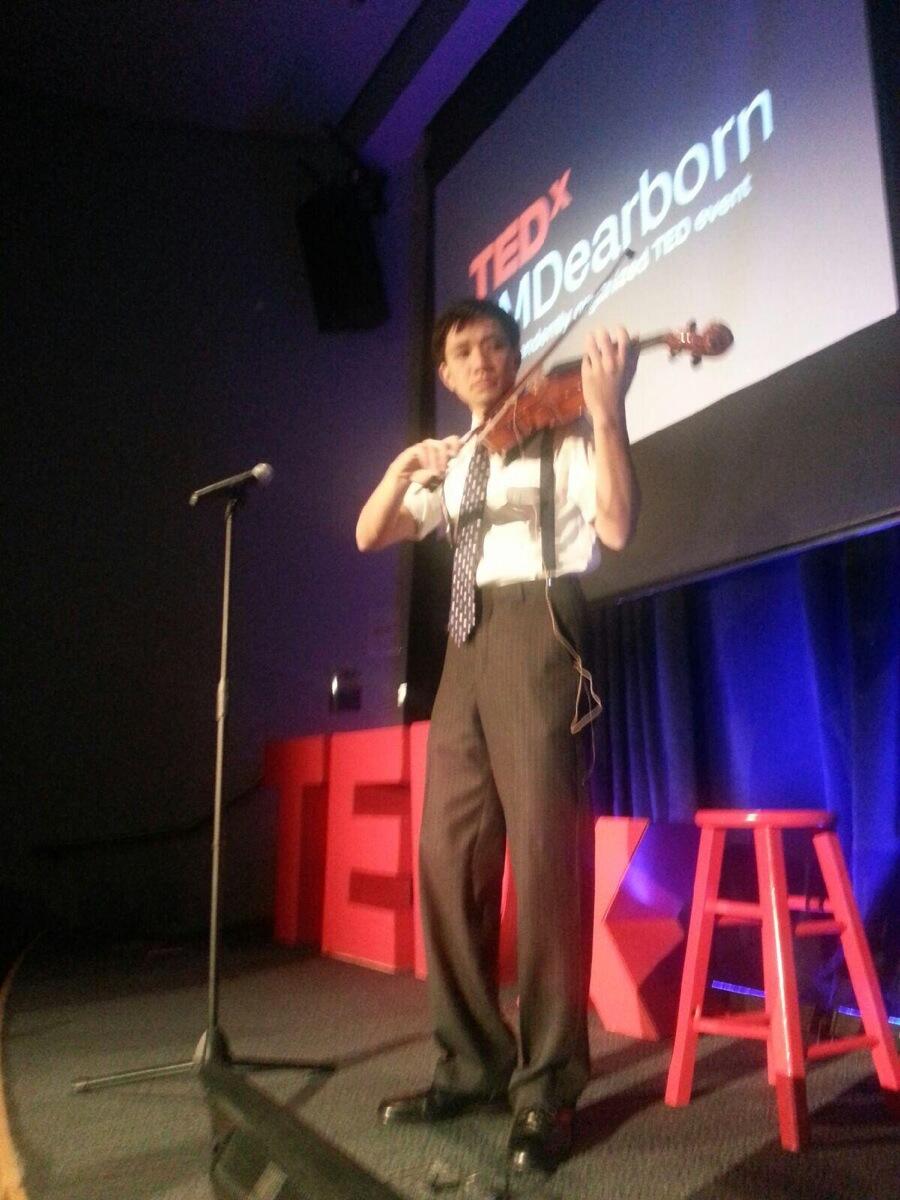
RAW REFLECTION: Post-TEDX Public Speaking

Yesterday I presented and performed two pieces for TEDX UM-Dearborn.  Here are my observations from the event:
Image credit to Greg Ezzo on Twitter

-As with every performance, I learn about who I really am in the moment from what I actually prepared and what I chose to use

-Virtue in performance (for what I mean, here's a statement on virtue in music): 
Everything I really prepared for came through fairly intuitively.  What I hoped but failed to thoroughly prepare for didn't manifest itself clearly when spoken under pressure.  I'll acknowledge that I didn't project my voice sufficiently too.

Granted, there were a fair number of curveballs thrown just before I got on stage:
I was asked to shave 5 minutes off of my time minutes before I walked on from a 12-15 minute timeframe, equipment wasn't readied for me to speak or play (amplifier and receiver was unplugged), and the timer was never started until I requested it about halfway through my set.  But what I've learned from this and previous trials and performances: you find yourself when you push yourself.  I learned on stage what exactly I had internalized and what I had yet to embody.  I'm certain learning to prepare for that better comes with time, additional exposure, and follow-through on not repeating the same mistakes.
My remarks were written in strategy language--they represented the content I sought to intellectually convey, but they didn't represent what I needed to say to human beings.  In my strategy work with the Ismotion/WorldByCycle team we've realized the same thing: every time we got stuck in crafting our business pitch, it was because we no longer wrote words that meant something to most English speaking human beings.  To bring stories to life, one needs verbs, not nouns to move us forward.


-I'm getting better at building emotional solidarity with audiences, but there's a threshold where the enthusiasm and emotion stirred up in my performance-presentations needs to match the integrity of the wisdom I strive to convey.  My intentions for the performance was to show that attendees had both a privilege and responsibility to take whatever they found inspiring or useful and share it with others.  At the same time, I hoped that bringing statistics about environmental health and air quality in Detroit/Southwest Detroit, and the "digital divide" (how the event required online applications in an area where digital literacy and access to the internet remains very low) would also spur lasting attention to bigger systemic environmental and digital justice issues.

-At an event like today's, innovations in emotional technology (how we get people to connect and humanely relate to each other) ought to be coupled with ethical intellectual food for thought of equal or greater quality as well.  I have an opportunity to educate a community.  Using new devices for engagement stays in the heart's memory, but sometimes a clear logical statement can help the mind stir the heart as people wind down from an event.  As a former debater, I know what a logical presentation and argument looks like.  While I wasn't at TEDX UM-Dearborn to debate, I did come with a message to assert.  I don't think it was done as clearly as I'd like, but I'm at peace with it for now.

I'm pleased to learn from various attendees who shared their thoughts (especially from Alex) that the concept of taking inspiration and carrying it forward beyond the event was clear.

-Seek out and listen to the people who didn't get your message(s)
Accolades and enthusiasms are wonderful and deeply appreciated, but in finding ways to refine how I communicate, it's best to engage those who didn't appreciate or grasp the points I hoped to convey.

-Prepare 2x more
For performance presentations that require solid grounding in data and ethics, it certainly takes twice as long to prepare.  In order to use the opportunity well, I need to do two things: Prepare the speech and practice the speaking/audience engagement, prepare the music and practice performing it too.

-That said, I enjoyed sharing it--in the future to prepare for events that charge a fee for attendees, I'll be sure to offer more opportunities to friends/the public for test-running my presentations/performances in progress.

-Unlike featured speakers for the event, I didn't have a dedicated speaking coach assigned to me and have yet to find one I'd trust on my own.  However, thanks to the generosity and attention of friends and the broader community, I was able to practice my remarks (a brief 3 minute or less speech), and sketch out how the presentation aspect blends into the audience participation & performance aspect.  

If you know what to look out for and can ask others to keep you accountable, it's possible to sharpen what you do without a professional coach.  I've been fortunate to have various professors, classes, and extracurriculars which helped hone what I pay attention to for better public speaking.  But without the keen attention, enthusiasm, and support of many friends and amicable acquaintances, I don't believe I'd have refined my message as well as I did.

Many thanks to Sara C., Megan M., Bear, Scotty, Thomas M., Marty S. and all those who shared their attention and insight.


Also: sometimes straightening out another person's collar when they're unaware can be as good as getting a hug from a dear friend.  I really appreciated Ryan K's keen eye in helping make sure I had my tie under the collar before I went onto state.

Pushups helped, I don't mind how odd it looks to others, I did a quick set of pushups a bit before going onto stage and it was worth it.

Monday, October 14, 2013

Greatness in your voice

There is greatness in your voice.

I can hear it.  You can feel it.  We know it.

If it quavers and shakes in fear:
let it be for the reasons we share with you.
Speak your truth with courage, and all your heart.

Inspire, then move us--with each word you expel, and each breath you spend.  We'll catch our breaths, and then we'll respire.

We'll breathe as we move closer toward something worth every spirited breath of speech, story, and song before our lives expire.

But it ends not at your life, nor ours.  Greatness flows over and through endeavors of legacy everlasting.

Free it with your voice and contribution to the world.
Let it ebb and flow from heart to heart: yours to mine, theirs to yours.

Call again!

Through sacred passage of wisdom in your call and listening--let your curiosity open the greatness of others, share your reliable truths, and always ask for the greatest of truth even when the only answer may be silence from your fellows.

The echoes of utterance will be great, and the world may quaver and shake in new movement as it awakens with the warmth of your voice for the reasons we share with you.

Share our Truth with courage and all hearts.


Hollow tree in Interlochen State Park, MI

#09:34 16 X 2013

Wednesday, July 31, 2013

Trust, but verify.

"She [Suzanne Massey] also asked Reagan to learn the now famous Russian phrase 'doveryai, no proveryai', which means 'Trust, but verify' "http://en.wikipedia.org/wiki/Suzanne_Massie

Then you can work toward beating the tragedy of the commons, which requires trust before people can collaborate.

http://info.worldbank.org/etools/docs/library/97605/conatrem/conatrem/documents/Ostrom-Ppt.pdf

I met the son of Suzanne Massey at a recent conference. In reading up about her son on Wikipedia, Bob Massey I found that his mother had a role in U.S. diplomatic relations between Ronald Reagan and Mikhail Gorbachev during the cold war.

(Ironically, I need to verify where the above claims really came from beyond taking wikipedia's list of books and interviews for granted...)